

Trending Now
 Govt. of India approves ₹12,200 crore, 29-km Thane Integral Ring Metro project in Maharashtra
 World’s Top 20 Metro Systems: Engineering Marvels Transforming the Future of Urban Mobility
 NCRTC celebrates Three Years of Namo Bharat, Highlights 4.5 crore Passenger Journeys
 Alstom eyes ₹2,000 crore Chennai Metro tender for supply of 168 Train Coaches
 SYSTRA India emerges as lowest bidder for Thane Metro Design Consultancy Contract
 Adani Group's Cemindia Projects wins ₹921.63 crore Underground Package for Jaipur Metro
 EFKON India wins ₹288.11 crore Station Systems Contract for Indore Metro Rail Project
 L&T partners with IIT Madras-Backed TuTr Hyperloop to explore Next-Gen Mobility
 Alstom, Larsen & Toubro unveil First Driverless Trainset for Mumbai Metro Lines 4 and 4A
 BEML, Czech Republic delegation explore strategic Industrial and Technology Partnerships
World’s Top 20 Metro Systems: Engineering Marvels Transforming the Future of Urban Mobility
Dr. Vinod Shah
Posted on: 2026-10-01 09:10:00
Viewer: 161
Comments: 0
Country: India
City: New Delhi
From London’s historic Underground to China’s sprawling networks and India’s rapidly expanding Delhi Metro, the world’s leading metro systems are reshaping cities through innovation, connectivity and sustainable transportation.
Crowded platforms, packed trains and hectic interchanges are familiar experiences for millions of urban commuters. Yet, imagine the world's largest cities without metro railways. Traffic congestion would worsen, journey times would increase and pollution would rise as millions of people struggled to reach workplaces, educational institutions and essential services.
Metro systems have evolved from pioneering underground railways into the backbone of modern urban mobility. They connect residential neighbourhoods with commercial centres, support economic development and offer an alternative to private vehicles. From Victorian tunnels and elevated steel structures to driverless trains and advanced signalling, these networks showcase remarkable achievements in engineering and urban planning.
The following 20 metro systems stand out for their history, scale, technology, passenger services and contribution to urban development. This is a curated selection rather than a strict numerical ranking.
1. London Underground, United Kingdom
The birthplace of underground urban railways
London Underground holds a unique place in transport history. The world's first underground passenger railway opened on 10 January 1863, initially using steam locomotives between Paddington and Farringdon.
Today, the network comprises 11 lines and approximately 400 kilometres of route, serving 272 stations. Known as the Tube, it connects central London with surrounding communities, with substantial sections running above ground.
Its iconic roundel, distinctive map and historic station architecture have influenced transport design worldwide. London's continuing investment in signalling, accessibility and infrastructure modernisation demonstrates the challenge of maintaining a historic network while meeting contemporary passenger expectations.
2. Beijing Metro, China
A vast network serving a megacity
Since opening in 1971, Beijing Metro has expanded into one of the world's largest urban rail networks. Its extensive lines connect residential districts, commercial centres, railway stations and suburban communities across China's capital.
High-capacity trains, frequent services and increasingly automated operations help accommodate enormous passenger demand. Several lines use driverless technology, reflecting China's broader investment in railway automation.
Beijing illustrates how sustained infrastructure development can support a rapidly growing metropolis, while highlighting the need to balance network expansion with operational efficiency and convenient passenger transfers.
3. Copenhagen Metro, Denmark
A benchmark for automated urban mobility
Copenhagen Metro demonstrates how automation can deliver frequent, convenient services in a relatively compact city. Opened in 2002, its four principal lines connect central Copenhagen, residential districts and the airport.
Fully automated trains operate around the clock, while clean stations, clear passenger information and convenient connections with buses, regional trains and cycling routes contribute to an integrated transport system.
Copenhagen's experience shows that successful metro planning involves more than technology. Efficient interchanges, thoughtful station design and coordination with other modes are equally important.
4. Paris Métro, France
A cultural icon beneath the French capital
Opened in 1900, Paris Métro has become an indispensable part of the city's identity. Its 16 lines and more than 300 stations provide dense coverage across central Paris, connecting residential areas, business districts and major cultural attractions.
The Art Nouveau entrances designed by Hector Guimard remain internationally recognised landmarks. Meanwhile, modernisation and automation projects, including improvements to Line 14, are helping increase capacity and improve services.
Paris demonstrates how a relatively compact network with closely spaced stations can provide exceptional convenience for short urban journeys.
5. Tokyo Subway, Japan
Precision in one of the world's busiest cities
Tokyo's subway system combines Tokyo Metro and Toei Subway, together operating 13 lines and hundreds of stations. These services form part of a much larger railway network connecting the Japanese capital with its surrounding metropolitan region.
Frequent trains, carefully coordinated operations, colour-coded routes and extensive passenger information help manage enormous commuter flows. Although peak-hour overcrowding remains a challenge, continuous improvements to station management and passenger guidance make the system easier to navigate.
Tokyo demonstrates the importance of operational discipline, reliable timetables and seamless connections in cities with exceptionally high travel demand.
6. Seoul Metropolitan Subway, South Korea
Technology focused on passenger convenience
Since the opening of Line 1 in 1974, Seoul's urban railway network has expanded extensively across the South Korean capital and surrounding region.
The system is known for digital passenger information, mobile connectivity, modern station facilities and convenient transfers. Its integration with buses and suburban railway services makes it an essential part of daily commuting.
Seoul's experience highlights how technology, accessibility, passenger comfort and safety can work together to improve the overall travel experience.
7. New York City Subway, United States
A railway that never sleeps
New York City's subway opened in 1904 and has become one of the most recognisable urban railways in the world. With hundreds of stations and extensive routes across Manhattan, Brooklyn, Queens and the Bronx, it supports the city's round-the-clock economy.
The network combines underground tunnels with elevated railways and operates both local and express services on selected corridors. Its distinctive steel structures have become familiar features of films and popular culture.
Ageing infrastructure, accessibility improvements and maintenance remain major challenges. Nevertheless, New York demonstrates the value of an extensive railway system that supports diverse communities and operates beyond conventional commuting hours.
8. Mexico City Metro, Mexico
Affordable transportation for millions
Opened in 1969, Mexico City Metro comprises 12 lines serving approximately 195 stations. It provides an essential alternative to road travel in a metropolitan area affected by congestion and air pollution.
Several lines use rubber-tyred trains, offering distinctive acceleration and braking characteristics. Affordable fares help make the system accessible to a broad cross-section of society.
Mexico City's experience demonstrates the social importance of affordable mass transit and the need for sustained investment in rolling stock, signalling, safety and maintenance.
9. Singapore Mass Rapid Transit, Singapore
Integrated planning in a land-constrained city
Singapore's MRT began operations in 1987 and has grown into an extensive network connecting residential communities, commercial districts and transport hubs.
Underground and elevated railways help accommodate the city-state's limited land availability, while automated train control and modern passenger information systems support efficient operations.
The MRT is closely integrated with buses, pedestrian infrastructure and urban development. Singapore demonstrates how coordinating transport investment with housing and land-use planning can reduce dependence on private vehicles.
10. Berlin U-Bahn, Germany
Historic infrastructure serving a modern capital
Berlin U-Bahn opened in 1902 and has developed through periods of war, division and reunification. Its nine principal lines serve approximately 175 stations through a combination of underground tunnels and elevated structures.
Together with the separate S-Bahn suburban railway, trams and buses, the U-Bahn provides extensive coverage across Berlin.
The network demonstrates how historic infrastructure can remain relevant through modernisation, effective interchange planning and integration with other transport modes.
11. Moscow Metro, Russia
Grand architecture and high-capacity operations
Moscow Metro opened in 1935 and is internationally famous for its monumental stations featuring marble, chandeliers, mosaics and elaborate decorative elements.
Its extensive network includes radial lines and circular routes that facilitate passenger transfers across the Russian capital. New lines and stations have expanded capacity and improved connections with developing districts.
Moscow illustrates how railway infrastructure can combine high-capacity transportation with distinctive architecture, while also incorporating emergency-preparedness functions in selected underground facilities.
12. Glasgow Subway, United Kingdom
A small network with a pioneering history
Opened in 1896, Glasgow Subway is one of the world's oldest underground passenger railways. Its circular route connects key neighbourhoods around the Scottish city's centre.
The system's compact tunnels and unusual narrow gauge give it a distinctive identity. Modernisation, including new trains and improvements to railway systems, is helping prepare the network for future requirements.
Glasgow demonstrates that a relatively small metro can deliver significant value when it connects important destinations reliably and integrates effectively with other transport services.
13. Shanghai Metro, China
Expansion on a megacity scale
Shanghai Metro began operations in 1993 and has expanded rapidly to become one of the world's longest metro networks, extending across more than 800 kilometres.
Its lines connect commercial districts, residential communities, railway terminals and major transport hubs. High-capacity trains and extensive interchange facilities support substantial daily passenger demand.
Shanghai's development demonstrates how mass transit can reshape urban growth and improve connectivity. Its continuing challenge is to ensure that rapid expansion is matched by reliable operations and effective integration.
14. Kyiv Metro, Ukraine
Public transportation and emergency resilience
Kyiv Metro opened in 1960 and has developed into a three-line network serving important areas of the Ukrainian capital.
Its deep underground stations have become particularly significant since Russia's full-scale invasion of Ukraine in February 2022, providing shelter during air-raid alerts while the metro continues to operate where conditions permit.
Kyiv demonstrates that underground railway infrastructure can serve a wider public-protection role during emergencies, highlighting the importance of resilience, emergency planning and continuity of essential services.
15. Chicago 'L', United States
The elevated railway that shaped a city
Chicago's elevated railway system, known as the 'L', traces its origins to the nineteenth century. The downtown Loop, opened in 1897, remains one of the city's most distinctive transport landmarks.
Today, eight colour-coded lines serve approximately 145 stations, using elevated structures alongside underground and ground-level sections.
The system demonstrates how elevated railways can provide rapid transit through dense urban areas without requiring extensive underground construction. Its experience also highlights the importance of maintaining ageing structures while minimising disruption to daily services.
16. Delhi Metro, India
A transformation in urban mobility
Delhi Metro began operations in December 2002 and has since become one of India's largest and most influential urban rail networks. It connects Delhi with neighbouring cities including Gurugram, Noida, Ghaziabad and Faridabad.
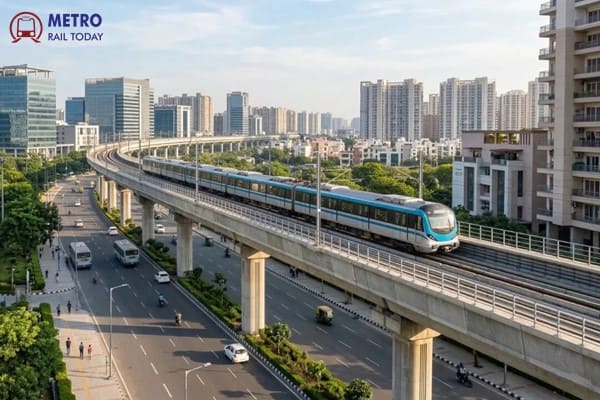
Its extensive network combines underground, elevated and at-grade sections, serving residential areas, commercial centres and major transport hubs. Modern signalling, automated fare collection and interchange facilities have helped establish new standards for urban rail travel in India.
Delhi Metro has also supported transit-oriented development and provided an alternative to private vehicles for millions of journeys. Its integration with regional railways, buses and regional rapid transit is increasingly important as the National Capital Region expands.
The system offers valuable lessons in project execution, safety, phased expansion and long-term operations. Future priorities include improving last-mile connectivity, accessibility and convenient passenger transfers.
17. Hong Kong Mass Transit Railway, Hong Kong
Connecting railways with urban development
Hong Kong's MTR began operating in 1979 and has become internationally recognised for reliable services and integration with the city's wider transport system.
The network connects Hong Kong Island, Kowloon and the New Territories, including major commercial centres, residential communities and airport services.
Its railway-plus-property model allows suitable developments around stations to contribute to railway investment and urban growth. Connections with buses, ferries, shopping centres and pedestrian networks further enhance convenience.
Hong Kong demonstrates how coordinated transport and land-use planning can create a financially and operationally integrated urban mobility system.
18. Budapest Metro, Hungary
A pioneer of electric underground railways
Budapest's Millennium Underground Line M1 opened in 1896 and became the world's first underground electric railway built specifically for urban passenger transport.
The historic line remains operational as part of a four-line metro network serving the Hungarian capital. Its compact stations and distinctive infrastructure reflect the engineering innovations of the late nineteenth century.
Budapest demonstrates how early technological breakthroughs shaped modern metro development and how cities can preserve historic transport assets while upgrading their networks for contemporary passengers.
19. Dubai Metro, United Arab Emirates
Driverless trains for a modern global city
Dubai Metro began operations with its Red Line in 2009, followed by the Green Line in 2011. Its fully automated, driverless trains connect major commercial districts, residential areas, tourist destinations and transport hubs.
The network includes extensive elevated sections and connections with buses, trams and airport services. Its development has supported the growth of business districts and communities along key transport corridors.
Dubai illustrates the advantages of designing modern metro infrastructure around automation and new urban development. Continued integration with feeder services and pedestrian networks will be important to expanding its usefulness.
20. Chongqing Rail Transit, China
Engineering solutions for a mountainous megacity
Chongqing Rail Transit showcases the ability of urban rail engineering to adapt to difficult geography. The Chinese city features steep hills, river valleys and densely developed districts that complicate conventional railway construction.
Its network combines conventional metro lines with distinctive monorail corridors, including Lines 2 and 3. These services connect residential communities, commercial centres and transport hubs across challenging terrain.
Chongqing demonstrates why metro technology must be selected according to local geography, travel demand and construction conditions rather than applying a single model to every city.
Lessons from the World's Leading Metro Systems
These 20 networks reveal several common principles. Beijing and Shanghai demonstrate the scale of investment required to serve megacities, while Copenhagen and Dubai highlight the growing importance of automation. Tokyo and Seoul illustrate the value of operational precision and passenger information, while Hong Kong and Singapore show how transport integration and urban planning can reinforce each other.
Delhi Metro highlights the transformative potential of mass transit in developing economies. Meanwhile, London, Paris and New York demonstrate the importance of maintaining historic infrastructure while upgrading capacity, safety and accessibility.
The future of metro rail will increasingly depend on digital signalling, predictive maintenance, energy-efficient trains, improved accessibility and integration with buses, regional railways and other mobility services. Financial sustainability and dependable maintenance will be just as important as new construction.
Conclusion: Building the Cities of Tomorrow
The world's leading metro systems are much more than railway networks. They connect people with employment and education, support economic growth and help cities manage congestion and environmental pressures.
For India, Delhi Metro and the expansion of urban rail across the country demonstrate the growing importance of mass transit in managing rapid urbanisation. Future progress will depend not simply on adding kilometres of track, but on delivering reliable services, convenient interchanges, affordable fares and effective last-mile connections.
Ultimately, the success of a metro should be measured by how effectively it improves people's lives. As cities continue to grow, these engineering marvels will remain central to building more connected, productive and sustainable urban communities.


Dr. Vinod Shah
Dr. Vinod Shah is an experienced urban transport journalist, blogger and key opinion leader.