

Trending Now
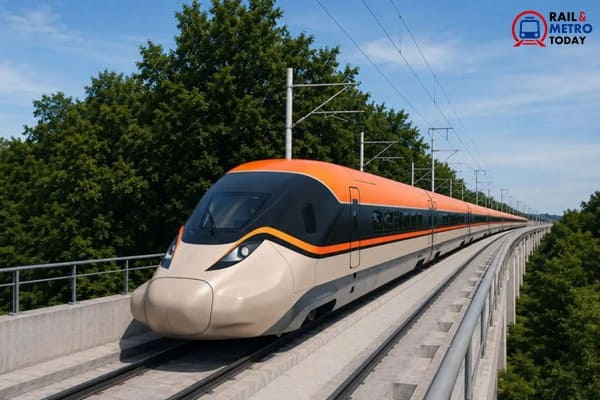 Meet the Global Technology Partners Powering the India's first B28 High Speed Bullet Trainset
 Sumitomo and L&T JV awarded Track and Electrical Systems Contract for Dhaka Metro Line 1
 EFKON wins ₹367.09 crore Underground Station Systems Contract for Indore Metro Rail Project
 Jupiter Wagons and Woojin sign MoU to form JV for Metro Coaches and Train Propulsion Technology
 Exclusive Interview with Suraj Pandey, CEO & Managing Director, ACME India Industries Ltd
- OHE System Energised on Surat–Bilimora Section of Mumbai–Ahmedabad Bullet Train Project
 Seven Bidders Qualify for Elevated Viaduct and 12 Stations Contract of Jaipur Metro Phase 2
 STUP Consultants–Assystem JV wins ₹14.20 crore Design Consultancy for Ahmedabad Metro
 Three Global Firms bid for General Consultancy Contract of Lucknow Metro Phase 1B Project
 ETA Engg - PISCESIA JV awarded ₹225.87 crore E&M Contract for Delhi Metro Phase 5A Project
Meet the Global Technology Partners Powering the India's first B28 High Speed Bullet Trainset
Dr. Vinod Shah
Posted on: 2026-11-23 07:52:00
Viewer: 110
Comments: 0
Country: India
City: New Delhi
India's journey towards high-speed rail is entering an important new phase with the development of its first indigenous B28 high-speed trainsets. Designed for a speed of 280 km/h and an operational speed of approximately 249 km/h, these trains are being developed for the Mumbai–Ahmedabad High-Speed Rail Corridor.
Manufactured at BEML's specialised Aditya Rail Complex in Bengaluru, the B28 programme represents more than the development of a new train. It brings together Indian manufacturers, global technology companies and specialised engineering partners to integrate advanced propulsion, braking, control, transmission, passenger comfort and safety systems.
The programme demonstrates how India is combining domestic manufacturing capabilities with international technological expertise to establish a foundation for future high-speed rail projects.
1. BEML Limited – The Principal Manufacturer and System Integrator
BEML Limited, a Government of India undertaking under the Ministry of Defence, is leading the design, manufacturing and commissioning of the B28 trainsets.
With established capabilities in railway coaches, metro rolling stock, defence equipment and heavy engineering, BEML brings significant manufacturing experience to this project.
Its newly developed Aditya Rail Complex in Bengaluru is equipped for specialised high-speed train manufacturing, including precision carbody fabrication, welding, assembly, painting and testing.
BEML is responsible for the train's structural body, interiors, integration and final assembly, ensuring that multiple specialised systems function as one integrated trainset.
The initial contract, awarded through Integral Coach Factory (ICF) in October 2024, covers two eight-car prototype trainsets.
2. Medha Servo Drives – Propulsion, Electrical Systems and Train Control
Hyderabad-based Medha Servo Drives Pvt. Ltd. is one of India's leading railway technology companies, specialising in electric propulsion, power electronics, onboard electronics and train control systems.
With over four decades of experience in transportation engineering, Medha has developed capabilities in traction equipment, converters, motors, bogies and complete trainset integration.
For the B28 programme, Medha's contribution is particularly important because high-speed trains require sophisticated electrical and control technologies to deliver smooth acceleration, reliable power distribution and coordinated train operations.
Its technology portfolio includes:
-
Traction and propulsion equipment.
-
Power converters and electrical control systems.
-
Train Control and Management Systems (TCMS).
-
Onboard electronics and monitoring.
-
Bogie and trainset engineering capabilities.
TCMS acts as the train's central nervous system, coordinating various onboard functions, monitoring equipment performance and supporting communication between different subsystems.
Medha's involvement also strengthens the indigenous technology component of the project, creating opportunities for domestic development and future manufacturing of critical railway systems.
3. Traktionssysteme Austria (TSA) – Advanced Traction and Gearbox Technology
Austria-based Traktionssysteme Austria GmbH (TSA) is an internationally recognised manufacturer of electric traction motors, generators and gearboxes for railway and commercial transportation applications.
Traction systems are fundamental to high-speed railway performance. They convert electrical energy into mechanical power, enabling trains to accelerate, maintain speed and operate efficiently.
TSA brings specialised expertise in traction transmission and gearbox engineering to the wider Indian railway ecosystem.
Its long-standing technology relationship with Medha is particularly relevant. The two companies established a joint venture, Medha Traction Equipment Pvt. Ltd., in 2009, enabling the manufacture of traction motors, gearboxes and generators in India.
This collaboration illustrates how international engineering expertise can be progressively integrated into India's domestic railway manufacturing supply chain.
4. Siemens Mobility – Advanced Automation and Control Technologies
Germany-based Siemens Mobility is a global railway technology company with expertise in rolling stock, railway automation, signalling, electrification and digital mobility solutions.
Automation and control technologies are essential to high-speed train operations, where multiple onboard systems must communicate and respond with precision.
For the B28 programme, Siemens Mobility is among the identified international technology partners associated with automation systems.
Its broader technological capabilities include:
-
Railway automation and control.
-
Digital monitoring and diagnostics.
-
Integrated railway systems.
-
Intelligent mobility and operational technologies.
Such technologies are important for ensuring coordinated system performance, operational reliability and effective monitoring of high-speed trains.
5. Knorr-Bremse AG – Braking, Doors and Passenger Safety Systems
Germany's Knorr-Bremse AG is a global leader in braking systems and a major supplier of advanced technologies for railway and commercial vehicles.
In high-speed rail, braking technology is among the most critical safety systems. Trains travelling at nearly 250 km/h require highly reliable braking solutions capable of delivering controlled deceleration under varying operating conditions.
For India's first high-speed trainsets, Knorr-Bremse has been contracted to supply several important systems, including:
-
Advanced braking systems.
-
Passenger entrance and door systems.
-
Heating, Ventilation and Air Conditioning (HVAC).
-
Sanitary and onboard toilet systems.
The company's contribution extends beyond equipment supply. Its Indian engineering and manufacturing presence, including facilities in Palwal and a technology centre in Pune, supports localisation and technical development.
Knorr-Bremse has also announced a 15-year maintenance, repair and spare-parts support arrangement for the technologies supplied for the initial prototype trains.
This long-term support is particularly important for maintaining reliability and availability throughout the trainsets' operational life.
6. COMPIN FAINSA – Passenger Seating and Interior Comfort
Spain-based COMPIN FAINSA is an established manufacturer of railway passenger seating and interior solutions.
Passenger comfort becomes an important engineering consideration in high-speed trains, where seating ergonomics, material quality, durability and space utilisation must meet demanding requirements.
Its contribution to the B28 programme includes passenger seating solutions designed to support comfortable long-distance journeys.
The importance of seating technology goes beyond aesthetics. High-quality railway seats must address ergonomic design, passenger safety, fire-performance requirements, ease of maintenance and long-term durability.
The company's involvement brings specialised international experience in railway passenger interiors to India's emerging high-speed rail segment.
7. Integral Coach Factory – The Indian Railways Production and Contracting Partner
Integral Coach Factory (ICF), Chennai, one of Indian Railways' principal production units, plays an important institutional and technical role in the B28 programme.
ICF awarded the original contract to BEML in October 2024 for the design, manufacturing and commissioning of two eight-car high-speed trainsets.
The contract, valued at approximately ₹866.87 crore, includes development costs, specialised tooling, fixtures and testing infrastructure.
ICF's involvement connects the project with Indian Railways' established rolling-stock development and production ecosystem.
THE BIGGER PICTURE: BUILDING INDIA'S HIGH-SPEED RAIL SUPPLY CHAIN
The B28 programme is significant because it brings together different layers of railway engineering under one manufacturing initiative.
While BEML leads carbody manufacturing and integration, Medha contributes Indian propulsion and control capabilities, TSA brings specialised traction technology, Knorr-Bremse supplies critical safety and passenger systems, and other international partners contribute automation and passenger-interior expertise.
This collaborative model offers several opportunities for India's railway industry:
1. Technology localisation: International partnerships can support the progressive transfer and development of specialised technologies within India.
2. Domestic supply-chain development: Indian MSMEs and component manufacturers can participate in manufacturing electrical equipment, mechanical assemblies, interior components, wiring systems and specialised railway products.
3. Engineering capabilities: Exposure to high-speed rail requirements can strengthen domestic expertise in precision manufacturing, testing, quality assurance and system integration.
4. Export opportunities: Developing reliable high-speed rolling stock and associated components can create opportunities for Indian manufacturers in international railway markets.
5. Future technology platforms: The experience gained through B28 can provide a foundation for the proposed B35 high-speed train platform and other future indigenous rolling-stock programmes.
CONCLUSION: FROM TECHNOLOGY COLLABORATION TO INDIGENOUS CAPABILITY
India's first B28 high-speed trainsets represent an important step towards developing a domestic high-speed rail manufacturing ecosystem.
The real significance of this programme lies not merely in achieving higher train speeds, but in building the engineering capabilities, supplier networks, technological partnerships and manufacturing infrastructure required to support an expanding high-speed rail network.
For India's railway industry, the B28 programme presents an important opportunity for manufacturers, technology providers, EPC companies, engineering firms and MSMEs to become part of a new generation of railway technology development.
As India moves towards its Viksit Rail 2047 vision, the ability to absorb global technologies, strengthen domestic manufacturing and progressively develop indigenous solutions will be central to establishing the country as a competitive global railway manufacturing hub.
The next chapter of India's high-speed rail journey will be defined not only by the trains it operates, but also by the technologies it develops and the industrial ecosystem it builds.


Dr. Vinod Shah
Dr. Vinod Shah is an experienced urban transport journalist, blogger and key opinion leader.