

Trending Now
 Govt. of India approves ₹12,200 crore, 29-km Thane Integral Ring Metro project in Maharashtra
 World’s Top 20 Metro Systems: Engineering Marvels Transforming the Future of Urban Mobility
 NCRTC celebrates Three Years of Namo Bharat, Highlights 4.5 crore Passenger Journeys
 Alstom eyes ₹2,000 crore Chennai Metro tender for supply of 168 Train Coaches
 SYSTRA India emerges as lowest bidder for Thane Metro Design Consultancy Contract
 Adani Group's Cemindia Projects wins ₹921.63 crore Underground Package for Jaipur Metro
 EFKON India wins ₹288.11 crore Station Systems Contract for Indore Metro Rail Project
 L&T partners with IIT Madras-Backed TuTr Hyperloop to explore Next-Gen Mobility
 Alstom, Larsen & Toubro unveil First Driverless Trainset for Mumbai Metro Lines 4 and 4A
 BEML, Czech Republic delegation explore strategic Industrial and Technology Partnerships
India’s First LNG-Powered Train Flagged Off from Sabarmati, Gujarat
MRT Online Desk
Posted on: 2026-09-27 16:55:00
Viewer: 1,506
Comments: 0
Country: India
City: New Delhi
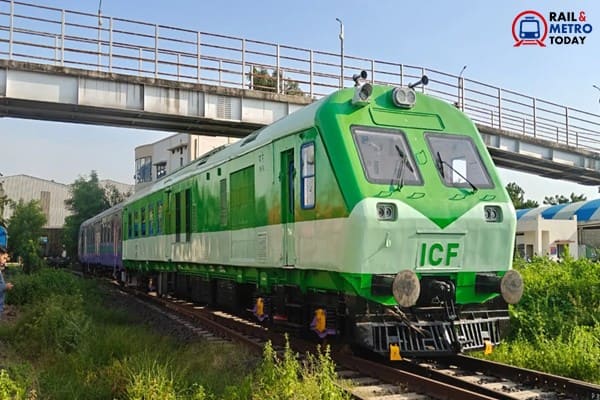
Ahmedabad, India (Rail & Metro Today): Indian Railways has taken a significant step towards adopting alternative and cleaner fuels with the flag-off of the country’s first LNG-powered train from Sabarmati Station on September 27, 2026. Union Home and Cooperation Minister Amit Shah flagged off the train, marking a new initiative aimed at reducing diesel consumption and promoting cleaner railway operations.
According to the Ahmedabad Railway Division, Indian Railways has deployed an LNG-based fuel system in the train’s Driving Power Cars (DPCs) for the first time. The technology uses a dual-fuel system that enables the same engine to operate on both Liquefied Natural Gas (LNG) and diesel, depending on fuel availability.
Two 1,400 HP DPCs Converted to Dual-Fuel Technology
As part of the initiative, two Driving Power Cars, each rated at 1,400 HP, have been converted from conventional diesel operation to an LNG-diesel dual-fuel system.
Before the train's introduction, the two converted DPCs underwent more than 2,000 kilometres of field trials to assess the performance and reliability of the new technology under operating conditions.
According to the supplied information, the dual-fuel system can enable LNG to replace up to around 40% of diesel consumption, potentially reducing the quantity of conventional diesel required for train operations.
How the LNG-Diesel System Works
The new train does not rely exclusively on LNG. Instead, its engines are equipped to operate using either LNG or diesel, allowing railway operations to continue even when LNG is not available.
This flexibility is one of the key features of the dual-fuel technology. Depending on fuel availability and operating requirements, the system can use LNG alongside diesel while maintaining the engine's operating capability.
The use of LNG is also expected to increase the distance that can be covered between refuelling requirements under the approved operating configuration.
LNG Tanks Provide Extended Operating Range
Each converted DPC has been equipped with an LNG tank with a capacity of approximately 2,200 litres. The tank can hold around 950–1,000 kg of usable LNG.
According to the approved design, a fully loaded LNG tank in one DPC can provide sufficient fuel for approximately 444 km of daily operation. This could help reduce the frequency of refuelling while supporting the operational flexibility of the dual-fuel system.
Focus on Lower Emissions and Fuel Consumption
The LNG initiative is also aimed at reducing the environmental impact associated with diesel-powered railway operations. Indian Railways expects the use of LNG to reduce diesel consumption and emissions, including carbon dioxide (CO₂), nitrogen oxides (NOx) and particulate matter (PM).
The initiative forms part of the broader effort to explore alternative fuel technologies for railway applications and improve fuel efficiency without compromising operational requirements.
Mrs. Mamta Shah, MD & CEO, Urban Infra Group, said the introduction of LNG dual-fuel technology demonstrates the potential for alternative fuels to complement the railway sector's ongoing energy-transition efforts.
“The deployment of LNG dual-fuel technology in railway operations represents an important step in exploring cleaner and more fuel-efficient alternatives for applications that continue to depend on conventional fuels. The ability to operate with both LNG and diesel provides operational flexibility while offering the potential to reduce fuel consumption and emissions. Continued field evaluation will be important in determining how such technology can be scaled across suitable railway applications.”
Estimated Fuel Cost Savings
In addition to environmental benefits, Indian Railways expects the technology to provide fuel-cost savings. Based on trial data, the railway estimates annual savings of approximately ₹11.9 lakh per DPC.
For an eight-coach rake, the estimated annual saving is around ₹23.9 lakh, according to the information provided.
The potential reduction in diesel consumption, combined with lower fuel costs and reduced emissions, could make LNG-based dual-fuel technology an option for further evaluation across suitable railway services.
Maintaining Engine Performance
Indian Railways has stated that the LNG dual-fuel system has been designed to maintain the power, reliability and operating performance of the conventional diesel engine.
The technology is therefore intended to achieve fuel savings and lower emissions without reducing the train's operational performance.
Indian Railways described the adoption of LNG dual-fuel technology as an initiative towards clean energy, improved fuel efficiency, reduced operating costs and environmental protection.
The commissioning of the LNG-powered train from Sabarmati marks an important milestone in India's exploration of alternative fuels for railway operations. The experience gained from the converted DPCs and their field performance will provide an important basis for assessing the wider application of LNG-based propulsion technology in the future.

MRT Online Desk
Metro Rail Today is an authentic and global news provider for the Rail & Metro industry from and around the world.