

New Delhi, India (Metro Rail Today): Delhi Metro Rail Corporation (DMRC) has officially awarded the prestigious Contract EC-03 for the Central Vista Corridor under Delhi Metro Phase V(A) to Cemindia Projects Limited, the construction arm of the Adani Group formerly known as ITD Cementation India Limited. The contract, valued at ₹1,023.82 crore, marks a major milestone in the expansion of Delhi’s underground metro network through one of the country’s most strategically sensitive and iconic zones.
The contract involves the design and construction of twin underground tunnels along with two major underground stations — Central Secretariat and Kartavya Bhawan — on the RK Ashram Marg–Indraprastha corridor. The Letter of Acceptance (LOA) was issued by DMRC on 2 April 2026, with the project slated for completion within 33 months from the date of Notice to Proceed.
Metro Connectivity Beneath India’s Power Corridor
The 2.84 km underground stretch will pass beneath some of India’s most prominent landmarks and government establishments, including India Gate, Kartavya Path, the Supreme Court, and several key ministry buildings in the New Delhi administrative district.
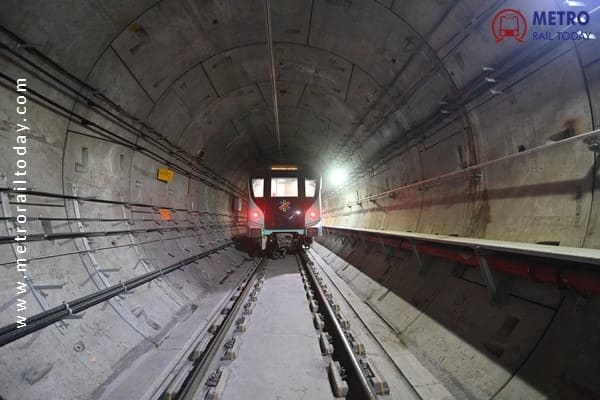
The scope of work includes twin tunnels using Shield Tunnel Boring Machines (TBMs) from Shivaji Stadium station to Central Secretariat station, a cut-and-cover tunnel section between Central Secretariat and Kartavya Bhawan, and construction of associated entry-exits and underground pedestrian subways.
The alignment traverses the heart of the redeveloped Central Vista precinct, which recently witnessed the transformation of Rajpath into Kartavya Path and the inauguration of the new Parliament House. Once operational, the corridor will provide seamless underground connectivity for government employees, tourists, and commuters travelling to the national capital’s administrative hub.
Industry experts believe the project represents one of the most technically demanding urban tunnelling assignments currently underway in India due to the presence of heritage structures, high-security government infrastructure, and dense underground utility networks.
Mrs. Mamta Shah, MD & CEO of Urban Infra Group, said, “The Central Vista Metro corridor is not just another underground connectivity project; it is an engineering intervention in one of the most sensitive urban precincts in the country. Delivering this project with precision and minimal disruption will demonstrate the maturity and global capability of India’s metro construction ecosystem.”
Aggressive Pricing and Complex Engineering
Interestingly, Cemindia Projects secured the contract with a bid of ₹1,024.80 crore, nearly 20% lower than DMRC’s estimated cost of ₹1,281 crore. The project will be supervised by PD/Central Vista acting as the Engineer for the contract.
DMRC has also identified a specific exclusion zone near Yuge Yugeen Bharat station between designated chainages, highlighting the complexity of integrating ongoing infrastructure activities within the Central Vista redevelopment zone.
The tunnelling works will require highly controlled TBM operations with millimetre-level precision to ensure structural safety around key national monuments and government buildings. Experts suggest that advanced geotechnical monitoring systems and real-time settlement control measures will play a critical role during execution.
Key Section of Delhi Metro Phase V(A)
Contract EC-03 forms the core package of the ambitious Delhi Metro Phase V(A), which received approval from the Delhi Cabinet in February 2026 at a total estimated investment of ₹12,014.91 crore.
Phase V(A) includes three corridors spanning 16.076 km with 13 stations, of which 10 will be underground. The flagship RK Ashram Marg–Indraprastha corridor will significantly strengthen connectivity in Central Delhi while extending the operational reach of the Magenta Line.
Once both Phase IV and Phase V(A) are completed, the Magenta Line is expected to become the longest corridor in the Delhi Metro network, stretching nearly 89 km from Botanical Garden to Inderlok. The line will feature 21 interchange stations and is planned to operate entirely with driverless train technology.
Central Secretariat station is also set to emerge as one of the most important interchange hubs in the network by connecting the Yellow Line, Violet Line, and the new Central Vista corridor. The integration is expected to ease traffic congestion in Central Delhi while significantly improving accessibility to key government districts and public landmarks.
With Delhi Metro continuing its rapid expansion into high-density urban and administrative zones, the Central Vista underground package is expected to become a benchmark project in India’s urban transit engineering landscape.