


Trending Now
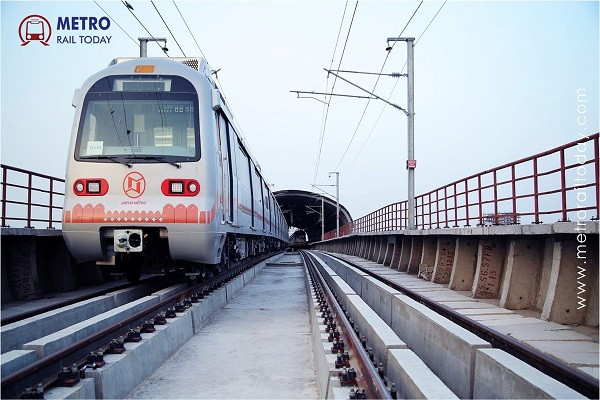 Paras Railtech wins ₹84.72 crore Ballastless Track Contract for Jaipur Metro Rail Project
 Indian Railways announces 3,548 Graduate-Level Vacancies under NTPC Recruitment 2026
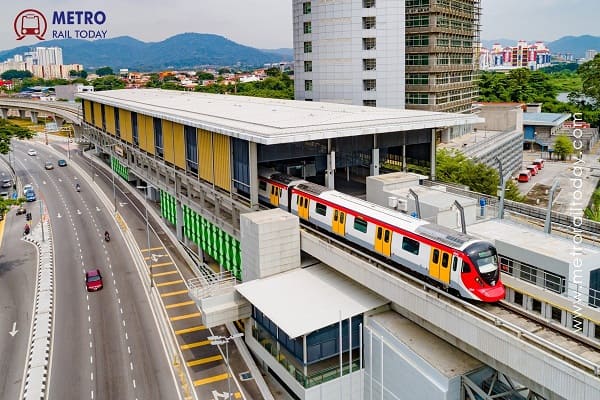 European Union sanctions €10 million to support extension of Hanoi Metro Line 3
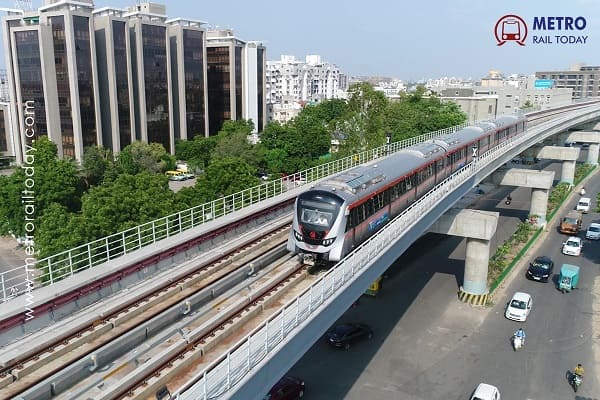 GMRC issues ₹683 crore Tender for construction of 8.68 km stretch for Ahmedabad Metro
- GMRC launches ₹439 crore Tender for construction of 5 New Ahmedabad Metro Stations
 Global tender issued for procurement of 60 Rolling Stock coaches for Hyderabad Metro Rail Project
 Global tender issued for procurement of 102 Rolling Stock coaches for Patna Metro Rail Project
 Gamuda awarded RM3.7 billion contract to build Keelung Mass Rapid Transit in Taiwan
 Maharashtra forms special Task Force to plan Rail, Metro and RRTS expansion
 Govt. of India approves ₹12,200 crore, 29-km Thane Integral Ring Metro project in Maharashtra
Alstom powers Delhi Metro's Pink and Magenta Line with Driverless Trains and CBTC Signalling
MRT Online Desk
Posted on: 2026-03-09 07:20:00
Viewer: 1,978
Comments: 0
Country: India
City: New Delhi
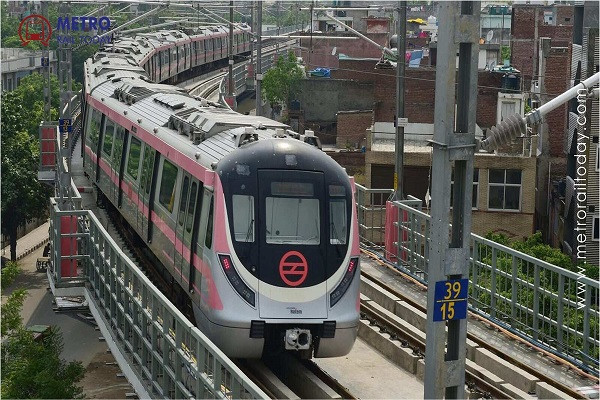
New Delhi, India (Metro Rail Today): Global mobility solutions provider Alstom has supplied advanced signalling systems and Metropolis metro trainsets for the newly opened extensions of Delhi Metro Line 7 (Pink Line) and Line 8 (Magenta Line), marking another milestone in the expansion of India’s largest metro network.
The new sections include the Majlis Park–Maujpur corridor on Line 7 and the Majlis Park–Deepali Chowk stretch on Line 8, both of which recently commenced revenue service as part of the Delhi Metro Phase IV expansion.
With the completion of the Pink Line extension, Line 7 is set to become India’s first circular metro corridor and the longest metro line in the country equipped for Unattended Train Operation (UTO) at the highest automation level (GoA4).
For the project, Alstom has deployed its Urbalis Flo Communications-Based Train Control (CBTC) signalling system, which enables high-capacity, driverless metro operations.
The system is designed to support Grade of Automation 4 (GoA4), allowing trains to operate fully automatically without onboard drivers while maintaining the highest levels of safety and operational efficiency.
The company has also supplied Metropolis metro trainsets for the corridor. These trains are designed for a safe speed of 95 km/h and an operational speed of 85 km/h.
As part of a larger €312 million contract, Alstom is currently supplying 312 metro cars for Delhi Metro Phase IV, all of which are 100 percent manufactured in India.
The trains are being produced at Alstom’s Sricity manufacturing facility in Andhra Pradesh, the company’s largest urban rolling stock production site in Asia.
The newly opened Magenta Line extension is strategically important as it enables interchange connectivity with three major Delhi Metro lines:
-
Yellow Line at Badli
-
Red Line at Madhuban Chowk
-
Pink Line at Majlis Park
These interconnections are expected to significantly improve travel options and reduce transfer times for commuters across the National Capital Region.
The Pink Line extension also strengthens the development of the Delhi Metro’s circular corridor, which will eventually create a loop connecting major parts of the city.
Alstom has been a key partner in the development of the Delhi Metro Rail Corporation (DMRC) network since its early phases.
The company has already delivered over 800 metro cars currently operating across the Delhi Metro system.
In addition to rolling stock supply, Alstom has contributed train control and signalling systems for several lines of the network, including the Red Line, Yellow Line, Green Line, Violet Line, and Pink Line.
Recently, the company also secured a 10-year maintenance contract for Delhi Metro Lines 1 and 2, covering comprehensive maintenance of trains, depot machinery, plant systems, and housekeeping operations at the Badli depot.
Commenting on the development, Mrs. Mamta Shah, MD & CEO, Urban Infra Group, said that advanced automation and signalling technologies are transforming the operational efficiency of modern metro networks.
“Driverless train operations supported by advanced CBTC signalling systems represent the next generation of metro technology. Such innovations enable higher capacity, improved safety, and more reliable operations, which are essential for rapidly expanding urban transit systems like the Delhi Metro,” she said.
She added that continued collaboration between metro authorities and global technology providers will be crucial for enhancing sustainable and efficient urban mobility across Indian cities.
Beyond Delhi, Alstom has delivered metro trains, signalling systems, and rail technologies for several Indian cities including Chennai, Mumbai, Lucknow, Kochi, Agra, Kanpur, Bhopal, and Indore.
The company has also supplied rolling stock and signalling solutions for India’s first regional rapid transit system (RRTS) connecting Delhi–Ghaziabad–Meerut.
With six industrial sites and five engineering centres in India, Alstom continues to play a major role in supporting the country’s “Make in India” and “Atmanirbhar Bharat” initiatives through local manufacturing and supply chain development.

MRT Online Desk
Metro Rail Today is an authentic and global news provider for the Rail & Metro industry from and around the world.