


Trending Now
 Titagarh Rail Systems becomes Corporate Member of Chamber of Railway Industries (Rail Chamber)
 World Bank approves ₹1,400 crore Civil Tender for Gurugram Metro Phase 2
 Bi-RIDE invites ₹200 crore Tender for Soladevanahalli Depot of Bengaluru Suburban Rail Project
 GHV India awarded ₹107.79 crore Civil Contract for Lucknow Metro East-West Corridor
 Pune Metro Line 3 set to launch First 12-km Section on 15 July 2026
 DMRC gets approval to Fell or Transplant 364 Trees for Central Vista Metro Corridor under Phase IV
 ₹4.5 Lakh crore Metro Rail Investment reaches less than 5% of Urban Population in India
 West Bengal plans to launch Water Metro Systems in Kolkata
- Titagarh Rail Systems targets full Indigenous Aluminium Coach Manufacturing by FY2027
 MMRDA issues Track Works Tender for Kasheli Depot of Mumbai Metro Line 5
Bangalore Metro Phase 3 Faces Delay as Double-Decker Flyover Design Pushes Deadline to 2031
MRT Online Desk
Posted on: 2025-09-11 07:10:00
Viewer: 2,754
Comments: 0
Country: India
City: Bengaluru
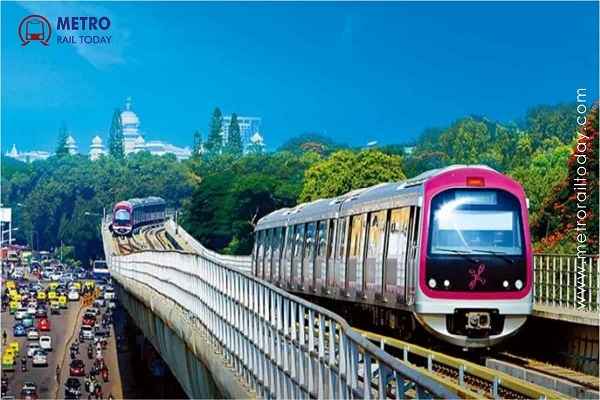
Bengaluru, India (Metro Rail Today): The much-anticipated Phase 3 of Namma Metro, popularly known as the Orange Line, is set to take longer than expected with the Bangalore Metro Rail Corporation Limited (BMRCL) revising its project design to include double-decker flyovers along key stretches. According to a report by The Hindu, this change has pushed the project’s completion timeline to May 2031, at least a year later than the original schedule.
The decision to integrate double-decker structures aims to address Bengaluru’s chronic traffic congestion by optimizing space for both metro and road infrastructure. However, the move is likely to raise project costs by about 5% and require additional land for wider stations and road expansion.
Commenting on this development, Mrs. Mamta Shah, MD & CEO of Urban Infra Group, said:
“Bengaluru’s metro expansion reflects the complex balancing act between urban mobility and road infrastructure needs. The inclusion of double-decker flyovers may extend timelines, but in the long run, such integrated solutions will ensure better traffic management and enhanced commuter experience.”
Phase 3, valued at over ₹15,611 crore, was launched in August 2025 when Prime Minister Narendra Modi inaugurated the Yellow Line and laid the foundation stone for the new corridors. The 44.65-km Orange Line project includes two routes: JP Nagar 4th Phase to Kempapura (32.15 km) and Hosahalli to Kadabagere (12.5 km), with a total of 31 elevated stations.
Officials said tenders for the civil works are expected to be floated in November 2025, with construction likely to commence by December or early 2026. The work will be split into at least eight packages and is projected to take five-and-a-half years once ground activity begins.
This is not Bengaluru’s first experiment with double-decker structures. The Yellow Line already features South India’s first rail-cum-road viaduct near Ragigudda, which connects to the busy Central Silk Board junction. The design is expected to serve as a model for the new Orange Line.
The upcoming line will significantly improve city-wide connectivity. It will link with the Green Line at JP Nagar and Peenya, Purple Line at Mysuru Road, and Blue and Red Lines at Hebbal, while also creating interchange points with the Pink Line. Once operational, Phase 3 is expected to carry 7.85 lakh passengers daily, expanding metro access to underserved neighborhoods such as Magadi Road and the western Outer Ring Road.
With Phase 2 and other corridors under development, Phase 3 will mark another step in Bengaluru’s bid to ease congestion and transform into a metro-driven urban hub.


MRT Online Desk
Metro Rail Today is an authentic and global news provider for the Rail & Metro industry from and around the world.