


Trending Now
 R Mohanraja appointed as new Secretary of Railway Board, Ministry of Railways
 Adani Group's construction arm bags first ₹1,024 crore Civil Contract of Delhi Metro Phase 5
 Govt approves permanent absorption of NCRTC Managing Director Shalabh Goel from Indian Railways
 Hyundai Rotem signs $332 million Rolling Stock Contract with Vietnam for Ho Chi Minh City Metro
 Maharashtra approves ₹18,130 Crore Mumbai Metro Line 5 Expansion & New Line 5A
 Telangana Govt approves ₹13,615 crore IRFC loan to takeover Hyderabad Metro from L&T
 DMRC appoints Sanjay Jamuar as First CEO of Delhi Metro International Limited
 India launches first High Speed Bullet Train Manufacturing Complex in Bengaluru
 Spain investigates CAF’s role in Jerusalem Light Rail Project amid Human Rights allegations
 Dr. Amit Kumar Jain conferred Delhi CM’s Award 2026 for driving Digital Innovation in Urban Mobility
Knorr-Bremse unviels plan to invest ₹1,907 Crore in New Rail Manufacturing Facility in Chennai
MRT Online Desk
Posted on: 2025-12-16 16:15:00
Viewer: 2,320
Comments: 0
Country: India
City: Chennai
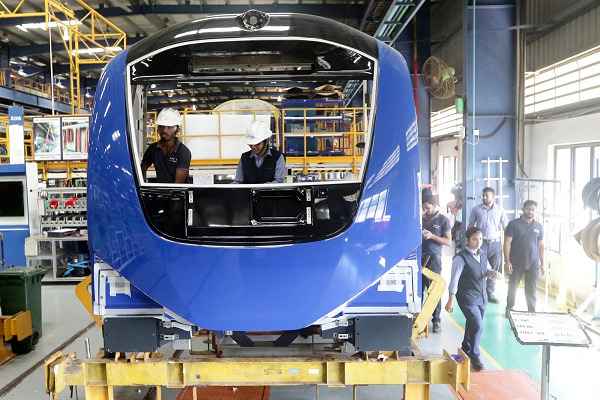
Chennai, India (Metro Rail Today): The Munich-headquartered Knorr-Bremse Group, a global leader in braking systems and safety-critical subsystems for rail and commercial vehicles, has announced plans to establish a new greenfield manufacturing facility on the Sriperumbudur industrial corridor near Chennai, with a proposed investment of ₹1,907 crore.
The facility will be developed by Knorr-Bremse India, the group’s Indian subsidiary headquartered in Haryana, at the SIPCOT Industrial Park, Sriperumbudur Phase IV, on a 46-acre site, according to documents submitted for statutory approvals.
The upcoming plant will manufacture door systems for metro, regional, and high-speed trains, along with friction materials for railway braking systems. These components are critical for passenger safety, operational reliability, and lifecycle performance of modern rail vehicles.
In addition to manufacturing, the project will include a dedicated technology and R&D centre, focusing on:
-
Rail and truck braking systems
-
Advanced friction technologies
-
Digital products for both Indian and global markets
This dual manufacturing-and-R&D approach reinforces Chennai’s growing role as a global rail and mobility technology hub.
Planned Production Capacity
Once operational, the Sriperumbudur facility is expected to achieve a monthly production capacity of:
-
Around 700 door drive units
-
Approximately 1,000 door leaf units
These products will cater to a wide range of rolling stock—from low-floor metro and EMU trains to very high-speed rail applications, supporting India’s expanding metro, regional rail, and future high-speed rail ambitions.
The greenfield project is expected to generate permanent employment for nearly 3,700 people, spanning manufacturing, engineering, R&D, and support functions. Industry experts note that the project will also create significant indirect employment across the supply chain, logistics, and ancillary industries.
The investment builds on Knorr-Bremse Group’s growing footprint in Chennai. Earlier, the company had announced the establishment of its global Artificial Intelligence (AI) centre in the city as part of its long-term digital strategy.
The AI centre focuses on developing solutions to:
-
Improve process efficiency
-
Enhance system performance
-
Accelerate implementation speed across global operations
Knorr-Bremse Group’s current global CEO, Marc Llistosella, has a longstanding association with India’s industrial landscape. He previously served as the first Managing Director and CEO of Daimler India Commercial Vehicles, where he played a pivotal role in setting up the ₹4,400-crore manufacturing operations at Oragadam and launching the BharatBenz truck and bus brand between 2008 and 2014.
Commenting on the development, Mrs. Mamta Shah, MD & CEO, Urban Infra Group, said:“Knorr-Bremse’s decision to invest nearly ₹2,000 crore in a greenfield rail manufacturing and R&D facility underscores India’s emergence as a strategic base for advanced rail systems. Chennai, in particular, is fast becoming a global hub for metro and high-speed rail technologies, aligned with India’s long-term urban mobility and Make in India objectives.”
With this major investment at Sriperumbudur, Knorr-Bremse strengthens its long-term commitment to India’s rail and mobility ecosystem. The project is expected to support the country’s rapidly expanding metro networks, future high-speed rail programmes, and export-oriented manufacturing ambitions, while reinforcing Tamil Nadu’s position as a preferred destination for high-value global rail investments.

MRT Online Desk
Metro Rail Today is an authentic and global news provider for the Rail & Metro industry from and around the world.