


Trending Now
 Pune Metro Line 3 targets September-end opening with 17 stations on Hinjawadi–Shivajinagar corridor
 Jupiter Wagons Limited forms New Subsidiary to expand Railway Mobility Business
 Five major firms bid for ₹1,878 crore Underground Section of Lucknow Metro Phase 1B Project
 DMRC focuses on Technology, Financial Sustainability and Global Expansion: Dr. Vikas Kumar
 DMRC seeks opportunity to take up operation and maintenance of the Kochi Metro Rail network
 New Zealand opens country's first Underground City Rail Link in Auckland
 Ireland approves construction of €15.7 billion Dublin MetroLink, tender to be launched soon
 India's Mumbai-Ahmedabad Bullet Train project completes construction of over 365 km Viaduct
 Metro Rail Expansion in India: 1,155 Km Network Across 26 Cities and the Road Ahead
 Mumbai BKC Pod Taxi project faces Architects’ concerns over cost, capacity and environment
Delhi Metro Rail Network to expand to 695 km by 2047, Six new RRTS Corridors planned
MRT Online Desk
Posted on: 2026-08-20 16:46:00
Viewer: 2,987
Comments: 0
Country: India
City: New Delhi
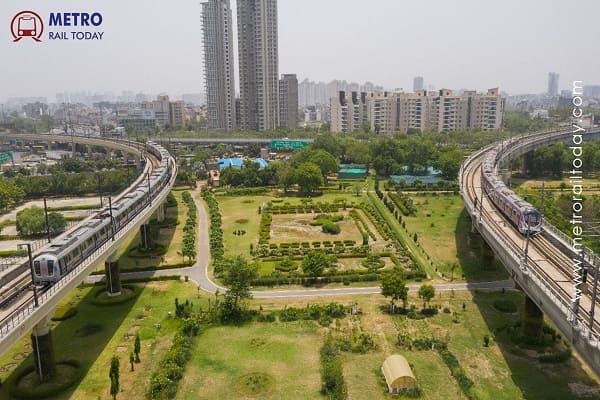
New Delhi, India (Rail & Metro Today): The Delhi Metro network is set for a major expansion under Delhi Master Plan 2047, with the government planning to increase the network from the existing 416 km to 695 km over the next two decades.
Union Minister for Housing and Urban Affairs Manohar Lal Khattar, while outlining the key features of the Delhi Master Plan 2047, also announced plans for six new Regional Rapid Transit System (RRTS) corridors to strengthen connectivity between Delhi and neighbouring regions.
The ambitious expansion comes as Delhi's population is projected to reach around 3.20 crore by 2047, creating a greater need for high-capacity, sustainable and integrated public transport.
Six New RRTS Corridors to Strengthen NCR Connectivity
According to Khattar, the RRTS network will be significantly expanded alongside the Delhi Metro. At present, only one RRTS corridor is operational, while six additional corridors are proposed as part of the long-term regional connectivity strategy.
The expansion is expected to improve connectivity between Delhi and surrounding cities and support faster movement of commuters across the National Capital Region (NCR).
Khattar said, “[Delhi] Metro network, which is presently 416 km, is planned to extend to 695 km. Additionally, along with the neighbouring states, the RRTS network, of which only one line is operational, will also extend with 6 new lines.”
Transit-Oriented Development Around Metro, RRTS Stations
The Delhi Master Plan 2047 also places strong emphasis on Transit-Oriented Development (TOD). The government plans to facilitate residential and commercial development around Metro and RRTS stations to create compact, well-connected urban centres.
The strategy is aimed at reducing dependence on private vehicles while making public transport more accessible to residents.
Sarai Kale Khan, Anand Vihar and Kashmere Gate to Become Multimodal Hubs
Three major locations — Sarai Kale Khan, Anand Vihar and Kashmere Gate — are planned as multimodal and transit hubs.
These hubs are expected to integrate Metro, RRTS, railway, bus and other public transport services, enabling seamless transfers between different modes.
The government also plans to strengthen last-mile connectivity to ensure that passengers can easily reach Metro and RRTS stations from residential and commercial areas.
Delhi May Get 24-Hour Metro Connectivity
In another significant proposal under the 24-hour city plan, the government is considering round-the-clock Metro operations in Delhi.
The proposed 24-hour Metro service could improve mobility for passengers travelling during late-night and early-morning hours and support Delhi's growing economy, transport and commercial activities.
The proposed expansion of the Metro network, RRTS corridors, multimodal hubs, TOD development and improved last-mile connectivity is aimed at creating an integrated transport ecosystem for Delhi and the wider NCR.
With the Delhi Metro targeted to reach 695 km and six additional RRTS corridors planned, the government sees public transport as a key pillar of Delhi's long-term urban development strategy towards Viksit Bharat 2047.


MRT Online Desk
Metro Rail Today is an authentic and global news provider for the Rail & Metro industry from and around the world.