

Trending Now
 Lisha Engineers bags ₹138.70 crore Sanoth Depot Contract for Delhi Metro's Rithala-Kundli Corridor
 India commissions 1,506-km dedicated freight railway corridor connecting JNPA to New Dadri
 Exclusive Interview with Uwe Sperber, Site Manager, Hubner Interface Systems India
 Bangalore Metro floated tender for 13.8-km Phase-3 Double-Decker Rail Infrastructure
 AECOM–NIPPON KOEI JV appointed as PMC Consultant for Chennai Metro Phase 1 capacity enhancement
 EPC Leader Larsen & Toubro Ltd (L&T) joins Chamber of Railway Industries as Corporate Member
 Contractor prequalification deadline for Dubai Metro Gold Line is extended to October 9
 Indore Metro Rail Network expands to 17 km as Priority Corridor 2 opened to public
 Jaffer PC appointed as Managing Director of Bangalore Metro Rail Corporation (BMRC)
 CMRL appoints Systra to prepare Multi-Modal Integration DPR for Chennai Metro Phase 1 stations
Future Metro Control Centres: ST Engineering Transforms Command Rooms to Intelligent Nerve Centres
MRT Online Desk
Posted on: 2026-05-26 09:44:00
Viewer: 25,597
Comments: 0
Country: India
City: New Delhi
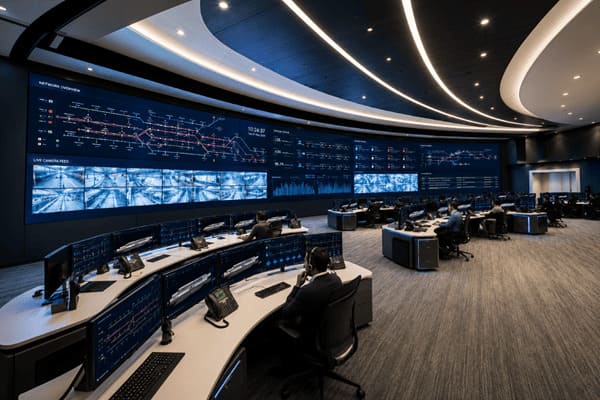
As global urban populations surge, metro systems have become the lifeblood of city mobility. In India, metro networks are expanding at a record pace with over 1,000 kilometres of operational lines and hundreds more under construction. But as networks expand and complexity increases, the core of every metro system – the Operations Control Centre (OCC) – needs to evolve from a conventional command room into an intelligent nerve centre powered by data, connectivity and artificial intelligence (AI).
How can operators manage sprawling networks, unpredictable passenger flows and complex multimodal interfaces? At the same time, they must maintain punctuality, safety and efficiency. The answer lies in integration, intelligence and innovation.
From Control to Collaboration
Conventional OCCs traditionally manage train signalling, power, communications and facilities systems separately. Each system functioned well within its silo; but this fragmentation becomes a liability during incidents. Operators must manually cross-reference data, slowing down response times and increasing the margin for human error. The Smart Metro Control Centre (SMCC) is the vital evolution of this model: a fully integrated Supervisory Control and Data Acquisition (SCADA) environment with data converging under one roof.
However, many traditional SCADA deployments face constraints in maintaining high‑bandwidth, low‑latency communication with moving trains, particularly as data demands increase – a gap that becomes critical during real‑time decision‑making. The increasing adoption of 5G is expected to significantly narrow this gap, enabling faster, near‑real‑time data exchange between trains and control centres. When that happens, control rooms will finally achieve seamless communication across all moving and fixed assets on the network.
AI: The Efficiency Driver for Train Operations
AI is fast becoming the unseen but valued aide in every modern OCC. In the next-generation SMCC by ST Engineering, a Singapore-headquartered global provider of smart mobility solutions, AI prompts operators across all systems, including communications and power, and provides recommendations based on standard operating procedures.
This is human judgment amplified by machine-speed intelligence. Instead of merely flagging incidents, the system contextualises them, suggesting responses that align with safety protocols or service recovery workflows. This not only speeds up recovery but fortifies operator training by providing real-time, guided decision support.
At the centre of this intelligence is data visualisation – exemplified in a unified 3D dashboard that allows operators to navigate tunnels, platforms and trains virtually, giving them greater oversight and control.
For example, a heat map of station congestion shows crowding in real time, while predictive modelling alerts staff before bottlenecks even form. Station air-conditioners, lighting and utilities are monitored continuously via sensors, enabling more sustainable energy optimisation. Train health is similarly tracked in real time, alerting operators when components are approaching failure. This transforms maintenance from a schedule-driven task to a predictive one, significantly reducing overhead and overall operational costs.
.jpg)
A unified 3D dashboard that allows operators to navigate tunnels, platforms and trains virtually, giving them greater oversight and control.
Integration That Saves Space and Time
In rapidly urbanising markets like India, metro systems often become a patchwork of different technologies across multiple phases of expansion; legacy systems running alongside new, automated corridors. That makes scalability and integration paramount. ST Engineering’s SMCC was specifically designed for such complexity. It merges data from signalling, SCADA, communications, depots and passenger information systems and more into one unified command and control platform.
At a time when control rooms are becoming more sophisticated yet space-constrained, consolidation matters. ST Engineering’s system integrates all operational functions into a single platform, eliminating rows of standalone servers and displays. The result? A cleaner, more efficient footprint – crucial as metros grow denser and more complex. In fact, the direction ahead is clear: control rooms will increasingly move away from traditional, heavy SCADA installations altogether. One workstation – not a room of servers – is already enough to manage an entire city’s metro network. This consolidation empowers strategic workforce optimisation, allowing personnel to transition from managing disparate systems to high-level oversight.
A System Built to Scale with the City
For metro operators and city authorities, scalability is essential. As urban networks expand, adding new lines, stations and depots must not require massive infrastructure overhauls. Here again, modular design and open architecture are key. ST Engineering’s SMCC allows flexible integration of new subsystems as networks evolve, keeping systems future-proof as technology and operations adapt to changing demand.
Depots, often treated as separate entities, are now being integrated into the same command ecosystem. This means maintenance scheduling, rolling stock availability and train deployment are synchronised seamlessly with passenger operations. For operators, it means fewer black boxes and a truly end-to-end view of the metro network.
Building a Secure and Connected Future
This robustness is reinforced by Safety Integrity Level (SIL) 2-certified architecture, ensuring that even as the system becomes smarter, safety remains uncompromised. The more integrated the system, the more vital its security. ST Engineering’s approach embeds layered cybersecurity and redundancy directly into system design – protecting operations from external interference while ensuring critical operational continuity.
The Road Ahead
ST Engineering’s track record spans more than 400 mobility projects across 90 cities worldwide, including in India. As metro expansion in India accelerates, the company’s experience in integrating complex systems into simplified and unified platforms is highly relevant. The vision is no longer about merely running trains safely; it’s about orchestrating efficient and sustainable city-wide mobility ecosystems with intelligence, foresight and precision.
Tomorrow’s metro control rooms will not be places of reaction but of prediction. By converging AI, data, 5G and integration, India’s metros can run smarter, safer and more reliably – orchestrated by one connected, intelligent, integrated control centre that scales seamlessly with changing needs.
For more details on our full suite of Smart Metro Systems.

MRT Online Desk
Metro Rail Today is an authentic and global news provider for the Rail & Metro industry from and around the world.