

Trending Now
 CLW sets Global Benchmark with record 800 Electric Locomotives production in FY 2025–26
 NMRC invites Applications for Key Executive Positions for Noida Metro Rail Project
 Central Govt rejects revised DPR of 7.5 km Noida-Greater Noida Metro Rail Extension Project
 Revised DPR of Prayagraj Metro focuses on seamless Rail-Air connectivity
 DMRC floats Tender for Central Vista Depot Design in Delhi Metro Phase V Expansion
 MMRDA seeks ₹14,100 Crore Loan for two upcoming Mumbai Metro Corridors
 Jupiter Wagons Eyes ₹20,000-Crore Mumbai Suburban Mega Rolling Stock Tender
 Mumbai Metro Chief Ashwini Bhide appointed as First Woman BMC Commissioner
 TBM ‘Parvati’ completes Underground Tunnelling on Kanpur Metro Phase 1 Project
 Surat Metro begins First Trial Run on 8.5 km Diamond Corridor between Dream City and Althan Tenement
Namo Bharat Trial Run Begins on Final Stretch of Delhi-Meerut RRTS Corridor
MRT Online Desk
Posted on: 2025-05-01 16:30:00
Viewer: 5,992
Comments: 0
Country: India
City: Meerut
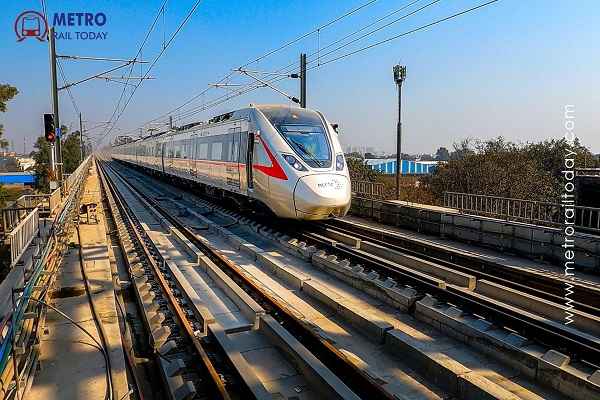
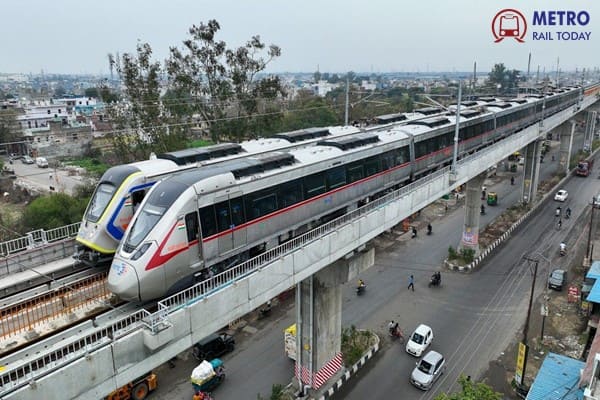
Meerut, India (Metro Rail Today): In a major milestone for India’s first Regional Rapid Transit System (RRTS), the Namo Bharat train began trial runs up to Modipuram, the final station in the Delhi-Ghaziabad-Meerut corridor, marking significant progress towards full-scale operations of the 82-km high-speed corridor.
The National Capital Region Transport Corporation (NCRTC) commenced the trial run on May 1, operating the train between Shatabdi Nagar and Modipuram via Begumpul — the first time a Namo Bharat train has traversed the underground section of Meerut, bringing high-speed rail closer to the heart of the city.
“This is a key step in the implementation of India’s first RRTS corridor, connecting Meerut to Delhi with a modern, efficient, and sustainable transport system,” said an NCRTC spokesperson.
Seamless Integration: From Underground to Elevated
The trial run covered critical underground stations such as Meerut Central, Bhaisali, and Begumpul. Among them, Begumpul will serve both Namo Bharat and Meerut Metro services, while Meerut Central and Bhaisali are dedicated Metro stations. The corridor then transitions back to an elevated alignment from Tank Chowk, passing through MES Colony, Daurli, Meerut North, and culminating at Modipuram — the final RRTS stop in Meerut.
Currently, Namo Bharat services are operational on a 55-km stretch from New Ashok Nagar to Meerut South, covering 11 stations, including Anand Vihar, Ghaziabad, and Duhai. Once the full 82-km corridor becomes operational, travel time between Delhi and Meerut will be reduced to just 55 minutes, transforming regional mobility in NCR.
High-Speed Trials and System Integration Underway
During this phase, trains are being manually operated to assess compatibility between the rolling stock and civil infrastructure. NCRTC will gradually expand testing to include automated systems, platform screen doors (PSDs), track integration, and overhead electrification. High-speed trials reaching up to the design speed of 180 kmph are scheduled in the coming days.
These trial runs also help fine-tune signalling systems, braking performance, and passenger interface technologies prior to public launch.
Meerut Metro: India’s First Dual-Use Infrastructure
In a first for India, Meerut Metro services are being developed to share infrastructure with Namo Bharat trains. The 23-km Meerut Metro corridor — 18 km elevated and 5 km underground — includes 13 stations, with three underground: Meerut Central, Bhaisali, and Begumpul. Metro trial runs are already in progress between Meerut South and Meerut Central.
This dual-use design improves efficiency and reduces costs, making Meerut the first Indian city to feature interoperable high-speed regional rail and metro services.
Key Transit Hubs Under Development
Stations like Shatabdi Nagar, Begumpul, and Modipuram are being developed into multi-modal transit hubs, offering seamless connectivity between Namo Bharat, Meerut Metro, buses, taxis, and autos. These hubs are expected to significantly reduce congestion and enhance last-mile connectivity across the city.
Full Corridor Completion Expected in 2025
With the final stretch now under active testing, the Delhi-Ghaziabad-Meerut RRTS corridor remains on track for completion within 2025, as per NCRTC’s timeline. The project, a flagship of India’s push for sustainable urban transport, is expected to revolutionize intercity commuting, slash carbon emissions, and boost economic growth along the corridor.

MRT Online Desk
Metro Rail Today is an authentic and global news provider for the Rail & Metro industry from and around the world.