

Trending Now
 BHEL and Titagarh to create a Joint Venture for 35-year Vande Bharat Sleeper Trainset Maintenance
 JSW Infrastructure completes acquisition of NCR Rail Infrastructure Limited at ₹467 crore
 Railway Ministry receives DPR for 1,500 km Delhi-Varanasi-Patna-Siliguri High Speed Rail Corridor
 India develops first High Speed Rail Coach for Mumbai-Ahmedabad Bullet Train Project
 Indian Railways plans 12,000 HP Push-Pull Locomotives to modernise conventional trains
 Russia offers Ivolga FG High-Speed Trains for India’s future Bullet Train projects
 Lisha Engineers bags ₹138.70 crore Sanoth Depot Contract for Delhi Metro's Rithala-Kundli Corridor
- India commissions 1,506-km dedicated freight railway corridor connecting JNPA to New Dadri
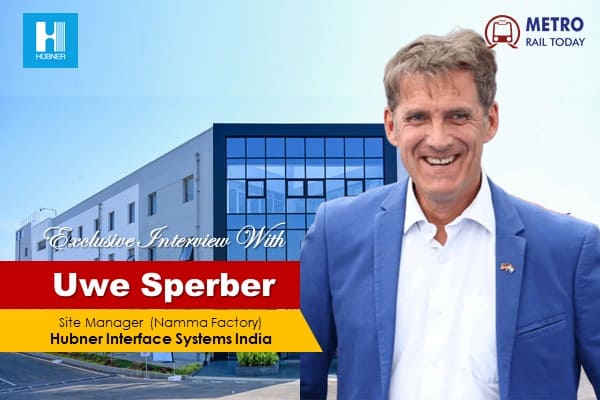 Exclusive Interview with Uwe Sperber, Site Manager, Hubner Interface Systems India
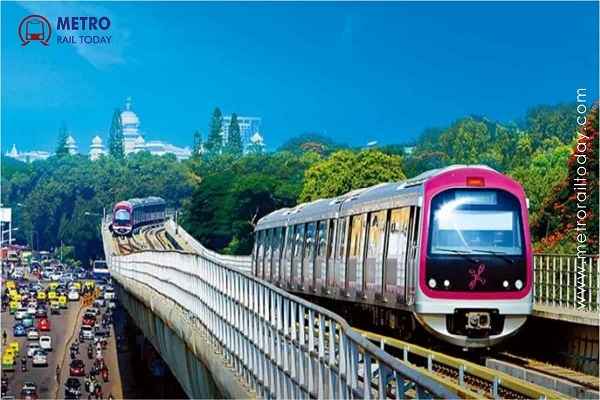 Bangalore Metro floated tender for 13.8-km Phase-3 Double-Decker Rail Infrastructure
Leadership and Expertise behind the success of Mumbai Metro Line 3 (Aqua Line)
Dr. Vinod Shah
Posted on: 2025-10-08 16:00:00
Viewer: 11,881
Comments: 0
Country: India
City: Mumbai
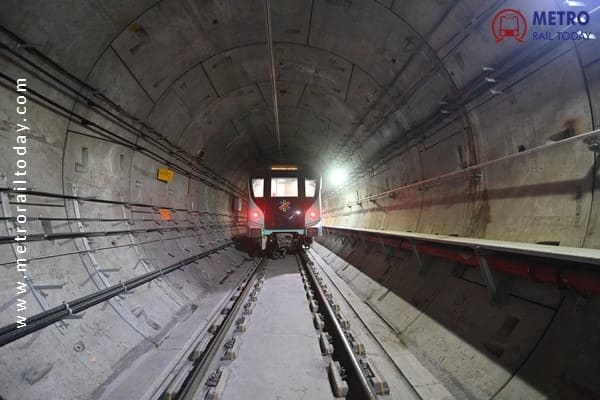
The Mumbai Metro Line 3, or the Aqua Line, stands as India’s largest single-phase underground metro project, a monumental achievement in urban infrastructure built at a cost exceeding ₹37,000 crore. Its success is a powerful case study in blending administrative grit, global engineering expertise, and complex logistical coordination.
The Aqua Line is a masterclass in modern infrastructure, but its success is rooted in the strategic leadership and specialized expertise of a complex ecosystem of international and domestic players. This project demanded a unique blend of administrative resilience, global engineering standards, and synchronized execution across seven distinct civil packages.
1. Project Overview and Route Details
The Aqua Line is a 33.5 km rapid transit corridor, Mumbai's first fully underground metro line (with 26 underground and 1 at-grade station), running from the financial hub of Cuffe Parade in the south to the suburbs of Aarey Colony in the north-center.
Full Route (South to North)
Cuffe Parade ↔ Vidhan Bhavan ↔ Churchgate ↔ Hutatma Chowk ↔ CSMT Metro ↔ Kalbadevi ↔ Girgaon ↔ Grant Road ↔ Mumbai Central ↔ Mahalaxmi ↔ Science Museum ↔ Acharya Atre Chowk ↔ Worli ↔ Siddhivinayak ↔ Dadar ↔ Shitaladevi ↔ Dharavi ↔ Bandra Kurla Complex (BKC) ↔ Bandra Colony ↔ Santacruz ↔ CSMIA T1 ↔ Sahar Road ↔ CSMIA T2 ↔ Marol Naka ↔ MIDC ↔ SEEPZ ↔ Aarey (at-grade station and depot)
Importance of Major Stations (Interchanges and Hubs)
The Aqua Line's strategic importance lies in its ability to decongest the overburdened Western and Central Suburban Railway lines by connecting major commercial, administrative, and transport hubs for the first time by a metro.
The Aqua Line is engineered to carry approximately 1.3 million passengers daily, drastically reducing travel time (Cuffe Parade to Aarey in under 60 minutes) and easing road traffic congestion by up to 15%.
2. The Anchor of Administrative Grit: Mrs. Ashwini Bhide, IAS
Mrs. Ashwini Bhide's leadership as the Managing Director of the Mumbai Metro Rail Corporation (MMRC) was the singular driving force behind the project's momentum. Her role went far beyond conventional administrative management, defining the project's ability to navigate immense structural challenges.
Mrs. Bhide embodied strategic continuity and administrative grit, providing the unwavering institutional support necessary for the technical teams to operate under extreme pressure.
3. The Global Brain Trust: General Consultants (MAPLE Consortium with Egis)
The MAPLE Consortium, which includes Egis as a key member, served as the General Consultant (GC). Their leadership was purely technical, ensuring that the design, specifications, and execution standards met the highest international benchmarks for underground rail systems.
-
Role: The GC team was responsible for reviewing designs, managing the various civil and system contractors, overseeing safety protocols, and providing technical guidance to MMRC, essentially acting as the project's quality and design supervisor.
-
Egis's Contribution: As a global leader in engineering and consultancy, Egis brought extensive international experience from major metro projects worldwide, ensuring the Aqua Line's tunnels, stations, and track specifications were robust enough to handle Mumbai's challenging geology and future ridership. This layer of oversight was vital for maintaining the integrity of the underground structure.
4. The Execution Force: Key Civil Contractors (The Joint Ventures)
The Aqua Line was divided into seven civil packages, each led by an international Joint Venture (JV). This required the MMRC leadership to manage diverse corporate cultures and technical methodologies in parallel.
This decentralized, JV-based model required exceptional contractual and technical leadership from the MMRC to ensure uniform progress and prevent a lag in one package from delaying the entire line.
5. The Systems Integrator: Rolling Stock & Systems Contractor (Alstom)
The final piece of the operational leadership was entrusted to Alstom Transport India. Their role moved the project from a civil construction site to a state-of-the-art metro system.
-
Key Deliverables: Alstom supplied the Alstom Metropolis rolling stock (driverless trains) and integrated the advanced Communication-Based Train Control (CBTC) signalling system.
-
Leadership in Technology: This partnership demonstrated MMRC’s commitment to adopting global cutting-edge technology. Alstom’s expertise ensured the Aqua Line would be capable of high-frequency, automated operations, making it future-ready for Mumbai's massive commuter base.
Conclusion: A Model for Infrastructure Leadership
The success of the Aqua Line is a powerful testament to a hybrid leadership model:
-
Visionary & Resilient (Mrs. Bhide): Providing the singular strategic direction and administrative muscle to overcome institutional and legal resistance.
-
Collaborative & Technical (MAPLE/Egis): Sourcing and integrating the necessary global technical brilliance required for a mega-project of this complexity.
-
Execution-Focused & Logistical (The Contractor JVs): Demonstrating the ability to mobilize vast capital, machinery, and multinational human resources simultaneously under intense pressure.
The Aqua Line’s success is a testament to the coordinated leadership of Mrs. Bhide and the MMRC, who successfully harnessed, negotiated, and synchronized the world-class expertise of these multinational JVs and consultants.
The Aqua Line’s journey showcases that success in 21st-century infrastructure projects hinges on a ‘Leadership of Confluence’—a system where bureaucratic grit, engineering excellence, and multinational collaboration fuse together to transform a blueprint into a functional, resilient reality.


Dr. Vinod Shah
Dr. Vinod Shah is an experienced urban transport journalist, blogger and key opinion leader.