

Trending Now
 Lisha Engineers bags ₹138.70 crore Sanoth Depot Contract for Delhi Metro's Rithala-Kundli Corridor
 India commissions 1,506-km dedicated freight railway corridor connecting JNPA to New Dadri
 Exclusive Interview with Uwe Sperber, Site Manager, Hubner Interface Systems India
 Bangalore Metro floated tender for 13.8-km Phase-3 Double-Decker Rail Infrastructure
 AECOM–NIPPON KOEI JV appointed as PMC Consultant for Chennai Metro Phase 1 capacity enhancement
 EPC Leader Larsen & Toubro Ltd (L&T) joins Chamber of Railway Industries as Corporate Member
 Contractor prequalification deadline for Dubai Metro Gold Line is extended to October 9
 Indore Metro Rail Network expands to 17 km as Priority Corridor 2 opened to public
 Jaffer PC appointed as Managing Director of Bangalore Metro Rail Corporation (BMRC)
 CMRL appoints Systra to prepare Multi-Modal Integration DPR for Chennai Metro Phase 1 stations
Second TBM begins excavating India’s First Undersea High Speed Rail Tunnel on MAHSR Project
MRT Online Desk
Posted on: 2026-07-18 16:39:00
Viewer: 3,389
Comments: 0
Country: India
City: New Delhi
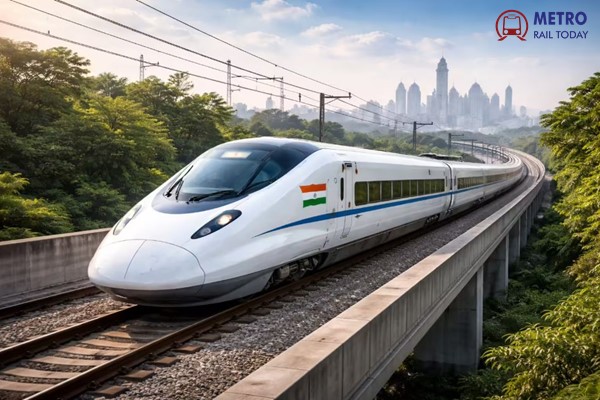
Mumbai, India (Metro Rail Today): The National High Speed Rail Corporation Limited (NHSRCL) has achieved another major engineering milestone in the Mumbai–Ahmedabad High-Speed Rail (MAHSR) project with the launch of the second Tunnel Boring Machine (TBM) for constructing India's first undersea rail tunnel beneath Thane Creek in Maharashtra.
The second TBM commenced excavation from Sawli (Ghansoli) towards Vikhroli, marking the start of another critical underground drive on the country's first bullet train corridor. Of the 10-kilometre tunnel section between these locations, nearly 7 kilometres will pass beneath Thane Creek, making it India's first underwater railway tunnel and one of the most technically challenging infrastructure works ever undertaken in the country.
The development follows the successful launch of the first TBM, which began its 6-kilometre drive from Vikhroli towards Bandra Kurla Complex (BKC) on 5 July 2026. Together, the two machines will construct the majority of the 21-kilometre underground section of the Mumbai–Ahmedabad Bullet Train corridor. While 16 kilometres will be excavated using Tunnel Boring Machines, the remaining 5 kilometres have already been completed using the New Austrian Tunnelling Method (NATM).
One of India's Largest Tunnel Boring Machines
The newly deployed TBM ranks among the largest ever used for railway tunnelling in India. The sophisticated machine features a 13.6-metre diameter cutterhead, equivalent to the height of a four-storey building, weighs nearly 3,200 tonnes, and stretches approximately 96 metres in length.
Designed as a Mixshield slurry-type Tunnel Boring Machine, it has been specifically selected to handle the complex geological conditions beneath Mumbai's densely populated suburban landscape and the Thane Creek seabed. The Mixshield technology uses pressurised bentonite slurry to stabilise the tunnel face during excavation, significantly reducing ground settlement and minimising disruption to nearby buildings, utilities and transport infrastructure.
The machine is also equipped with an advanced Semi-Continuous Advance (SCA) system, enabling simultaneous excavation and installation of precast concrete tunnel lining segments. This integrated approach improves construction efficiency while maintaining high levels of operational safety.
Engineering Beneath Land and Sea
Launching the massive TBM required the construction of a 39-metre-deep launch shaft at Sawli, equivalent to a 12-storey building below ground level. Given the confined working space, the machine was transported and assembled underground in multiple stages.
Its trailing backup system consists of four double-storey gantries housing essential operational equipment, including slurry pumps, hydraulic systems, operator cabins, grouting systems, electrical distribution units, emergency refuge chambers and maintenance facilities.
The tunnelling operation is supported by an extensive surface infrastructure that includes slurry treatment plants, bentonite storage facilities, dedicated power substations, backup generators, water treatment systems, concrete batching plants and sewage treatment facilities to ensure uninterrupted operations.
"The commencement of India's first undersea railway tunnel is a defining moment for the country's infrastructure sector. Delivering such a technologically advanced project requires world-class engineering, precision planning and continuous innovation. The Mumbai–Ahmedabad Bullet Train project is not only introducing high-speed rail to India but is also creating new benchmarks in underground construction, tunnelling technology and engineering excellence that will benefit future infrastructure projects across the country," said Mrs. Mamta Shah, MD & CEO of Urban Infra Group.
Advanced Safety and Monitoring Systems
Given the complexity of tunnelling beneath an urban environment and a water body, NHSRCL has deployed multiple layers of safety and monitoring systems throughout the project.
The TBM is equipped with a real-time multi-gas monitoring system that continuously measures methane, oxygen, carbon monoxide and carbon dioxide levels to ensure a safe working environment for personnel.
Fire protection systems include automatic fire detection, suppression systems for electrical panels and hydraulic units, water curtain protection and sprinkler networks along emergency escape routes.
Meanwhile, an extensive network of Surface Settlement Points (SSPs), Optical Displacement Sensors, Tilt Meters, Strain Gauges, Seismographs and three-dimensional monitoring targets has been installed to monitor ground movement, structural behaviour and vibrations in real time, ensuring the safety of surrounding buildings and infrastructure during excavation.
The completed tunnel will be designed as a fully waterproof structure using double-layer Ethylene Propylene Diene Monomer (EPDM) gaskets combined with hydrophilic sealing systems to prevent water ingress and ensure long-term durability under challenging underground and underwater conditions.
Accelerating India's First Bullet Train Corridor
The 508-kilometre Mumbai–Ahmedabad High-Speed Rail Corridor is India's first bullet train project and is being developed with Japanese Shinkansen technology. Once operational, the corridor will significantly reduce travel time between Mumbai and Ahmedabad while introducing world-class high-speed rail infrastructure to the country.
The commencement of the second TBM drive represents another major milestone in the execution of the project, which continues to witness rapid progress across civil works, bridge construction, station development and track infrastructure. Beyond delivering faster passenger mobility, the project is expected to create lasting capabilities in advanced tunnelling, high-speed rail engineering and underground construction, strengthening India's expertise in executing complex transport infrastructure of global standards.


MRT Online Desk
Metro Rail Today is an authentic and global news provider for the Rail & Metro industry from and around the world.