


Trending Now
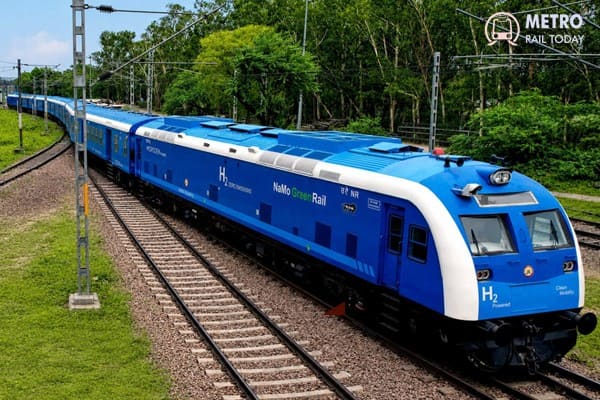 PM Narendra Modi flags off India’s First and World’s most powerful Hydrogen-Powered Rail Service
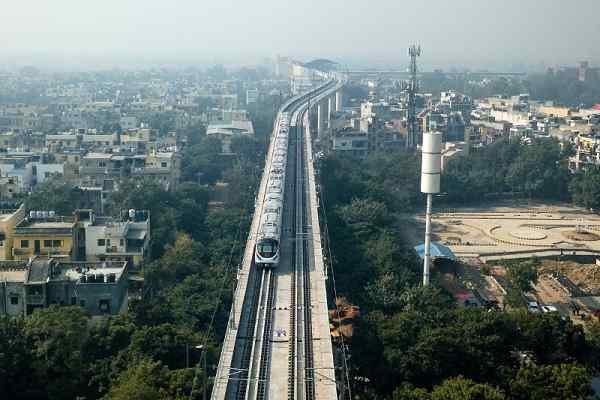 DMRC to study Double-Decker Flyover-cum-Metro Corridor for Delhi Metro Phase V Expansion
 RITES awarded ₹79.22 crore Consultancy Contract for Patna Metro Rail Project
 Pre-construction activities begins for 306 km Chennai–Bengaluru High Speed Bullet Train Corridor
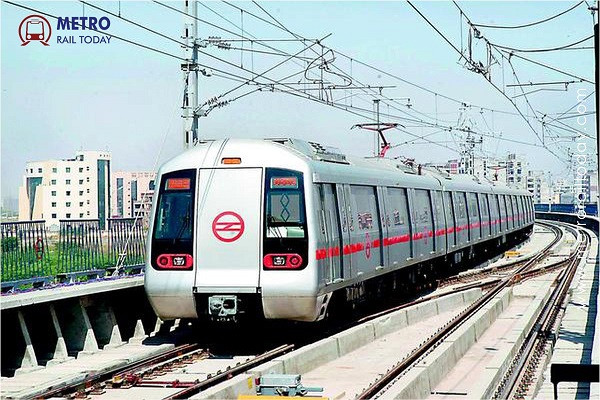 DMRC floats ₹18.97 crore Electrical Tender for Delhi Metro Red Line Extension to Kundli
 Bangalore Metro to launch ₹1,274 crore tender for Platform Screen Door Upgrade across 191 Stations
 AECOM-led JV bags Design Consultancy Contract for Chennai Metro Phase 1 Capacity Enhancement
 MoHUA proposes Housing above Delhi Metro Stations to promote Transit-Oriented Development
- Enhanced land compensation may increase Mumbai–Ahmedabad Bullet Train Project cost
 Assam Govt Cabinet approves four-phase Guwahati Metro Rail Project with ₹18,000 crore Investment
DMRC to study Double-Decker Flyover-cum-Metro Corridor for Delhi Metro Phase V Expansion
MRT Online Desk
Posted on: 2026-07-13 11:15:00
Viewer: 186
Comments: 0
Country: India
City: New Delhi
New Delhi, India (Metro Rail Today): The Delhi Metro Rail Corporation (DMRC) has initiated plans to examine the feasibility of developing an integrated double-decker flyover-cum-Metro corridor along the proposed 16.5-kilometre Keshav Puram–Rohini Sector 34 corridor under the planned Delhi Metro Phase V(B) expansion.
The proposed study represents an innovative approach to urban infrastructure development by combining an elevated roadway and metro viaduct within a single integrated structure. The initiative aims to optimise land utilisation, reduce construction footprints and simultaneously improve road and rail connectivity in one of Delhi's rapidly developing urban corridors.
₹2.08 Crore Consultancy Proposed
DMRC has proposed appointing a consultant for an estimated ₹2.08 crore to undertake a comprehensive feasibility study for the project. The consultancy assignment is expected to be completed within six months and will evaluate the technical, financial, environmental and operational viability of constructing a Metro corridor on the upper deck while accommodating an elevated road or flyover on the lower deck.
The integrated infrastructure model is intended to ease increasing traffic congestion while expanding Delhi's metro network without requiring significant additional land acquisition—an important consideration in densely built-up urban areas.
Comprehensive Technical Assessment Planned
According to the proposed scope of work, the consultant will evaluate multiple aspects of the project, including route alignment options, traffic demand, transport integration, structural feasibility, construction methodology, utility shifting requirements and commercial viability.
The study will also examine the need for supporting road infrastructure such as entry and exit ramps, loop connections, cloverleaf interchanges and directional ramps at major traffic intersections to ensure seamless integration with the existing road network.
The proposed corridor traverses heavily urbanised areas between Keshav Puram and Rohini Sector 34, where existing metro structures, flyovers, underground utilities, limited right-of-way and busy traffic junctions present significant engineering challenges.
Advanced Surveys and Traffic Modelling
To support the feasibility assessment, the appointed consultant will undertake a series of detailed field investigations, including traffic volume counts, turning movement surveys, origin-destination studies, public transport usage surveys, road inventory assessments, and speed and delay analyses.
Limited topographical verification will also be carried out at critical locations to validate engineering assumptions and identify site-specific constraints.
Based on these investigations, the consultant will prepare a comprehensive transport demand model to evaluate both existing and future traffic requirements. Conceptual engineering plans will then be developed to integrate the proposed metro viaduct with the elevated roadway while ensuring efficient movement for both public transport and private vehicles.
Cost-Benefit and Environmental Evaluation
In addition to technical investigations, the consultancy will include concept-level structural assessments, construction feasibility studies and preliminary estimates of land requirements.
The consultant will also prepare indicative project cost estimates, conceptual bills of quantities and comparative commercial analyses of alternative structural configurations. A detailed cost-benefit analysis and environmental impact assessment will be undertaken to evaluate the long-term economic and environmental viability of the project.
The final report will consolidate the findings from all stages of the study and recommend the most suitable alignment, structural configuration and implementation strategy for the proposed corridor.
Supporting the Next Phase of Delhi Metro
The proposed Keshav Puram–Rohini Sector 34 corridor forms part of the planned Delhi Metro Phase V(B) expansion programme, which seeks to further strengthen mass transit connectivity across the National Capital Region.
The feasibility study reflects DMRC's continued emphasis on adopting innovative engineering solutions to address urban transport challenges while making efficient use of limited urban land. If found viable, the double-decker corridor could become another landmark addition to Delhi's transport infrastructure, complementing similar integrated road-and-metro structures already being developed in other Indian cities.
As Delhi continues to expand, projects that combine multiple transport modes within a single infrastructure corridor are expected to play an increasingly important role in reducing congestion, enhancing commuter convenience and promoting sustainable urban mobility.


MRT Online Desk
Metro Rail Today is an authentic and global news provider for the Rail & Metro industry from and around the world.