

Trending Now
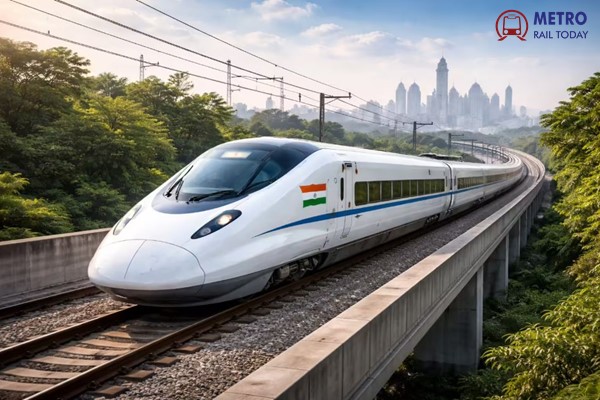 Keralam High-Speed Rail proposal is technically feasible but project cost may double: Expert Panel
 DMRC begins Construction work on Inderlok–Indraprastha Corridor under Delhi Metro Phase 4 Expansion
 Bihar approves RRTS Plan to connect Patna with Gaya, Muzaffarpur, Ara and Begusarai
 Indian Prime Minister Narendra Modi to Flag Off Asia's First Hydrogen-Powered Train on July 17
 DMRC launches Delhi Metro International Limited to expand Urban Transit Expertise Globally
 Prime Minister Narendra Modi lays Foundation Stone for ₹13,037 Crore Jaipur Metro Phase 2 Project
 MRVC seeks Capital Infusion to Fast-Track ₹64,644 crore Railway Infrastructure Pipeline in Mumbai
 DMRC commences construction work for Central Vista Corridor under Delhi Metro Phase V
 Dhaka unveils with Two New Metro Lines and Five Monorail Corridors in New Transport Master Plan
 KfW delegation conducts Four-Day Appraisal Visit for Gurugram Metro Rail Project Financing
Keralam High-Speed Rail proposal is technically feasible but project cost may double: Expert Panel
MRT Online Desk
Posted on: 2026-07-06 16:18:00
Viewer: 56
Comments: 0
Country: India
City: Kochi
Kochi, India (Metro Rail Today): Kerala's ambitious plan to develop a 473.2-kilometre high-speed rail corridor between Thiruvananthapuram and Kannur has received a major boost after a state government-appointed expert committee found the proposal to be technically feasible and environmentally viable. However, the panel has cautioned that the project's actual cost could be nearly double the estimate submitted by renowned railway engineer E. Sreedharan, citing complex geological conditions and evolving construction requirements.
The four-member expert committee is expected to submit its final report to Chief Minister V. D. Satheesan next week after completing its evaluation of the proposal, which aims to introduce one of India's most advanced high-speed rail corridors running almost entirely on an elevated alignment.
Elevated Alignment Reduces Environmental Impact
According to sources familiar with the committee's findings, the panel has broadly endorsed the project's engineering concept and noted that its fully elevated design presents significantly fewer environmental challenges than the previously proposed SilverLine semi-high-speed rail project.
Unlike the SilverLine proposal, which involved extensive embankments across Kerala, the elevated corridor is expected to minimise land fragmentation and avoid creating barriers that could affect drainage patterns or increase flood risks. The committee reportedly observed that the elevated structure would preserve ecological continuity while reducing disruption to local communities and agricultural land.
The proposed corridor is designed to connect Kerala's major cities through a high-speed rail system that could dramatically reduce travel time between the southern and northern parts of the state while supporting long-term economic development and regional integration.
"The adoption of elevated high-speed rail infrastructure represents an important evolution in sustainable transportation planning. Elevated corridors can significantly reduce environmental impacts, improve operational efficiency and preserve natural landscapes when compared with conventional at-grade alignments. At the same time, comprehensive technical studies and realistic financial planning are essential to ensure the long-term viability of such transformational infrastructure projects," said Mrs. Mamta Shah, MD & CEO of Urban Infra Group.
Geological Challenges Could Increase Construction Cost
While the committee has expressed confidence in the project's technical feasibility, it has raised concerns regarding the financial assumptions outlined in the proposal. The original submission prepared by E. Sreedharan, former Managing Director of the Delhi Metro Rail Corporation (DMRC), estimates the project cost at around ₹57,000 crore, with an overall completion cost of approximately ₹60,000 crore.
However, the expert panel believes the final expenditure could be almost twice the proposed estimate, primarily because of Kerala's highly variable geological conditions. According to sources, the proposal assumes relatively uniform soil characteristics across long stretches of the alignment, whereas the state's soil profile changes frequently, often within a few hundred metres.
These variations would require different foundation designs and construction techniques for the elevated viaducts and supporting pillars, resulting in significantly higher civil engineering costs. The committee has also factored in rising material prices, increasing labour costs and the additional expenditure associated with powering the corridor through solar energy.
Further Technical Assessment Required
The panel has also identified several technical aspects that require further examination before the project advances. One of the key issues relates to the proposed alignment near Cochin International Airport, where an elevated high-speed rail structure could potentially interfere with aircraft approach and departure paths. This aspect is expected to undergo detailed technical scrutiny before any final alignment is approved.
Another area requiring additional evaluation is tunnelling. The proposal currently includes only a 6.5-kilometre tunnel in the Thiruvananthapuram section and does not envisage tunnelling through Ernakulam. The committee is expected to examine whether additional underground sections may be necessary to optimise alignment, improve operational efficiency or address local constraints.
The panel has also highlighted the importance of incorporating lifecycle costs into the project's financial assessment, including the future replacement of solar panels after their operational lifespan of around 15 years.
Next Phase Hinges on Detailed Evaluation
The Kerala government constituted the expert committee on 6 June following the submission of an interim report by the Delhi Metro Rail Corporation (DMRC). Its findings are expected to guide the state's decision on the next phase of the proposed high-speed rail project, including detailed engineering studies, alignment finalisation and financing options.
If implemented, the Thiruvananthapuram–Kannur High-Speed Rail corridor could become one of India's longest elevated high-speed rail systems, significantly improving intercity connectivity and supporting economic growth across Kerala. However, the committee's observations underscore the need for rigorous engineering validation and realistic cost estimation before moving the project into the implementation stage.


MRT Online Desk
Metro Rail Today is an authentic and global news provider for the Rail & Metro industry from and around the world.