

Trending Now
 RITES submits fresh DPR to UPMRC for ₹12,000 crore Prayagraj Metro Rail Project
 Paras Railtech wins ₹84.72 crore Ballastless Track Contract for Jaipur Metro Rail Project
 Indian Railways announces 3,548 Graduate-Level Vacancies under NTPC Recruitment 2026
 European Union sanctions €10 million to support extension of Hanoi Metro Line 3
 GMRC issues ₹683 crore Tender for construction of 8.68 km stretch for Ahmedabad Metro
- GMRC launches ₹439 crore Tender for construction of 5 New Ahmedabad Metro Stations
 Global tender issued for procurement of 60 Rolling Stock coaches for Hyderabad Metro Rail Project
 Global tender issued for procurement of 102 Rolling Stock coaches for Patna Metro Rail Project
 Gamuda awarded RM3.7 billion contract to build Keelung Mass Rapid Transit in Taiwan
 Maharashtra forms special Task Force to plan Rail, Metro and RRTS expansion
Metroman E. Sreedharan submits new Blueprint for ₹54,000 Crore Kerala High Speed Rail Corridor
MRT Online Desk
Posted on: 2026-06-01 06:10:00
Viewer: 2,482
Comments: 0
Country: India
City: Kochi
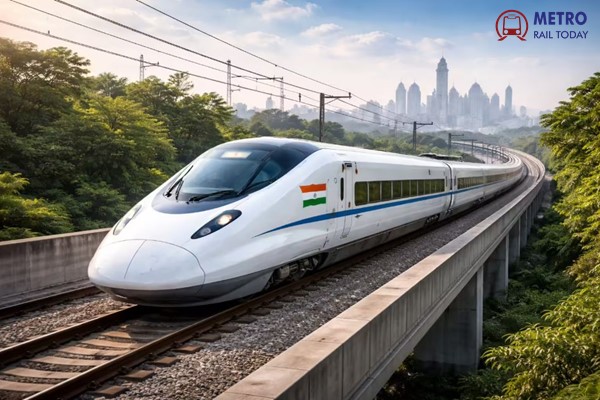
Kochi, India (Metro Rail Today): Kerala is once again moving towards the development of a modern high-speed rail network, with the state government actively reviving plans for a new rail corridor connecting Thiruvananthapuram and Kannur. Unlike the previously proposed SilverLine semi-high-speed project that faced strong public opposition and was eventually shelved, the new proposal aims to minimise land acquisition and social disruption while delivering faster, affordable, and sustainable transportation across the state.
The ambitious project is being developed in collaboration with Indian Railways and under the guidance of renowned railway engineer and “Metroman” E. Sreedharan, whose expertise has been instrumental in several landmark transportation projects across India.
During a high-level meeting at the Kerala Secretariat, Sreedharan submitted the Detailed Project Report (DPR) for the proposed corridor to Chief Minister V.D. Satheesan. The proposal was reportedly prepared following discussions with Union Railway Minister Ashwini Vaishnaw, indicating growing support from the Central Government for the project.
According to officials, the Chief Minister has assured that the proposal will be placed before the State Cabinet within the next fifteen days for detailed review and consideration. Sreedharan has expressed confidence that the entire project can be completed within five years, subject to timely approvals and clearances from various authorities.
Stretching approximately 465 kilometres, the proposed corridor will connect Thiruvananthapuram and Kannur through a network designed for operating speeds of up to 180 kmph. Once operational, travel time between the two cities is expected to be reduced dramatically to just 3 hours and 20 minutes, offering a transformative alternative to road transport and conventional rail services.
The corridor is planned to feature 22 stations, strategically located at intervals of approximately 20 to 30 kilometres, enabling regional connectivity while maintaining high-speed operations. The route will also provide seamless connectivity to three major airports in Kerala, strengthening multimodal transportation links and improving accessibility across the state.
A key differentiator of the new proposal is its emphasis on avoiding the challenges that plagued the SilverLine project. The alignment is designed to rely extensively on underground tunnels and elevated viaducts, thereby eliminating the need for large-scale surface-level land acquisition. Elevated sections are expected to require a narrow right-of-way of only about 20 metres, substantially reducing the impact on residential and agricultural land.
Officials stated that any land temporarily utilised during construction activities would be restored and returned to original owners after completion of works. This approach is expected to address concerns related to displacement and environmental impact that emerged during the earlier SilverLine initiative.
Another notable feature of the project is its focus on affordability. According to Sreedharan, the proposed service is being designed for mass public use rather than premium travel. Ticket prices are expected to be lower than those of existing AC Chair Car services and Vande Bharat trains, making high-speed travel accessible to a broader segment of society.
Beyond the initial Thiruvananthapuram–Kannur corridor, the DPR also outlines several future expansion possibilities. Proposed extensions include connections from Kannur to Mangaluru, Kozhikode to Kalpetta, Pattambi and Thrissur to Palakkad, and links to Guruvayur. Southern extensions connecting Pathanamthitta to Pamba and Thiruvananthapuram to Parassala have also been discussed as part of a long-term vision for a statewide high-speed rail network.
The project is expected to deliver significant economic and environmental benefits. Estimates suggest that nearly 30,000 daily commuters could shift from road-based transportation to rail, resulting in annual fuel savings of approximately ₹3,500 crore while reducing traffic congestion and carbon emissions.
The total project cost has been estimated at around ₹54,000 crore. Under the proposed financing structure, approximately 70% of the funding would be contributed through government support. The Central Government is expected to provide about ₹20,171 crore, while the Kerala Government would contribute around ₹19,380 crore. The remaining 30% of the funding requirement is proposed to be raised through market borrowings, bonds, and other financing mechanisms.
The proposal represents one of the most ambitious transportation initiatives currently under consideration in southern India and has the potential to reshape mobility patterns across Kerala if approved.
Commenting on the development, Mrs. Mamta Shah, MD & CEO, Urban Infra Group, said:
“The revival of Kerala’s high-speed rail vision reflects the growing importance of fast, sustainable, and integrated transportation systems in supporting regional economic development. The emphasis on minimal land acquisition, environmental sensitivity, and affordable mobility demonstrates a progressive approach to infrastructure planning. If implemented successfully, the project could become a model for future high-speed rail development in India.”
With Cabinet discussions expected shortly and coordination between the state and central governments gaining momentum, the proposed high-speed corridor could mark the beginning of a new era in Kerala’s transportation infrastructure, offering faster connectivity, economic growth, and a more sustainable mobility future.


MRT Online Desk
Metro Rail Today is an authentic and global news provider for the Rail & Metro industry from and around the world.