

Trending Now
 Siemens Bags Order from Titagarh Rail Systems for Pune Metro Extension Trainsets
 Titagarh Rail Systems becomes Corporate Member of Chamber of Railway Industries (Rail Chamber)
 World Bank approves ₹1,400 crore Civil Tender for Gurugram Metro Phase 2
 Bi-RIDE invites ₹200 crore Tender for Soladevanahalli Depot of Bengaluru Suburban Rail Project
 GHV India awarded ₹107.79 crore Civil Contract for Lucknow Metro East-West Corridor
 Pune Metro Line 3 set to launch First 12-km Section on 15 July 2026
 DMRC gets approval to Fell or Transplant 364 Trees for Central Vista Metro Corridor under Phase IV
 ₹4.5 Lakh crore Metro Rail Investment reaches less than 5% of Urban Population in India
 West Bengal plans to launch Water Metro Systems in Kolkata
- Titagarh Rail Systems targets full Indigenous Aluminium Coach Manufacturing by FY2027
Mumbai–Ahmedabad Bullet Train Project achieves third Mountain Tunnel Breakthrough in Maharashtra
MRT Online Desk
Posted on: 2026-06-02 16:50:00
Viewer: 1,481
Comments: 0
Country: India
City: Mumbai
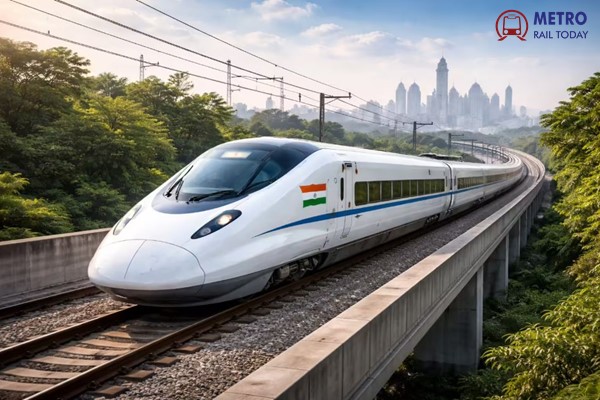
Palghar, Maharashtra (Metro Rail Today): The Mumbai–Ahmedabad High-Speed Rail (MAHSR) Project has achieved another significant engineering milestone with the successful breakthrough of Mountain Tunnel MT-07 at Ambesari village in Dahanu Taluka of Palghar district, Maharashtra. The achievement marks the third mountain tunnel breakthrough completed in the state within the last five months, underscoring the rapid progress being made on India’s first bullet train corridor.
The newly completed MT-07 tunnel, measuring 417 metres in length and 14.4 metres in width, has been designed to accommodate both up and down tracks of the high-speed rail corridor. Excavation was carried out using a carefully controlled drilling and blasting methodology from both ends of the tunnel, supported by advanced engineering techniques, rigorous safety protocols, and continuous geotechnical monitoring.
The successful breakthrough highlights the growing expertise being developed in India for executing complex tunnelling works required for large-scale high-speed rail infrastructure projects.
Advanced Engineering and Safety Measures
Given the challenging geological conditions and the importance of maintaining structural stability throughout construction, the tunnel excavation was supported by sophisticated monitoring systems and real-time geotechnical instrumentation.
Project teams deployed a comprehensive monitoring framework including Surface Settlement Points (SSP), 3D targets, strain gauges, and seismographs to continuously assess tunnel behaviour, ground movement, vibration levels, and the impact on surrounding structures. These systems enabled engineers to make real-time adjustments while ensuring safe and precise excavation activities.
Worker safety remained a key priority throughout the operation. Extensive measures such as advanced ventilation systems, fire safety arrangements, controlled access management, and continuous geotechnical supervision were implemented to maintain safe working conditions during tunnelling operations.
Rapid Progress Across Maharashtra Tunnels
The breakthrough of MT-07 builds upon a series of recent achievements in the Maharashtra section of the Mumbai–Ahmedabad Bullet Train Project.
The first major milestone was achieved on 2 January 2026 when Mountain Tunnel MT-05, spanning approximately 1.5 km, recorded the first successful mountain tunnel breakthrough in Maharashtra near Saphale in Palghar district.
This was followed by the breakthrough of MT-06 on 3 February 2026, involving a 454-metre-long tunnel excavated using the New Austrian Tunnelling Method (NATM). The completion of MT-05 and MT-06 within just one month demonstrated the accelerating pace of construction activities along the corridor.
Among the seven mountain tunnels currently under construction in Maharashtra, MT-05, MT-06, and MT-07 have now achieved complete breakthroughs. Additionally, MT-08, measuring approximately 350 metres, had already achieved breakthrough on 5 October 2023.
Construction progress continues on the remaining tunnels, with MT-03 exceeding 80% excavation completion, MT-04 approaching 60% progress, while work on MT-01 and MT-02 is advancing steadily.
Strategic Connectivity Between Maharashtra and Gujarat
Of the total eight mountain tunnels being constructed as part of the Mumbai–Ahmedabad Bullet Train Project, seven are located in Maharashtra’s Palghar district, while one is situated in Valsad district, Gujarat, where tunnelling work has already been completed.
Notably, all three mountain tunnels located between the upcoming Boisar and Vapi Bullet Train stations have now been successfully excavated. This section traverses a strategically important industrial belt connecting Maharashtra and Gujarat and forms a critical part of the overall high-speed rail alignment.
The successful completion of tunnelling activities in this segment represents a major step toward establishing seamless high-speed connectivity between two of India’s most economically significant regions.
Commenting on the achievement, Mrs. Mamta Shah, MD & CEO, Urban Infra Group, said:
“The successful breakthrough of MT-07 demonstrates the remarkable engineering capabilities being developed through the Mumbai–Ahmedabad Bullet Train Project. Complex tunnelling works such as these not only accelerate project execution but also strengthen India’s expertise in advanced railway infrastructure construction. Such milestones are laying the foundation for a modern high-speed rail ecosystem that will support the nation’s long-term mobility and economic growth ambitions.”
Strengthening India’s High-Speed Rail Capabilities
The Mumbai–Ahmedabad Bullet Train Project continues to serve as a platform for introducing advanced tunnelling technologies, precision construction methods, and world-class safety standards into India’s railway infrastructure sector.
The project is helping build domestic expertise in high-speed rail engineering while creating capabilities that can support future bullet train and semi-high-speed rail corridors across the country.
As tunnelling, viaduct construction, station development, and systems installation progress simultaneously across multiple sections, the project continues to move closer to transforming intercity travel in India through faster, safer, and more sustainable transportation solutions.

MRT Online Desk
Metro Rail Today is an authentic and global news provider for the Rail & Metro industry from and around the world.