

Trending Now
 Alstom eyes ₹2,000 crore Chennai Metro tender for supply of 168 Train Coaches
 SYSTRA India emerges as lowest bidder for Thane Metro Design Consultancy Contract
 Adani Group's Cemindia Projects wins ₹921.63 crore Underground Package for Jaipur Metro
 EFKON India wins ₹288.11 crore Station Systems Contract for Indore Metro Rail Project
 L&T partners with IIT Madras-Backed TuTr Hyperloop to explore Next-Gen Mobility
 Alstom, Larsen & Toubro unveil First Driverless Trainset for Mumbai Metro Lines 4 and 4A
 BEML, Czech Republic delegation explore strategic Industrial and Technology Partnerships
- Six Firms qualify for ₹1,160 crore Underground Tunnel Package of Jaipur Metro Rail Project
 Alstom and Siemens sign $1.5 billion Rolling Stock contract for Riyadh Metro Rail Project
 Bangladesh approves Tk 58,477 crore contracts for Dhaka Metro Lines 1 and 5
Insights from Evgeny Maslov, Chief Industrial Designer of the Vande Bharat Sleeper Train Project
MRT Online Desk
Posted on: 2026-02-02 11:25:00
Viewer: 44,232
Comments: 0
Country: India
City: New Delhi
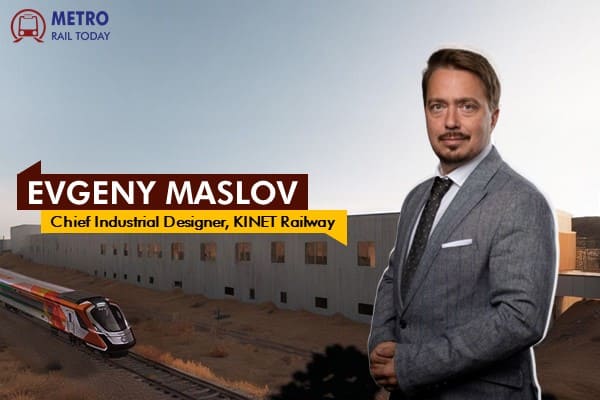
As Indian Railways leaps into a new era of high-speed travel, the Vande Bharat Sleeper stands as a testament to the fusion of cutting-edge technology and human-centric design. Central to this transformation is Evgeny Maslov, Chief Industrial Designer of the Vande Bharat Sleeper Train Project being developed by KINET Railway Solutions in joint venture with Rail Vikas Nigam Limited (RVNL). With a portfolio spanning global markets and a deep understanding of multi-day travel cultures, Maslov is the visionary crafting the "visual language" for India’s future rail journeys. In this exclusive interview with Metro Rail Today, he discusses the transition from "pompous luxury" to "friendly smart design," the integration of indigenous block printing, and the engineering marvels behind the train's aerodynamic silhouette.
You’ve mentioned that the First AC compartment is designed to be a "calm, airy environment" rather than "pompous luxury." How do you balance high-end industrial aesthetics with the practical need for inclusivity and mass comfort in the Indian context?
Evgeny Maslov: When we started this project, our goal wasn’t just about building a new train. We were essentially crafting a new visual language for Indian Railways – setting a fresh standard for both comfort and the emotional experience of travel.
Today, design has moved beyond mere aesthetics– it’s become intelligent. The world around us is getting smarter, and a modern train interior needs to keep up. That’s why we aimed to create what I call friendly smart design. It doesn’t draw attention to its features – instead, it intuitively adapts to the person, gently guides them, and creates a real sense of care.
In the first-class sleeper interior, we deliberately moved away from the idea of “pompous luxury”. Instead, we’ve created a meditative, bright, airy space where comfort feels natural. This design is meant to be universal – equally welcoming for elderly passengers, travellers with disabilities, families with children, and solo travellers.
The mission was to make every person feel that the interior was thoughtfully designed for them, not for some abstract “premium” user.
The use of traditional block printing motifs in the cabin interiors was a highlight of the IREE 2025 showcase. How did your team collaborate with Indian artists to ensure global design standards respect indigenous identity?
Evgeny Maslov: The ideation to use block printing wasn’t just a decorative experiment for us – it was a deep cultural exploration. What makes Indian artistic tradition truly unique is that many crafts, like traditional block printing, have preserved their authenticity for thousands of years.
We asked ourselves: why do these patterns still evoke such a strong sense of home, warmth, and belonging among Indians? To find the answer, we immersed ourselves in the local context: we visited markets, workshops, old city quarters, museums, and had meaningful conversations with artists and craftsmen.
The result is a unique pattern that doesn’t merely decorate the interior – it literally wraps around the living area, making it feel homely, familiar, and relatable. This isn’t ornamentation for the sake of ornamentation. It’s a bridge between contemporary industrial design and India’s centuries old artistic heritage.
Small details like the "bookshelf" under the staircase for personal items have been highly praised. What other "hidden" design features have been integrated to solve common pain points for long-distance Indian travelers?
Evgeny Maslov: We put the passenger at the heart of the design – a real person, not just someone travelling from point A to point B. What matters to them is comfort, privacy, a sense of safety, and cosiness. That’s why we analysed every detail that could make the journey more pleasant.
Take, for example, the niche under the staircase. Imagine! It’s not just a technical feature – it’s a little bedside table where you can put your favorite book, phone, or watch: all the things people usually keep close at home.
We paid special attention to the ladder to the upper berth. Each step is made up of several elements: a rigid base, a soft non‑slip insert, and carefully calculated curves that increase the footing area and reduce the risk of slipping.
Our goal was to create an interior that responds to the needs of the person inside it. Foldable armrests like in a personal lounge chair, bottle holders integrated into the table, an additional shelf for hand luggage, and charging ports within arm’s reach allow passengers to stay comfortable without unnecessary movement. Individual lighting allows reading at night without disturbing others. All these details create the feeling that the coach is a temporary home, not just a means of transport.
From redesigned ladders for senior citizens to better upper-berth access, how has Kinet utilized ergonomics to make the 10–16 hour journey more comfortable for India’s diverse demographic?
Evgeny Maslov: India is a country with a rapidly growing passenger volume, and traditional approaches to interior design are no longer sufficient. Our goal is to establish a new standard of comfort for Indian Railways – to transform the train from mere transportation into the optimal way to connect cities and families.
With that in mind, we simulated dozens of user scenarios: how a person uses the berth during the day and at night, how they sit on it, read, watch films, or chat with a fellow traveller. Based on these observations, we made subtle, almost imperceptible adjustments to the geometry of the berth and the upholstered seating elements to create a truly adaptable space.
Minor tweaks to the surface plane provide natural lumbar support, while a refined inclination angle makes you feel as if you’re sitting in an armchair. We carefully optimised every centimetre and millimetre to ensure that, on a long journey, passengers can change their posture without discomfort.
Kinet’s Vande Bharat sleeper is designed for a 180 kmph test speed. How does the industrial design–specifically the aerodynamic nose cone–contribute to the train's stability and noise reduction at such high speeds?
Evgeny Maslov: The Kinet team includes designers with automotive industry experience – where aesthetics and aerodynamics have co‑existed in symbiosis for decades, shaping new expressions of dynamism. We’ve brought this expertise to rail transport.
The nose cone isn’t just an engineering necessity that ensures stability at speeds up to 180 km/h – it’s also a visual symbol of dynamism, speed, and forward momentum, Indian symbol.
The exterior design is a synergy of contemporary automotive trends: dynamic surfaces, jewel like attention to lighting, energetic silhouette and graphics. A key feature is the horizontal element on the front mask – it splits the mask into two parts and, in motion, evokes the image of a star in flight. It continues along the sides of the train, giving the whole form a sense of speed and modern energy. The lighting design resembles a diamond in a setting – our tribute to India’s jewelry traditions.
Our aim was to create an iconic Vande Bharat image that simultaneously resonates with India’s unique cultural heritage and its technological progress.
With the Marathwada Rail Coach Factory now fully operational, how has the transition from design concept to physical car-body production at Latur influenced your iterative design process?
Evgeny Maslov: Industrial design is not just about what’s conceived on paper – it’s also about what gets realised on the ground. The launch of the Marathwada plant marked a crucial milestone: we immersed ourselves in India’s manufacturing culture, and this insight helps us integrate our expertise into local processes, fostering a new level of production culture.
Design is a horizon, a guiding star. It sets the direction that all technological processes must follow, ensuring that the final product lives up to the vision we presented last year.
Having a background in global industrial design, what unique challenges did you face in adapting European sleeper standards to the high-occupancy requirements of Indian Railways?
Evgeny Maslov: Our team has extensive experience adapting projects for diverse markets – British, American, European. But the Russian experience proved to be the most valuable: the culture of multi‑day train journeys, where the train becomes a family space, a temporary home. This resonated surprisingly well in India – and we brought it to Indian soil, adapting it to local needs. Our project focuses on the cross‑fertilization of travel cultures.
Here’s the fascinating thing: there’s a common perception that public transport is purely simple and utilitarian. Yet we understand that for India – with its rich cultural heritage and ancient artistic traditions – visual identity carries immense weight.
We tried to listen to the people and to the country, striving to create the perfect fusion of aesthetics and functionality. In India, a train isn’t just an object – it’s a living being.
With the project emphasizing eco-friendly materials and energy efficiency (including regenerative braking), how are sustainable materials integrated into the interior GFRP panels and furnishings?
Evgeny Maslov: The world has entered an era of rethinking our relationship with nature. For us, sustainability isn’t just about selecting materials – it’s also about reimagining how we manufacture things.
We’ve reviewed every single component, engaging suppliers in deep conversations about where materials come from, what their lifecycle looks like, and how they can be recycled. From GFRP interior panels to furniture and decorative elements – everything is designed with eco‑friendliness, durability, and minimal environmental impact in mind.
But for us, sustainability goes beyond materials – it’s also a social process. It’s about revitalising local factories, creating jobs, and fostering regional development. We see sustainability as a delicate balance between people, nature, and society.
Reports suggest a shift toward 24-coach configurations for some Vande Bharat Sleeper routes. How does increasing the train length impact the design of centralized systems like the modular pantry or the passenger information displays?
Evgeny Maslov: As a designer, I’ll answer your question from that perspective. A train isn’t just a space for passengers – it’s also a workplace for the staff who keep everything running smoothly.
When developing the Vande Bharat, we made it a priority to create comfortable conditions for all stakeholders involved in the journey. That’s why we put significant effort into designing key service areas: restrooms, luggage storage zones, spaces for operational equipment, furniture storage areas.
Well‑designed, user‑friendly spaces for staff are an essential part of any modern train. After all, they directly enable employees to do their jobs effectively – and that, in turn, has a tangible impact on passengers’ overall travel experience.
With the 6th RailTrans Expo 2026 on the horizon, we would love to know your thoughts on KINET using this platform to showcase a full-scale mock-up or VR walkthrough of your latest innovations to the industry. How important are such expos for gathering direct stakeholder feedback?
Evgeny Maslov: Next, we will present new comfort classes (2AC, 3AC)and an expanded design approach. Last year, we showcased the First AC compartment design concept and received valuable feedback from both passengers and partners.
Exhibitions like RailTrans Expo are a unique platform where you can observe how people interact with design in real time. Their emotions are impossible to fake. This kind of immediate response is incredibly motivating – it guides us and helps refine our design decisions.
For me personally, engaging with India’s design community was particularly meaningful. I witnessed a strong desire to grow, exchange knowledge, and shape a new culture of industrial design. Our product has become evidence that Indian industrial design is at an inflection point – a moment of transformation. And we’re committed to moving forward together with Indian culture, shaping the future of design in this vibrant context.
Evgeny Maslov’s vision for the Vande Bharat Sleeper extends far beyond the aesthetics of a train; it is about respecting the "living being" that rail travel represents in India. By bridging the gap between global expertise and local craftsmanship, Kinet is not just transporting people, but elevating the very spirit of the Indian journey. As we look toward the 6th RailTrans Expo 2026, the industry awaits the next chapter in this remarkable design evolution.
For more exclusive insights into India's metro and rail projects, stay tuned to Metro Rail Today.

MRT Online Desk
Metro Rail Today is an authentic and global news provider for the Rail & Metro industry from and around the world.