


Trending Now
 CLW sets Global Benchmark with record 800 Electric Locomotives production in FY 2025–26
 NMRC invites Applications for Key Executive Positions for Noida Metro Rail Project
 Central Govt rejects revised DPR of 7.5 km Noida-Greater Noida Metro Rail Extension Project
 Revised DPR of Prayagraj Metro focuses on seamless Rail-Air connectivity
 DMRC floats Tender for Central Vista Depot Design in Delhi Metro Phase V Expansion
 MMRDA seeks ₹14,100 Crore Loan for two upcoming Mumbai Metro Corridors
 Jupiter Wagons Eyes ₹20,000-Crore Mumbai Suburban Mega Rolling Stock Tender
 Mumbai Metro Chief Ashwini Bhide appointed as First Woman BMC Commissioner
 TBM ‘Parvati’ completes Underground Tunnelling on Kanpur Metro Phase 1 Project
 Surat Metro begins First Trial Run on 8.5 km Diamond Corridor between Dream City and Althan Tenement
LDA proposes extension of Lucknow Metro East–West Corridor up to Rashtra Prerna Sthal
MRT Online Desk
Posted on: 2026-02-23 15:46:00
Viewer: 1,010
Comments: 0
Country: India
City: Lucknow
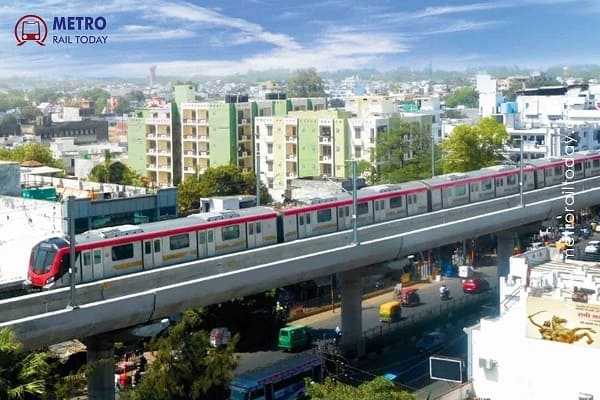
Lucknow, India (Metro Rail Today): The Lucknow Development Authority (LDA) had formally urged Uttar Pradesh Metro Rail Corporation (UPMRC) to extend the corridor up to Rashtra Prerna Sthal, stating that the move would enhance connectivity and allow residents and visitors to access the site conveniently without relying on private vehicles or intermediate modes of transport.
The UPMRC has clarified that no immediate alterations can be made to the proposed East–West Corridor of the Lucknow Metro, following a request from the LDA to extend the line by around three kilometres. However, UPMRC officials have indicated that the project is already at an advanced stage of planning and alignment finalisation. Any modification at this juncture would require a comprehensive re-evaluation of the project’s technical, financial and statutory parameters.
UPMRC Managing Director Sushil Kumar described the proposal as positive in intent but difficult to implement at this stage. He noted that clarity would emerge once the Detailed Project Report (DPR) is formally presented, but emphasised that executing such an extension in the current phase would be challenging.
Senior metro officials explained that any extension would necessitate initiating the entire statutory and technical process afresh. This would involve preparation of a new DPR, including feasibility studies, alignment planning, technical assessments, cost estimates and revised ridership projections. The DPR would then require approval from the Uttar Pradesh government, followed by financial appraisal and clearances from relevant authorities before being submitted to the Centre.
Officials further highlighted that extending the corridor would significantly increase the project’s cost. Additional civil works, possible land acquisition, signalling systems, station construction and other infrastructure components would need to be incorporated. Funding arrangements would also have to be restructured to accommodate the expanded scope.
Meanwhile, the East–West Corridor recently received a major boost after the Department of Economic Affairs under the Union Ministry of Finance granted in-principle approval for external borrowing of ₹2,883.93 crore. The approval enables UPMRC to raise funds from the New Development Bank (NDB), a multilateral institution established by BRICS nations. The loan will be backed by a sovereign guarantee from the Central government. The total estimated cost of the East–West Corridor stands at ₹5,801.05 crore.
Commenting on the development, Mrs. Mamta Shah, MD & CEO, Urban Infra Group, said, “Metro alignments must be finalised with long-term urban planning in mind. While last-mile extensions can enhance connectivity, changes at advanced stages often impact timelines and financing structures. A data-driven evaluation through the DPR process is essential to balance mobility benefits with fiscal prudence.”
The clarification from UPMRC underscores the structured and multi-layered approval framework governing metro expansion projects, particularly when external funding and sovereign guarantees are involved.

MRT Online Desk
Metro Rail Today is an authentic and global news provider for the Rail & Metro industry from and around the world.