

Trending Now
 Modern Trainlines and the End of Coal Trains: Why Rail Networks Have Moved Forward
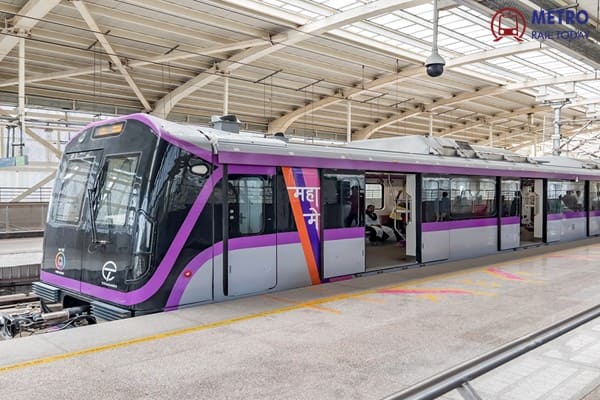 Siemens Bags Order from Titagarh Rail Systems for Pune Metro Extension Trainsets
 Titagarh Rail Systems becomes Corporate Member of Chamber of Railway Industries (Rail Chamber)
 World Bank approves ₹1,400 crore Civil Tender for Gurugram Metro Phase 2
 Bi-RIDE invites ₹200 crore Tender for Soladevanahalli Depot of Bengaluru Suburban Rail Project
 GHV India awarded ₹107.79 crore Civil Contract for Lucknow Metro East-West Corridor
 Pune Metro Line 3 set to launch First 12-km Section on 15 July 2026
 DMRC gets approval to Fell or Transplant 364 Trees for Central Vista Metro Corridor under Phase IV
 ₹4.5 Lakh crore Metro Rail Investment reaches less than 5% of Urban Population in India
 West Bengal plans to launch Water Metro Systems in Kolkata
Railway Ministry directs NHSRCL to prepare revised DPR for Delhi–Varanasi High Speed Rail Corridor
MRT Online Desk
Posted on: 2026-02-23 08:30:00
Viewer: 2,801
Comments: 0
Country: India
City: New Delhi
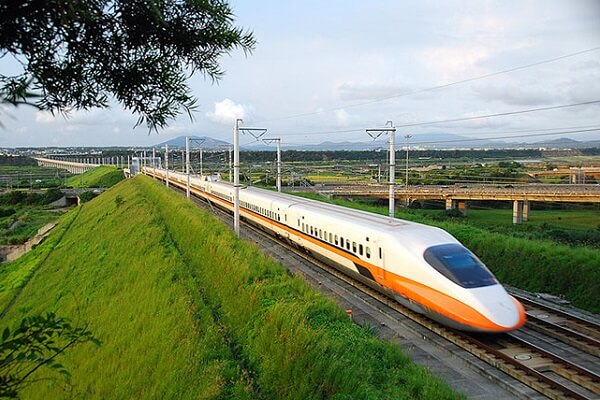
New Delhi, India (Metro Rail Today): The Delhi–Varanasi high-speed rail corridor has been identified as the first priority project among the seven bullet train corridors announced by the Government of India. The Railway Board has directed the National High-Speed Rail Corporation Limited (NHSRCL) to update the Detailed Project Report (DPR) originally prepared in 2021, paving the way for accelerated implementation.
The existing DPR outlines a route beginning at Sarai Kale Khan in Delhi and passing through 12 cities in Uttar Pradesh before reaching Varanasi. The proposed alignment includes Noida, Jewar, Mathura, Agra, Firozabad, Etawah, Kannauj, Lucknow, Ayodhya, Raebareli, Prayagraj and Bhadohi, creating a major high-speed connectivity spine across north and eastern Uttar Pradesh.
Railway Board officials believe that updating the earlier DPR will help minimize changes to proposed station locations and reduce delays in execution. NHSRCL teams have already visited Uttar Pradesh to finalize the location for the project office, indicating early groundwork for project rollout.
The renewed push follows Finance Minister Nirmala Sitharaman’s recent budget announcement reaffirming the government’s vision for seven high-speed rail corridors. The proposed corridors include Delhi–Varanasi, Varanasi–Siliguri, Mumbai–Pune, Pune–Hyderabad, Hyderabad–Chennai, Hyderabad–Bengaluru and Bengaluru–Chennai.
The government has estimated an overall investment of approximately ₹16 lakh crore for these projects, with trains expected to operate at speeds ranging between 250 km/h and 350 km/h. The Railway Board has instructed NHSRCL not only to update DPRs and conduct necessary surveys but also to prepare contract documentation to streamline tendering and execution.
To ensure uniformity and long-term sustainability, the Board has emphasized the development of common technical standards for all high-speed rail projects, with NHSRCL tasked with formulating and implementing these benchmarks. Dedicated core teams will be established for each corridor, and technical staff will undergo specialized training prior to deployment. NHSRCL will submit weekly progress reports to the Railway Board to facilitate timely decision-making and coordination.
Commenting on the development, Mrs. Mamta Shah, MD & CEO, Urban Infra Group, said, “Prioritising the Delhi–Varanasi corridor signals a decisive expansion of India’s high-speed rail ambition beyond the western corridor. The route traverses high-density urban, industrial and pilgrimage centres, offering strong ridership potential. However, synchronized planning in land acquisition, financing strategy and standardisation of technical systems will be crucial to translating this vision into time-bound execution.”
The move marks a significant step toward building a nationwide high-speed rail grid, aimed at transforming intercity mobility and strengthening economic integration across regions.


MRT Online Desk
Metro Rail Today is an authentic and global news provider for the Rail & Metro industry from and around the world.