

Trending Now
 AI-Powered Monitoring System to safeguard Mumbai–Ahmedabad Bullet Train Operations
 Kerala not submitted DPR to Centre for proposed Thiruvananthapuram–Kasaragod RRTS Corridor
 Telangana allocates ₹1,100 crore for Hyderabad Metro Expansion in 2026–27 Budget
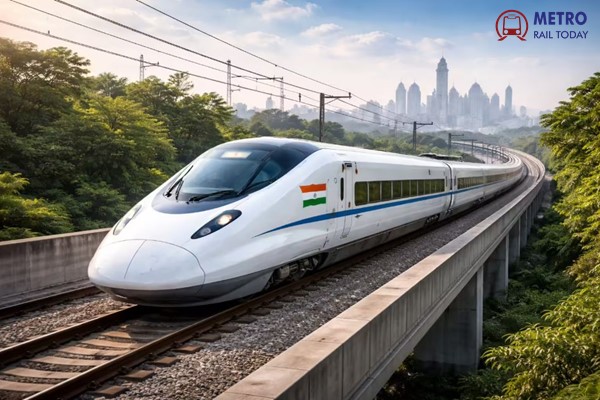 RITES bags ₹105.69 crore contract to maintain India’s First High-Speed Rail Test Track in Rajasthan
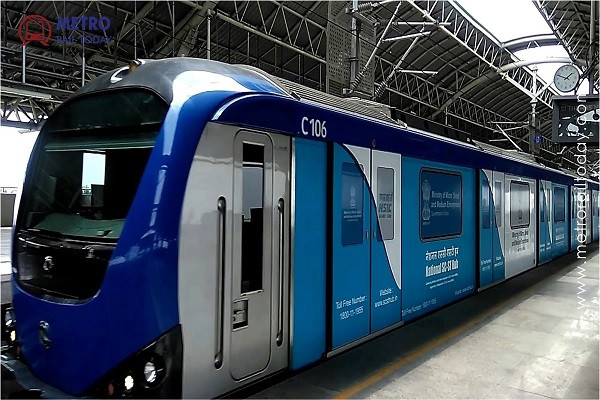 Airfloa Rail Technology awarded Rolling Stock Order for Chennai Metro Phase 2
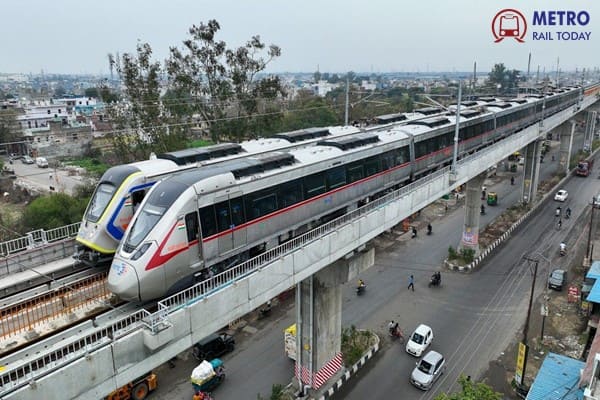 18 Metro Stations planned along Gurugram–Faridabad Namo Bharat RRTS Corridor
- BEML–Medha Consortium bids to supply 16 Trainsets for Mumbai–Ahmedabad Bullet Train Project
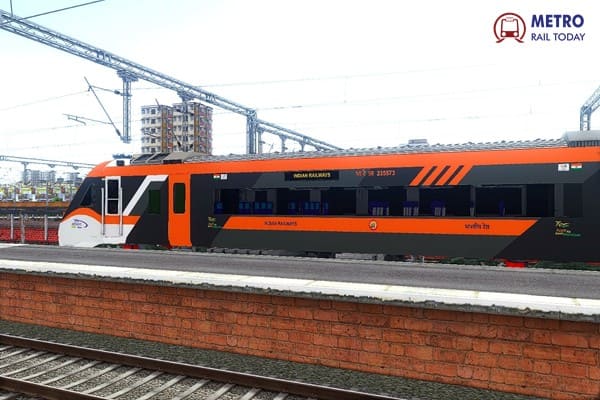 Indian Railways attracts $942 million FDI in 11 years as Rail Exports cross ₹26,000 Crore
 Konkan Railway, Aarvee Engineering join hands to expand Rail & Metro Infrastructure Projects
 CMRS completes Safety Inspection of Indore Metro Phase 2 Priority Corridor
AI-Powered Monitoring System to safeguard Mumbai–Ahmedabad Bullet Train Operations
MRT Online Desk
Posted on: 2026-03-19 14:06:00
Viewer: 89
Comments: 0
Country: India
City: New Delhi
New Delhi, India (Metro Rail Today): India’s first high-speed rail corridor between Mumbai and Ahmedabad will be equipped with an advanced AI-driven monitoring system designed to detect track defects and equipment failures in real time, significantly enhancing safety and predictive maintenance capabilities for trains running at speeds of up to 350 kmph.
The technology forms part of a Condition-Based Monitoring (CBM) system that uses sensors installed on high-speed trains to continuously assess track conditions and the health of critical onboard components. Developed by South Korea-based firm Globiz, the system was recently showcased at a railway technology event in Chennai, highlighting the next generation of digital safety solutions for high-speed rail networks.
Real-Time Monitoring of Track and Train Systems
The CBM system enables continuous monitoring of railway infrastructure and rolling stock through high-precision sensors mounted on train coaches. These sensors analyze vibrations, temperature patterns, and mechanical performance while trains operate at high speeds.
If abnormal vibrations are detected at a particular location, the system cross-verifies the data across multiple coaches. When several coaches report similar anomalies, the system automatically flags the specific section of track for inspection, enabling early identification of potential faults before they develop into serious defects.
In critical situations, the system can trigger an automatic speed reduction to around 20 kmph using the train’s braking system, while simultaneously alerting the driver through onboard display units and notifying maintenance teams.
Commenting on the significance of such technologies, Mrs. Mamta Shah, MD & CEO, Urban Infra Group, said, “Advanced digital monitoring systems will be fundamental to the safe operation of high-speed rail networks. AI-driven predictive maintenance solutions not only enhance safety but also optimize lifecycle costs by allowing operators to intervene before failures occur.”
Predictive Maintenance for High-Speed Rail
Beyond track monitoring, the system also continuously tracks the performance of critical train components such as bearings, gearboxes, traction motors, and door systems. By analyzing operational data and vibration patterns, the platform can predict potential component failures weeks in advance, allowing railway operators to carry out maintenance based on actual wear conditions rather than fixed replacement cycles.
According to Woo Seong Seo, Director at Globiz, the company is preparing to begin deliveries of the CBM system for the Mumbai–Ahmedabad high-speed rail project soon.
“We will start delivering the CBM system for India’s first high-speed rail from May. We are also in talks with the Integral Coach Factory and metro systems in the country,” Seo said.
For deployment in India, the technology has been specially adapted to handle harsher operating environments, including higher vibration levels and complex climatic conditions. The system is also designed to integrate with multiple telecommunications networks and cloud-based monitoring platforms, enabling centralized oversight of train operations and infrastructure health.
Enhancing Safety for India’s First Bullet Train
The 508-kilometre Mumbai–Ahmedabad High-Speed Rail corridor, being implemented by the National High-Speed Rail Corporation Limited (NHSRCL), is India’s first bullet train project and represents a major leap in the country’s railway modernization journey.
By incorporating advanced digital technologies such as AI-driven condition monitoring, the project aims to ensure world-class safety standards, reduced maintenance costs, and uninterrupted high-speed operations.
As India prepares to enter the era of high-speed rail, innovations like predictive monitoring systems will play a critical role in building a resilient, safe, and technologically advanced railway ecosystem capable of supporting next-generation mobility.

MRT Online Desk
Metro Rail Today is an authentic and global news provider for the Rail & Metro industry from and around the world.