

Trending Now
 Washington Metro celebrates its Golden Jubilee—50 years of passenger service
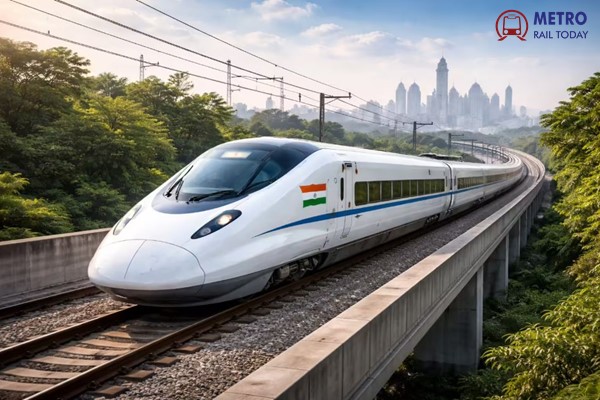 Two TBMs arrive in Mumbai for undersea tunneling on Mumbai-Ahmedabad Bullet Train Project
 Alstom awarded €915 million Rolling Stock Contract for Belgrade’s First Driverless Metro Line
 Bhopal Metro begins Signalling works to boost train frequency on Priority Corridor
 Elevated vs. Ground Trains: Which Is Better for Modern Travel?
 CMRS approves commencement of train operations on 11.5 km Indore Metro Extension
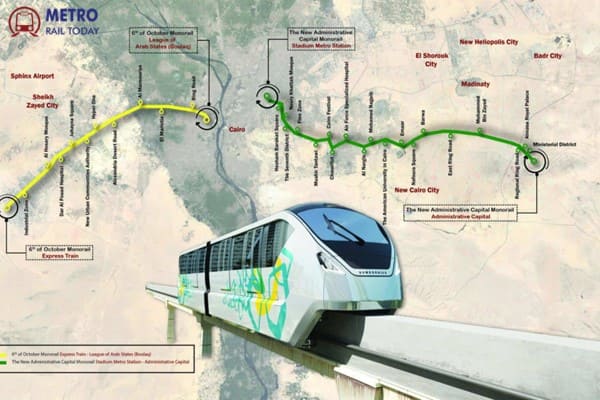 Egypt launches Africa’s longest 56.5-km East Nile Monorail Line in Cairo
 JICA signs ₹6,100 Crore Loan Agreement for Bangalore Metro Phase 3 Orange Line
 MTA launches RFP for procurement of 2,390 Metro Cars to modernize New York Metro
 Rail Chamber launches 2026–27 Membership Drive to strengthen India’s Railway Industry Ecosystem
Two TBMs arrive in Mumbai for undersea tunneling on Mumbai-Ahmedabad Bullet Train Project
MRT Online Desk
Posted on: 2026-03-23 17:25:00
Viewer: 588
Comments: 0
Country: India
City: Mumbai
Mumbai, India (Metro Rail Today): In a major boost to the Mumbai–Ahmedabad High-Speed Rail (MAHSR) project, two of India’s largest Tunnel Boring Machines (TBMs) have arrived at Jawaharlal Nehru Port, Mumbai, marking a critical milestone for the country’s first bullet train corridor. The arrival on March 23, 2026, comes after months of delays caused by geopolitical disruptions that had held up the equipment in China.
Manufactured by Germany-based Herrenknecht at its Guangzhou facility, the massive TBMs weigh nearly 3,000 tonnes each and feature a cutting diameter ranging from 13.1 to 13.65 metres, making them among the largest ever deployed for rail tunnelling in India.
Key Breakthrough for Underground Section
The TBMs were transported aboard the vessel LOA Fortune, which departed from Guangzhou on March 7, halted at Chennai, and reached Mumbai later in the month. Following unloading, the machine components will be transported using over 150 trailers to construction sites at Vikhroli and Savali.
Assembly and testing of the machines are expected to take approximately 90 days, with full-scale tunnelling operations scheduled to commence by July 2026.
These TBMs will be deployed to excavate the remaining 16.12 kilometres of the 21-kilometre underground stretch between Bandra-Kurla Complex (BKC) and Shilphata, one of the most technically challenging sections of the project.
Commenting on the development, Mrs. Mamta Shah, MD & CEO, Urban Infra Group, said, “The deployment of high-capacity TBMs for the Mumbai–Ahmedabad bullet train project represents a significant leap in India’s tunnelling capabilities. Complex infrastructure such as undersea tunnels requires advanced technology and precision engineering, and this milestone reflects the project’s steady progress toward global standards.”
India’s First Undersea Rail Tunnel
A key highlight of this underground stretch is the 7-kilometre undersea tunnel beneath Thane Creek, which will be India’s first subsea rail tunnel. The section is crucial for ensuring seamless connectivity through densely populated and environmentally sensitive zones in the Mumbai Metropolitan Region.
So far, approximately 4.88 kilometres of the tunnel has already been completed using the New Austrian Tunnelling Method (NATM). The arrival of TBMs is expected to significantly accelerate construction of the remaining section.
Rapid Progress Across the Corridor
The National High Speed Rail Corporation Limited (NHSRCL) reports substantial progress across the 508-kilometre Mumbai–Ahmedabad corridor. As of March 2026, around 341 kilometres of viaduct girder casting and 430 kilometres of pier construction have been completed.
The project is being executed in phases, with the first operational segment between Surat and Bilimora (50 km) targeted for commissioning by August 15, 2027. The entire corridor is expected to be completed by December 2029.
The Mumbai–Ahmedabad bullet train project is India’s flagship high-speed rail initiative, aimed at transforming intercity travel with speeds of up to 320 kmph and world-class infrastructure.
With tunnelling works set to accelerate in the coming months, the project is steadily moving closer to reshaping high-speed mobility in India, setting new benchmarks in engineering, technology, and execution.


MRT Online Desk
Metro Rail Today is an authentic and global news provider for the Rail & Metro industry from and around the world.