


Trending Now
 Siemens Bags Order from Titagarh Rail Systems for Pune Metro Extension Trainsets
 Titagarh Rail Systems becomes Corporate Member of Chamber of Railway Industries (Rail Chamber)
 World Bank approves ₹1,400 crore Civil Tender for Gurugram Metro Phase 2
 Bi-RIDE invites ₹200 crore Tender for Soladevanahalli Depot of Bengaluru Suburban Rail Project
 GHV India awarded ₹107.79 crore Civil Contract for Lucknow Metro East-West Corridor
 Pune Metro Line 3 set to launch First 12-km Section on 15 July 2026
 DMRC gets approval to Fell or Transplant 364 Trees for Central Vista Metro Corridor under Phase IV
 ₹4.5 Lakh crore Metro Rail Investment reaches less than 5% of Urban Population in India
 West Bengal plans to launch Water Metro Systems in Kolkata
- Titagarh Rail Systems targets full Indigenous Aluminium Coach Manufacturing by FY2027
Bangalore Metro commences first trial run of Driverless train on Yellow Line
MRT Online Desk
Posted on: 2024-03-08 07:00:00
Viewer: 1,971
Comments: 0
Country: India
City: Bengaluru
Bengaluru, India (Metro Rail Today): Bengaluru's vibrant tech hub, Electronics City, home to major corporations like Infosys and Biocon, is now on the verge of seamless Metro connectivity.
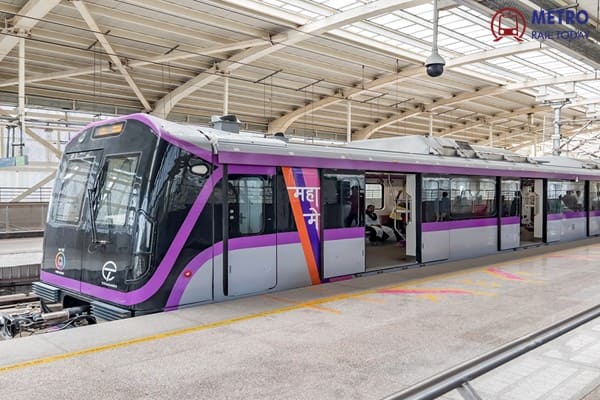
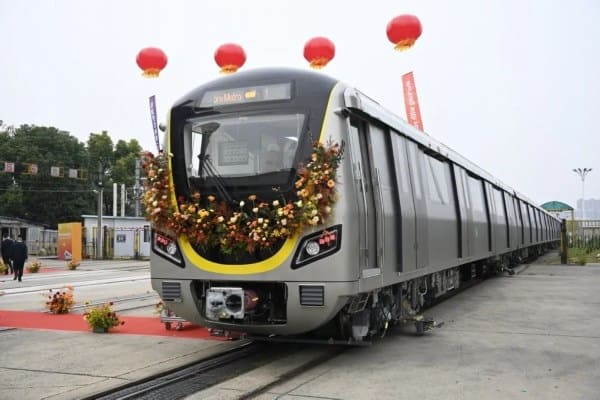
On March 7, the Bangalore Metro Rail Corporation Limited (BMRCL) marked a significant milestone by commencing slow trial runs on the Yellow Line, connecting Bommasandra to RV Road. Excitement rippled through the city as curious residents captured videos from their high-rises, eagerly anticipating the technological leap in their daily commutes.
"This marks the inaugural operation of a six-coach train on the main line of this new standalone corridor. The trial run spanned the section between Bommasandra and Bommanahalli stations on the Yellow Line," stated a BMRCL official.
The trial run, originating from Hebbagodi depot at 6:55 pm, maintained a steady speed of 10 kmph. Covering the stretch between Bommasandra and Bommanahalli stations, the train arrived at Bommasandra at 7:14 pm and Bommanahalli at 8:05 pm. On the return journey, it reached Bommasandra at 9:11 pm.
Traveling at a deliberate pace of 10-25 kmph, the trial assessed various parameters along the route, including the civil interface, track alignment, and more. Initial operations will see the train running at lower speeds, with plans to incrementally increase speed in the coming days.
Jithendra Jha, the project manager for rolling stock at BMRCL, announced, "We will conduct trial runs between Bommasandra and Central Silk Board using the prototype train that arrived from China on February 14 in the coming days. The trial run on the remaining Central Silk Board - RV Road section will commence in April."
The 18.8-km Bengaluru Metro's Yellow Line, linking RV Road with Bommasandra, initially aimed for operational readiness in 2021. However, BMRCL extended the deadline to December 2024.
The Yellow Line boasts 16 stations, strategically positioned to serve key areas such as Jayanagar, BTM Layout, HSR Layout, Electronics City, and Bommasandra Industrial Area. The line's significance lies in its potential to enhance connectivity for both residents and employees in these thriving neighborhoods.
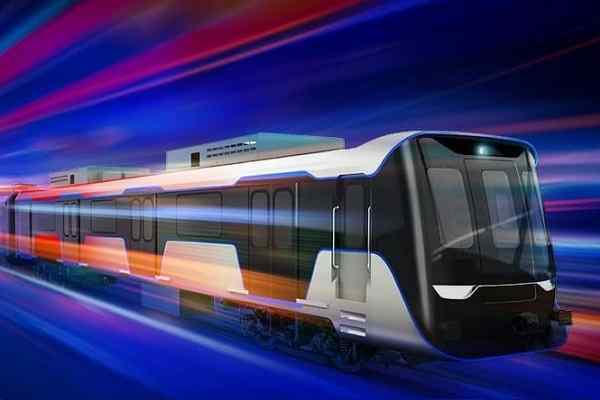
Equipped with the Communication-Based Train Control (CBTC) System, commonly known as 'Driverless Technology,' these trains aim to reduce headway to an impressive 90 seconds from the existing two and a half minutes. Despite their compatibility with driverless operations, BMRCL plans to deploy loco pilots initially.
A BMRCL official outlined the rigorous testing schedule, involving approximately 37 tests spanning four months, followed by system integration with signaling systems, telecommunication systems, power supply systems, and more for an additional 45 days.
Statutory safety tests, including oscillation trials by the Research Designs and Standards Organization (RDSO) and inspection by the Commissioner of Metro Rail Safety (CMRS), are integral to the process.
BMRCL intends to invite the Commissioner of Railway Safety (CRS) for safety clearance by October. Pending CMRS approval, operations are scheduled to commence by December 2024.
For oscillation trials, three trains will be necessary. "We will conduct 90% testing with this prototype train. Once we receive two more trains from Titagarh, we will initiate the remaining test runs with three trains."
In conclusion, Bengaluru's leap into the era of driverless metro technology signifies a promising future for efficient and rapid commuting, set to reshape the city's transportation landscape.

MRT Online Desk
Metro Rail Today is an authentic and global news provider for the Rail & Metro industry from and around the world.