


Trending Now
 RITES submits fresh DPR to UPMRC for ₹12,000 crore Prayagraj Metro Rail Project
 Paras Railtech wins ₹84.72 crore Ballastless Track Contract for Jaipur Metro Rail Project
 Indian Railways announces 3,548 Graduate-Level Vacancies under NTPC Recruitment 2026
 European Union sanctions €10 million to support extension of Hanoi Metro Line 3
 GMRC issues ₹683 crore Tender for construction of 8.68 km stretch for Ahmedabad Metro
- GMRC launches ₹439 crore Tender for construction of 5 New Ahmedabad Metro Stations
 Global tender issued for procurement of 60 Rolling Stock coaches for Hyderabad Metro Rail Project
 Global tender issued for procurement of 102 Rolling Stock coaches for Patna Metro Rail Project
 Gamuda awarded RM3.7 billion contract to build Keelung Mass Rapid Transit in Taiwan
 Maharashtra forms special Task Force to plan Rail, Metro and RRTS expansion
CAG flags major planning and financial irregularities in Bangalore Metro Phase 1 & 2
MRT Online Desk
Posted on: 2026-08-10 09:10:00
Viewer: 2,134
Comments: 0
Country: India
City: New Delhi
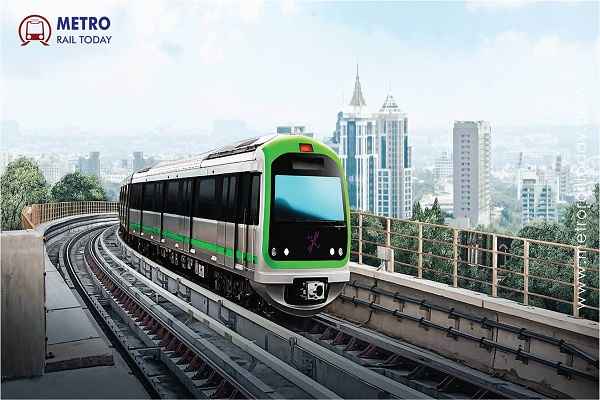
New Delhi, India (Rail & Metro Today): The Comptroller and Auditor General of India (CAG) has flagged significant deficiencies in the planning, land acquisition, project execution, financial management and operations of the Bangalore Metro Rail Project, raising concerns over ridership projections, land compensation, project costs and the financial sustainability of the system.
The findings are contained in CAG Performance Audit Report No. 7 of 2026, covering the implementation of Phase 1 and Phase 2 of the Bengaluru Metro by Bangalore Metro Rail Corporation Limited (BMRCL). The report was presented in Parliament on Monday.
BMRCL is a 50:50 joint venture between the Government of India and the Government of Karnataka.
Phase 1 and Phase 2 implementation under audit
Commercial operations of Bengaluru Metro Phase 1 began in stages from October 2011, with the entire 42.30-km network becoming operational by June 2017.
Phase 2 services commenced in stages between January 2021 and March 2023, covering 27.36 km, while the remaining works were scheduled for completion by December 2026.
The CAG audit examined planning, implementation, monitoring and operations of Phases 1 and 2. Phases 2A and 2B were excluded from the audit scope. The audit covered the period from the inception of the projects up to March 2021, while selected contracts were examined for physical and financial progress up to March 2023.
Phase 2 DPRs prepared without comprehensive mobility planning
One of the key observations concerns the preparation of the Phase 2 Detailed Project Reports (DPRs).
According to the CAG, the DPRs were prepared without a comprehensive mobility plan, transit-oriented development policy or land-use policy.
The audit also highlighted a major gap between projected and actual passenger demand. The Peak Hour Peak Direction Traffic (PHPDT) for Phase 1 in 2021 was found to be significantly below projections, ranging between 6,429 and 8,852 passengers.
The CAG noted that no study had established how ridership could be increased sufficiently to justify continued investment in a heavy metro system.
Ridership projections and revenue estimates questioned
The audit found that ridership figures used for calculating the Financial Internal Rate of Return (FIRR) and Economic Internal Rate of Return (EIRR) appeared to have been overestimated.
At the same time, BMRCL did not undertake a detailed study to determine the reasons behind lower-than-expected ridership.
The revenue gap was particularly significant. Between 2016-17 and 2022-23, BMRCL generated only ₹1,758.13 crore in actual farebox revenue, against projected fare revenue of ₹7,736.70 crore.
The CAG attributed the low ridership to several factors, including lack of integration with BMTC services, inadequate last-mile connectivity and insufficient parking facilities.
Land acquisition cost increased by ₹6,603 crore
Land acquisition emerged as one of the most significant areas of concern in the audit.
For Phase 1, BMRCL acquired 62.67 hectares, compared with the 45.24 hectares originally projected. For Phase 2, it acquired 145.16 hectares against a projected requirement of 165.09 hectares.
According to the CAG, improper land estimation and delays in acquisition contributed to an increase of ₹6,603.39 crore in land acquisition costs.
The audit also found instances where BMRCL applied non-agricultural land rates to agricultural land or added attributes applicable to converted land while determining compensation.
This resulted in excess payment of ₹294.72 crore in land compensation to landowners.
Additional ₹186.86 crore paid as interest
Delays in the land acquisition process also resulted in additional financial liability.
The CAG found that BMRCL paid ₹186.86 crore in additional compensation as interest at 12%, because final notifications for land acquisition were issued beyond the prescribed period of 270 days.
The findings underline the financial impact of delays in land acquisition, particularly on large urban rail projects where land costs form a substantial component of overall project expenditure.
Absence of procurement manual flagged
The CAG also pointed out weaknesses in BMRCL's procurement processes.
The corporation did not have a procurement manual, according to the audit.
In addition, taxes incorporated in the estimates of nine civil contracts resulted in an increase of ₹1,222.40 crore in project costs, further contributing to the financial burden of the metro projects.
BMRCL dependent on Karnataka government for debt servicing
The audit raised concerns about the financial sustainability of BMRCL, observing that the corporation remained completely dependent on the Karnataka government for servicing project debt because of inadequate revenues and continuous cash losses.
The substantial gap between projected and actual farebox revenue has further weakened the corporation's financial position.
The CAG's findings suggest that the financial assumptions underlying the projects did not sufficiently account for the challenges of generating passenger revenue at the projected levels.
Metro station commercial spaces remain largely vacant
The audit also identified shortcomings in BMRCL's efforts to generate non-fare revenue through property development.
Of the 2.46 lakh sq ft of built-up area developed at metro stations for property development, approximately 2.23 lakh sq ft remained vacant.
The vacant space resulted in an estimated loss of ₹38.53 crore in lease-rent revenue during 2019-22.
The finding highlights the unrealised potential of commercial development around metro stations as a supplementary source of revenue.
CAG highlights need for integrated urban mobility planning
The audit observations point towards a broader issue in Bengaluru's metro expansion—the need to integrate metro planning with the city's overall transport and land-use strategy.
The CAG's findings on ridership indicate that metro infrastructure alone may not generate expected passenger volumes unless supported by feeder services, seamless integration with BMTC, adequate parking, last-mile connectivity and coordinated urban development.
The report also highlights the importance of realistic demand forecasting, timely land acquisition, stronger procurement systems and effective utilisation of commercial assets.
For Bengaluru, which is continuing to expand its metro network under subsequent phases, the CAG findings could serve as an important reference for improving project planning, financial management and multimodal integration in future metro projects.


MRT Online Desk
Metro Rail Today is an authentic and global news provider for the Rail & Metro industry from and around the world.