

Trending Now
 DMRC seeks opportunity to take up operation and maintenance of the Kochi Metro Rail network
 New Zealand opens country's first Underground City Rail Link in Auckland
 Ireland approves construction of €15.7 billion Dublin MetroLink, tender to be launched soon
 India's Mumbai-Ahmedabad Bullet Train project completes construction of over 365 km Viaduct
 Metro Rail Expansion in India: 1,155 Km Network Across 26 Cities and the Road Ahead
 Mumbai BKC Pod Taxi project faces Architects’ concerns over cost, capacity and environment
 Railway Ministry approves ₹383.78 crore Vande Bharat Maintenance Depot at Tatanagar
 NCRTC announces Mega Recruitment Drive for Supervisors, IT, O&M and Technical Staff
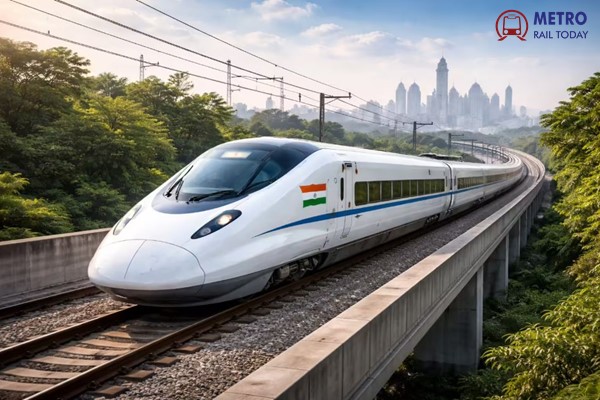 BEML wins ₹5,432 crore Rolling Stock Contract for Mumbai-Ahmedabad Bullet Train Project
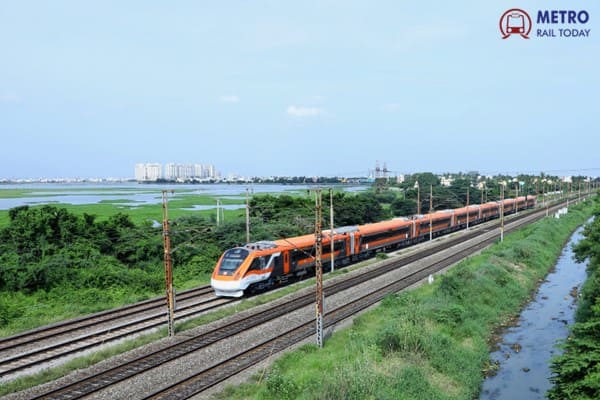 BHEL and Titagarh to create a Joint Venture for 35-year Vande Bharat Sleeper Trainset Maintenance
India's Mumbai-Ahmedabad Bullet Train project completes construction of over 365 km Viaduct
MRT Online Desk
Posted on: 2026-09-07 08:15:00
Viewer: 65
Comments: 0
Country: India
City: New Delhi
New Delhi, India (Rail & Metro Today): India’s first high-speed rail corridor has crossed another major construction milestone, with 365 km of viaduct completed on the 508-km Mumbai-Ahmedabad High-Speed Rail (MAHSR) corridor, according to the National High Speed Rail Corporation Limited (NHSRCL) progress report for August 2026.
The project, being developed to support train operations at speeds of up to 320 kmph, is progressing across Gujarat, Maharashtra and the Union Territory of Dadra and Nagar Haveli. The first passenger services are targeted for August 2027 on the initial Surat–Vapi section, while completion of the entire Mumbai–Ahmedabad corridor is targeted for December 2029.
MAHSR Construction Progress
NHSRCL’s August 2026 progress figures indicate that construction has advanced substantially across the corridor. About 455 km of pier work has been completed, while 365 km of viaduct is now ready.
The project has also recorded 299 km of noise barriers, along with the completion of 15 steel bridges and 17 river bridges. Four mountain tunnels have been excavated, while approximately 5 km of tunnel work has been completed using the New Austrian Tunnelling Method.
Track-related construction is also progressing. Around 222 km of reinforced concrete track bed has been completed, with 98 km of track slabs laid using CAM injection.
The electrification package has crossed another important milestone, with more than 9,100 overhead electrification (OHE) masts installed across 203 km. The complete corridor is planned to have more than 20,000 OHE masts.
These figures represent an increase over the July 2026 progress figures cited in Parliament, when pier work stood at 452 km, girder work at 356 km, track bed construction at 209 km and OHE mast installation at 190 km.
Surat–Vapi Section Targeted for First Operations
The initial passenger service is planned on the Surat–Vapi section, with the section expected to be completed before the first train trials.
Railway Minister Ashwini Vaishnaw has said that construction of the Vapi–Surat section is targeted for completion by December 2026, after which testing and commissioning activities would follow. The planned inaugural service in August 2027 is expected to cover around 100 km, while official project documentation identifies the section as approximately 97 km.
The Surat–Bilimora stretch has also been identified separately as an important section expected to enter service in 2027.
The MAHSR corridor is planned to open in phases. The sequence described in official project information includes the initial Vapi–Surat section, followed by Vapi–Ahmedabad, Thane–Ahmedabad and eventually the complete Mumbai–Ahmedabad corridor.
Indigenous High-Speed Trainset for Initial Services
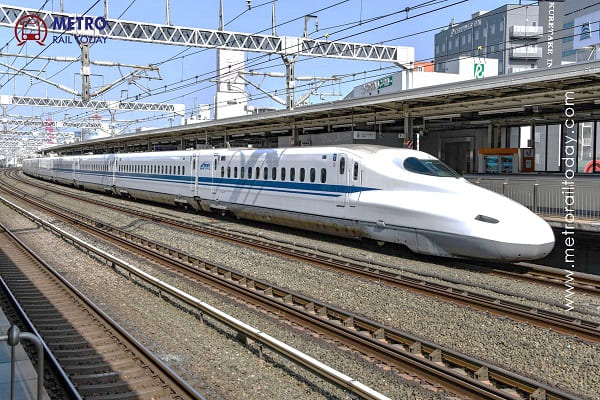
The first operations on the initial section are planned with India’s indigenous B28 high-speed trainset, which has been designed for a maximum test speed of 280 kmph.
BEML is manufacturing the trainset at its Aditya High-Speed Rail Complex in Bengaluru. The first body frame has reportedly been completed and sent for structural testing, with track trials expected around May–June 2027.
On 18 September 2026, BEML announced an order worth more than ₹5,400 crore from NHSRCL covering the supply and maintenance of high-speed rolling stock and allied works for the corridor. The Japanese E10 Shinkansen remains part of the longer-term rolling stock plan.
508-km Mumbai–Ahmedabad High-Speed Rail Corridor
The MAHSR corridor will connect Bandra Kurla Complex (BKC) in Mumbai with Sabarmati in Ahmedabad over approximately 508 km. The alignment passes through Maharashtra, Gujarat and the Union Territory of Dadra and Nagar Haveli.
Nearly 90% of the alignment is elevated, with the remainder comprising tunnels, bridges and station areas. One of the project's most technically significant components is the approximately 21-km Mumbai-side tunnel, which includes an undersea section beneath Thane Creek.
The corridor will have 12 stations:
Mumbai BKC, Thane, Virar, Boisar, Vapi, Bilimora, Surat, Bharuch, Vadodara, Anand, Ahmedabad and Sabarmati.
The trains are designed for speeds of up to 350 kmph, with commercial operations planned at up to 320 kmph. According to statements by the Railway Minister, the fastest service between Mumbai and Ahmedabad is planned to take approximately 1 hour 58 minutes with four stops, while a service stopping at all 12 stations would take around 2 hours 17 minutes.
2×25 kV High-Speed Electrification System
The MAHSR corridor will use India’s first 2×25 kV high-speed overhead traction system, designed for operations at up to 320 kmph.
Power will be supplied from the national grid through dedicated traction substations located along the corridor. More than 20,000 OHE masts are planned across the project, with over 9,100 already installed as of August 2026.
The high-speed electrification system is being developed as an integral part of the corridor’s signalling, track and rolling-stock requirements, enabling the railway to operate at substantially higher speeds than conventional Indian railway services.
Project Progress and Remaining Milestones
The Mumbai–Ahmedabad High-Speed Rail project was launched in 2017 and originally had a 2023 completion target. The schedule was subsequently affected by delays, including land acquisition issues in Maharashtra.
The project has since accelerated, with Gujarat recording substantial progress in stations and civil structures. Structural work has been completed at Sabarmati, Ahmedabad, Vadodara and Bharuch, while finishing and track-related works are progressing. Track work has also begun at Surat, Bilimora and Bharuch.
In Maharashtra, construction activity is progressing on piers, stations and the major tunnel package.
“The Mumbai–Ahmedabad High-Speed Rail project is establishing an entirely new technological and engineering ecosystem for India’s high-speed railway sector. The progress in viaducts, track systems and electrification demonstrates the scale of infrastructure being created, while the introduction of indigenous high-speed rolling stock could further strengthen domestic capabilities across design, manufacturing, testing and maintenance,” said Mrs. Mamta Shah, MD & CEO, Urban Infra Group.
The immediate focus is now on completing the Vapi–Surat construction package by December 2026, followed by testing and train trials targeted around May–June 2027. If the current schedule is maintained, the first passenger service could begin in August 2027, ahead of the targeted December 2029 completion of the full Mumbai–Ahmedabad corridor.
The MAHSR project is therefore moving from large-scale civil construction towards an increasingly integrated phase involving track, electrification, rolling stock, signalling, testing and commissioning. Its eventual commissioning will establish India’s first operational high-speed rail corridor and provide a new benchmark for future high-speed rail projects in the country.


MRT Online Desk
Metro Rail Today is an authentic and global news provider for the Rail & Metro industry from and around the world.