

Trending Now
 Alstom to deploy DTG Signalling System for Jaipur Metro’s 5.2-km Phase-1 Extension
 RVNL floats ₹297.45-crore Power Systems Tender for Kolkata Metro Purple Line
 Siemens Mobility awarded $772 million Trainset Contract for California High-Speed Rail Project
 RITES submits fresh DPR to UPMRC for ₹12,000 crore Prayagraj Metro Rail Project
 Paras Railtech wins ₹84.72 crore Ballastless Track Contract for Jaipur Metro Rail Project
 Indian Railways announces 3,548 Graduate-Level Vacancies under NTPC Recruitment 2026
 European Union sanctions €10 million to support extension of Hanoi Metro Line 3
 GMRC issues ₹683 crore Tender for construction of 8.68 km stretch for Ahmedabad Metro
- GMRC launches ₹439 crore Tender for construction of 5 New Ahmedabad Metro Stations
 Global tender issued for procurement of 60 Rolling Stock coaches for Hyderabad Metro Rail Project
Railway Ministry receives DPR for 1,500 km Delhi-Varanasi-Patna-Siliguri High Speed Rail Corridor
MRT Online Desk
Posted on: 2026-09-14 08:15:00
Viewer: 1,943
Comments: 0
Country: India
City: New Delhi
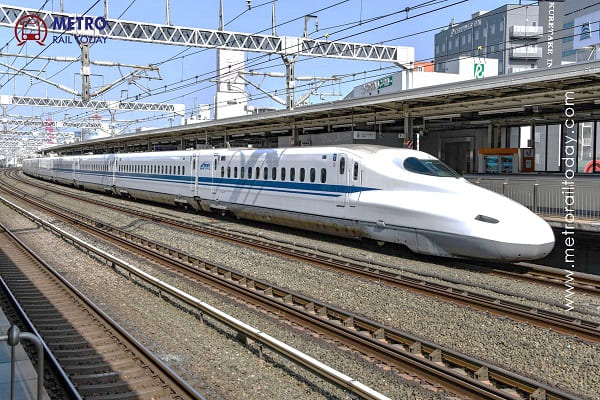
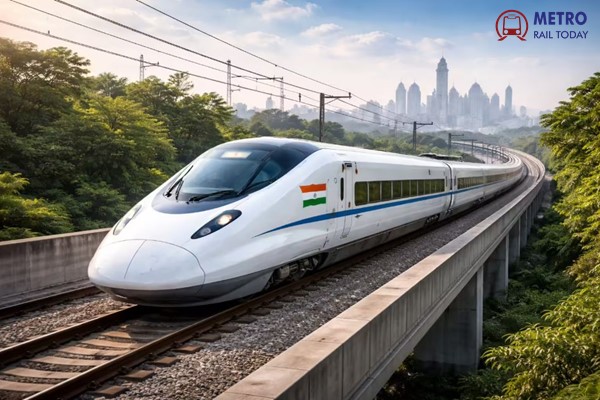
New Delhi, India (Rail & Metro Today): India’s proposed Delhi-Varanasi High-Speed Rail Corridor is moving towards a new phase of planning, with ground survey activities gathering pace following the submission of the Detailed Project Report (DPR) for the larger Delhi-Varanasi-Patna-Siliguri High-Speed Rail Corridor by the National High Speed Rail Corporation Limited (NHSRCL) to the Railway Ministry.
The proposed corridor is expected to become one of India’s most significant high-speed rail projects after the Mumbai-Ahmedabad High-Speed Rail Corridor. The government has identified the Varanasi route among the high-priority bullet train corridors, with the project planned for development in phases.
The first phase is centred on the Delhi-Varanasi section, while subsequent development is proposed towards Patna and Siliguri. Further progress will depend on government examination and approvals, including the required Cabinet approval.
Delhi-Varanasi Bullet Train to Cover Major Cities
The proposed Delhi-Varanasi high-speed rail corridor is planned to connect the national capital with several major urban, industrial, commercial and religious centres across Uttar Pradesh.
The alignment is proposed to begin at Sarai Kale Khan in Delhi and pass through the wider National Capital Region before connecting cities and regions including Noida, Jewar, Mathura, Agra, Etawah, Kanpur, Lucknow, Rae Bareli, Prayagraj, Bhadohi and Varanasi.
Preliminary planning for the wider Delhi-Varanasi-Patna-Siliguri corridor envisages a high-speed rail network extending deep into eastern India. The Delhi-Varanasi section is expected to significantly reduce the journey time between the two cities, with preliminary estimates indicating a travel time of around four hours.
An important feature of the proposed network is the potential connection to Jewar Airport, which could create an additional multimodal link between high-speed rail and one of the National Capital Region’s major emerging aviation hubs.
Delhi to Patna in Less Than Five Hours
The proposed expansion towards Bihar could further transform intercity connectivity in eastern India. Preliminary estimates suggest that a high-speed rail service could reduce the Delhi-Patna journey to around 4 hours 41 minutes, compared with more than 12 hours on many existing conventional rail services.
The Bihar section is expected to connect important urban centres, with locations such as Buxar, Ara, Patna, Mokama, Begusarai, Khagaria, Katihar and Kishanganj being considered in the broader planning process.
For Patna, station planning is particularly important because of the city's rapidly expanding metropolitan region. Locations around Phulwari Sharif and Bihta have reportedly emerged during preliminary assessments, although final station locations and project configurations will depend on the approved DPR and subsequent planning.
The potential connection with Bihta is also strategically significant because the area is emerging as an important aviation, industrial and urban development zone.
Ground Surveys Gain Momentum
NHSRCL has begun strengthening its field-level planning capabilities for the proposed high-speed rail corridor. A notification issued in September called for the deployment of senior railway technical officials for ground survey and project-related activities.
The fieldwork is expected to support detailed assessment of alignment, land requirements, engineering conditions and other project parameters across the proposed corridor.
Ground surveys and soil investigations are particularly important for high-speed rail because the infrastructure requires stringent standards for alignment, foundations, bridges, viaducts, tunnels, track systems and train operations.
Land acquisition is also likely to be one of the most important implementation challenges. Preliminary assessments have indicated substantial land requirements across the corridor, with acquisition and land-related preparations already being examined in parts of Uttar Pradesh and Bihar.
Potential Economic Impact Across the Corridor
According to Mrs. Mamta Shah, MD & CEO, Urban Infra Group, the significance of the proposed Delhi-Varanasi High-Speed Rail project extends beyond faster passenger journeys.
“The Delhi-Varanasi High-Speed Rail Corridor has the potential to reshape the economic geography of northern and eastern India. High-speed connectivity between Delhi, major cities of Uttar Pradesh and eventually Bihar can create stronger links between business centres, tourism destinations, educational institutions and emerging industrial clusters. The real value of the project will depend on how effectively stations are integrated with local transport systems and regional development.”
The corridor could have a particularly strong impact on tourism. Delhi, Agra, Ayodhya, Prayagraj, Varanasi and several other destinations along or near the proposed alignment attract large numbers of domestic and international visitors.
Faster rail connectivity could make it easier to combine multiple destinations within a single journey, potentially supporting hospitality, retail, local transport and other tourism-linked sectors.
High-Speed Rail and India's Growing Network
The Delhi-Varanasi project comes at a time when India is preparing to enter the operational era of high-speed rail through the Mumbai-Ahmedabad High-Speed Rail project.
The 508-km Mumbai-Ahmedabad corridor is currently under construction and is targeted to begin high-speed rail operations in 2027. Its experience in construction, systems integration, rolling stock, operations and maintenance is expected to provide valuable lessons for subsequent corridors.
India is also examining several other potential high-speed rail routes as part of its longer-term rail modernisation programme. The proposed Delhi-Varanasi corridor is particularly important because it could establish a high-speed rail connection across one of the country's most densely populated and economically significant regions.
Journey Times Could Transform Regional Mobility
The preliminary journey-time estimates illustrate the potential impact of high-speed rail on long-distance travel. A Delhi-Varanasi journey that currently requires many hours by conventional rail could potentially be completed in around four hours. Similarly, Delhi-Patna travel could potentially fall to less than five hours.
Such reductions could change travel behaviour significantly. Business travellers could undertake same-day journeys between major cities, while students, professionals and tourists could gain much faster access to opportunities in different urban centres.
The economic impact could extend beyond major cities as well. Smaller urban centres connected to the high-speed rail network could benefit from improved accessibility, new investment and greater integration with larger regional economies.
Looking Towards Siliguri and Beyond
The longer-term vision extends beyond Varanasi and Patna towards Siliguri, creating a high-speed rail spine connecting Delhi with eastern India and the strategic gateway to the Northeast.
The wider Delhi-Varanasi-Patna-Siliguri corridor is expected to cover more than 1,500 km under the current planning concept. There has also been discussion about the possibility of eventually extending high-speed rail connectivity beyond Siliguri towards Guwahati, although such an extension would require separate planning and approvals.
For now, the immediate focus remains on surveys, technical assessments, land requirements and government consideration of the DPR.
A Major Test for India's High-Speed Rail Ambition
The proposed Delhi-Varanasi High-Speed Rail Corridor represents an important next step in India's ambition to develop a nationwide high-speed rail network. Its significance lies not only in reducing travel time but also in creating stronger economic and social connections between some of India's most important cities.
As ground surveys accelerate and the DPR moves through the approval process, the project is entering a crucial preparatory stage. If approved and implemented as planned, the Delhi-Varanasi corridor could become a cornerstone of India's emerging high-speed rail network and eventually provide the foundation for faster connectivity from the national capital to Varanasi, Patna, Siliguri and potentially the Northeast.


MRT Online Desk
Metro Rail Today is an authentic and global news provider for the Rail & Metro industry from and around the world.