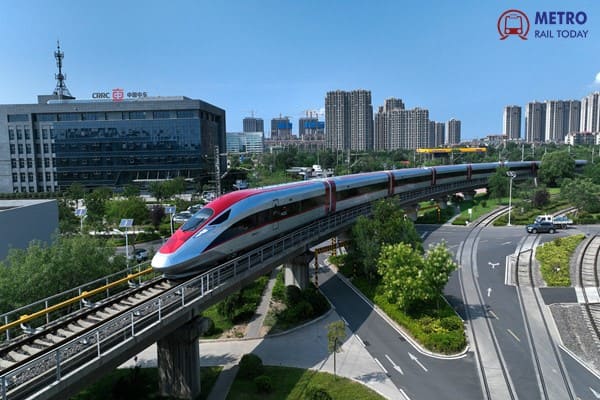


Trending Now
 RATP Dev–ComfortDelGro JV signs Operations & Maintenance Contract for Copenhagen Metro
 Rail Chamber explores India–Czech Railway Industry Partnerships at New Delhi Business Forum
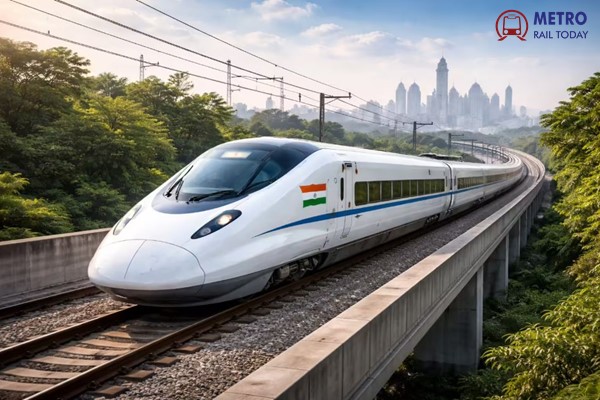 India must prove Safety before running different Bullet Train Systems on One Corridor: JTTRI Chief
 Tender issued for Feasibility Study to Transition Hubballi-Dharwad BRTS to Modern Tram System
 Tamil Nadu Chief Minister seeks Centre’s approval for Bengaluru–Hosur Metro Link
 K-RIDE to appoint Detailed Design Consultant for Bengaluru Suburban Rail Project
 Prime Minister Narendra Modi inaugurates first 15-km stretch of Chennai Metro Phase 2
 Karnataka proposes 270-km RRTS Network linking Bengaluru with Tumakuru, Mysuru and KGF
 Alstom and Vingroup sign MoU to supply up to 200 Metro Trains for Hanoi Urban Rail Projects
 Afcons Infrastructure wins ₹1,383 crore Civil Contract for Lucknow Metro Phase 1B Corridor
India must prove Safety before running different Bullet Train Systems on One Corridor: JTTRI Chief
MRT Online Desk
Posted on: 2026-10-12 06:30:00
Viewer: 449
Comments: 0
Country: India
City: New Delhi
New Delhi, India (Rail & Metro Today): India must demonstrate the safety and reliability of operating domestically manufactured and Japanese-imported bullet trains, along with their respective signalling systems, before considering their use on the same high-speed rail corridor, according to Masafumi Shukuri, Chairman of the Japan Transport and Tourism Research Institute (JTTRI) and the International High-Speed Rail Association (IHRA).
Speaking to the media on the sidelines of the Kautilya Economic Conclave earlier this month, Shukuri emphasised that safety must remain the overriding priority as India advances its ambitious high-speed rail programme. He said there was no established precedent, in his view, for operating two different high-speed rail systems on the same line and that the proposed arrangement would need to be proven safe through appropriate testing.
Shukuri also stressed that high-speed rail should be treated as an integrated system rather than simply a combination of trains, tracks and signalling equipment. Civil infrastructure, rolling stock, signalling, maintenance, workforce training and operational management must work together to deliver the levels of safety and reliability expected from services running at speeds of around 300 kmph.
Safety First in India’s Bullet Train Programme
India is developing its first high-speed rail corridor between Mumbai and Ahmedabad, a project spanning approximately 500 kilometres. As India plans the commissioning of a priority section using domestically manufactured bullet trains, questions have emerged about how these trains and their signalling systems would operate alongside the Japanese technology originally associated with the project.
Shukuri said prioritising a section to meet India's schedule was understandable. However, he underlined that commissioning the infrastructure and procuring trains would not, by themselves, be sufficient to ensure operational readiness.
Passengers should be able to board a high-speed train knowing that they can complete a journey of around 500 kilometres in approximately two hours without concerns about safety or reliability, he said. Achieving that objective requires the timely training of personnel, the development of appropriate technical skills and know-how, and sufficient trials to establish the performance of the final commissioned train.
Representing IHRA, Shukuri highlighted the principle of “crash avoidance” as fundamental to high-speed railway operations. The objective, he explained, must be to prevent collisions through a system designed around safety at every level.
Can Two Different Bullet Train Systems Share One Corridor?
The possible operation of two types of bullet trains with different signalling systems on a single high-speed rail corridor was one of the central issues addressed in the interview.
According to Shukuri, there has been no prior case of a high-speed railway operating a mixture of two different systems on the same line. He cautioned that whether such an arrangement could operate safely would have to be demonstrated rather than assumed.
“If you are looking at this kind of situation where there is any kind of uncertainty and we have two different systems, then to have a rolling stock running at 300 km per hour with people in it, is not possible, in my view,” he said.
He added that safety must be established through proof and testing. In his assessment, one of the systems would eventually need to be adopted rather than continuing with both. However, he declined to express a preference for either the domestically manufactured or Japanese system, saying the decision would depend on discussions between the parties directly involved and the governments of India and Japan.
His remarks underline the importance of resolving technical and operational compatibility questions before any decision is taken on running different high-speed train technologies on the same corridor. The interview does not establish that a final decision on the choice of rolling stock or signalling system has been made.
The Total Systems Approach to High-Speed Rail
Beyond the choice of trains, Shukuri emphasised the importance of what he described as the “Total Systems Approach”. Under this approach, every element of a high-speed railway must be planned, tested and operated as part of a single integrated system.
The principal components include civil works, tracks, signalling and rolling stock. These must be supported by effective maintenance arrangements, trained personnel and appropriate management systems.
Shukuri argued that a high-speed railway cannot deliver safe and reliable operations unless all these components function together. A technically advanced train alone is not enough; the wider infrastructure and operational framework must also be capable of supporting it.
Workforce preparation is particularly important as India develops the expertise required to operate high-speed services. Personnel must possess the necessary technical knowledge and practical skills, while trials must demonstrate that the completed train and associated systems perform as intended.
Shukuri said Japanese technology and experience would have an important role to play in this process. He also cautioned that the commissioning of the priority section should be viewed as only the beginning of a larger programme, with substantial work still required to establish the complete operating system.
Shukuri Defends the Project Timeline
Shukuri also offered a perspective on the pace of the Mumbai–Ahmedabad high-speed rail project, rejecting the suggestion that its progress should be judged without considering its scale and complexity.
The project was agreed upon by Prime Minister Narendra Modi and Japan’s then Prime Minister Shinzo Abe in December 2015. IHRA, established in 2014, had been visiting India and engaging with potential stakeholders on high-speed rail even before the project was formally announced by the two leaders.
Shukuri said the construction of a roughly 500-kilometre high-speed railway, being undertaken for the first time in India, was a massive undertaking that could not reasonably be expected to be completed within just a few years.
He also cited the disruption caused by the COVID-19 pandemic and challenges such as delays in land acquisition. In his view, these factors needed to be considered when assessing the project’s progress.
Japan’s own experience provides an important perspective, he said. The country’s first high-speed railway began operating in 1964, giving it more than six decades of experience in constructing and operating such systems. Shukuri observed that even in present-day Japan, building a new 500-kilometre high-speed rail line would not be achievable within 10 years.
He therefore considered the Indian project to be progressing strongly despite the challenges encountered along the way.
Choosing a System for Safe and Reliable Operations
Shukuri was also asked about remarks reportedly made earlier in the year by former Japanese minister Hideki Makihara, who attributed delays in the Indian bullet train project to problems on the Indian side. Shukuri said he had not personally read Makihara’s exact comments and therefore preferred not to comment on them.
Instead, he focused on the broader requirements for successful high-speed rail operations: safety, reliability, technical compatibility and an integrated operating framework.
His central message was that India’s high-speed rail ambitions must be supported by a proven system in which trains, signalling, infrastructure, maintenance and personnel work together. The question of whether different rolling stock and signalling technologies can safely operate on the same corridor must be resolved through evidence and testing.
As India moves towards commissioning its priority high-speed rail section, the choice of technology and the readiness of the entire operating system will be critical. Shukuri’s comments place the emphasis firmly on demonstrating safety before introducing high-speed services, with the eventual choice of system left to the relevant stakeholders and the governments of India and Japan.

MRT Online Desk
Metro Rail Today is an authentic and global news provider for the Rail & Metro industry from and around the world.