


Trending Now
 Siemens Bags Order from Titagarh Rail Systems for Pune Metro Extension Trainsets
 Titagarh Rail Systems becomes Corporate Member of Chamber of Railway Industries (Rail Chamber)
 World Bank approves ₹1,400 crore Civil Tender for Gurugram Metro Phase 2
 Bi-RIDE invites ₹200 crore Tender for Soladevanahalli Depot of Bengaluru Suburban Rail Project
 GHV India awarded ₹107.79 crore Civil Contract for Lucknow Metro East-West Corridor
 Pune Metro Line 3 set to launch First 12-km Section on 15 July 2026
 DMRC gets approval to Fell or Transplant 364 Trees for Central Vista Metro Corridor under Phase IV
 ₹4.5 Lakh crore Metro Rail Investment reaches less than 5% of Urban Population in India
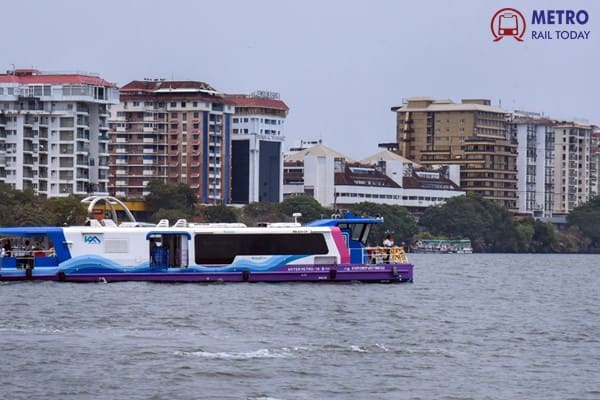 West Bengal plans to launch Water Metro Systems in Kolkata
- Titagarh Rail Systems targets full Indigenous Aluminium Coach Manufacturing by FY2027
Construction begins on Delhi Metro Phase 4's Saket G Block–Lajpat Nagar Corridor
MRT Online Desk
Posted on: 2025-12-12 16:45:00
Viewer: 1,562
Comments: 0
Country: India
City: New Delhi
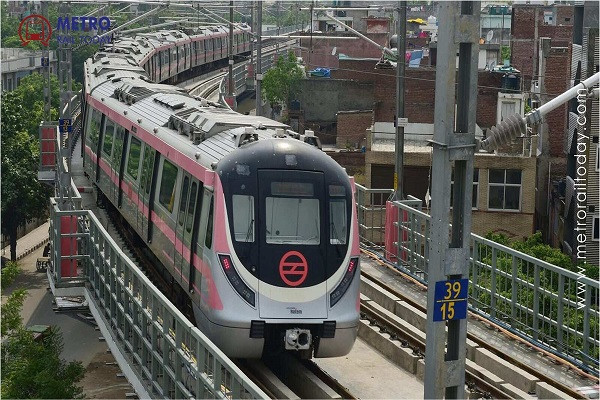
New Delhi, India (Metro Rail Today): The Delhi Metro Rail Corporation Limited (DMRC) has formally commenced construction work on the Saket G Block–Lajpat Nagar corridor, marking a major milestone in Phase-IV of the Delhi Metro project. This is the first corridor beyond the Phase-IV priority sections where physical construction activity has begun, signaling steady progress in expanding the capital’s metro network.
The First Test Pile and Ground Breaking Ceremony for the corridor—part of the Golden Line (Line-11)—was held at Pushpa Bhawan near Saket, laying the foundation for full-scale civil works.
The ceremony was attended by Dr. Vikas Kumar, Managing Director, DMRC, along with senior officials from DMRC and Rail Vikas Nigam Limited (RVNL), which has been appointed as the contractor for this section.
The Lajpat Nagar–Saket G Block corridor will be an elevated metro line and will feature eight stations, namely:
-
Lajpat Nagar
-
Andrews Ganj
-
Greater Kailash-1
-
Chirag Delhi
-
Pushpa Bhawan
-
Saket District Centre
-
Pushp Vihar
-
Saket G Block
Once operational, the corridor will significantly improve metro accessibility across South Delhi, benefitting residential areas, educational institutions, government offices, and commercial hubs.
Strategic connectivity and interchange benefits
The Golden Line corridor has been designed as a vital east–west link in South Delhi, ensuring seamless integration with the existing metro network:
-
Chirag Delhi station will connect with the Magenta Line
-
Lajpat Nagar station will provide interchange with both the Violet Line and Pink Line
With these connections, Lajpat Nagar is set to emerge as a triple interchange station, enhancing network flexibility and reducing travel time for thousands of daily commuters.
DMRC officials said the commencement of piling work represents the transition from planning to execution, reinforcing Delhi Metro’s commitment to sustainable, high-capacity public transport. The corridor is expected to ease road congestion, lower vehicular emissions, and support transit-oriented development in South Delhi.
Important localities such as Greater Kailash-1, Greater Kailash, Saket, Pushp Vihar, and surrounding areas will gain direct metro connectivity for the first time, making daily commuting faster and more reliable.
Other Phase-IV corridors progressing
In addition to the Golden Line, the other two Phase-IV corridors are also advancing through preparatory stages:
-
Inderlok–Indraprastha corridor
-
Rithala–Narela corridor
DMRC confirmed that tendering processes and pre-construction activities for these corridors are currently underway.
Commenting on the start of construction, Mrs. Mamta Shah, MD & CEO, Urban Infra Group, said: “The commencement of civil works on the Saket G Block–Lajpat Nagar corridor reflects DMRC’s disciplined project execution approach. Phase-IV will play a crucial role in strengthening last-mile connectivity and creating high-capacity transit links in dense urban zones, especially in South Delhi where travel demand continues to rise.”
Since its inception, DMRC has remained at the forefront of urban mobility transformation in India, setting global benchmarks in safety, punctuality, and project delivery. The Phase-IV expansion is expected to further enhance Delhi’s metro footprint, making public transport more accessible, efficient, and environmentally sustainable.


MRT Online Desk
Metro Rail Today is an authentic and global news provider for the Rail & Metro industry from and around the world.