


Trending Now
 Siemens Bags Order from Titagarh Rail Systems for Pune Metro Extension Trainsets
 Titagarh Rail Systems becomes Corporate Member of Chamber of Railway Industries (Rail Chamber)
 World Bank approves ₹1,400 crore Civil Tender for Gurugram Metro Phase 2
 Bi-RIDE invites ₹200 crore Tender for Soladevanahalli Depot of Bengaluru Suburban Rail Project
 GHV India awarded ₹107.79 crore Civil Contract for Lucknow Metro East-West Corridor
 Pune Metro Line 3 set to launch First 12-km Section on 15 July 2026
 DMRC gets approval to Fell or Transplant 364 Trees for Central Vista Metro Corridor under Phase IV
 ₹4.5 Lakh crore Metro Rail Investment reaches less than 5% of Urban Population in India
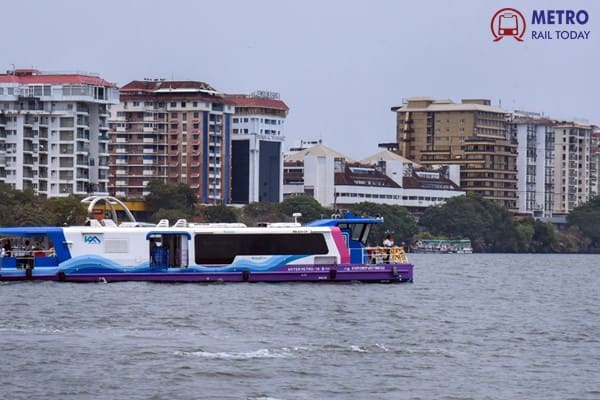 West Bengal plans to launch Water Metro Systems in Kolkata
- Titagarh Rail Systems targets full Indigenous Aluminium Coach Manufacturing by FY2027
Deepest tunnel breakthrough recorded on Golden Line of Delhi Metro Phase 4 Project
MRT Online Desk
Posted on: 2025-03-18 16:15:00
Viewer: 1,605
Comments: 0
Country: India
City: New Delhi
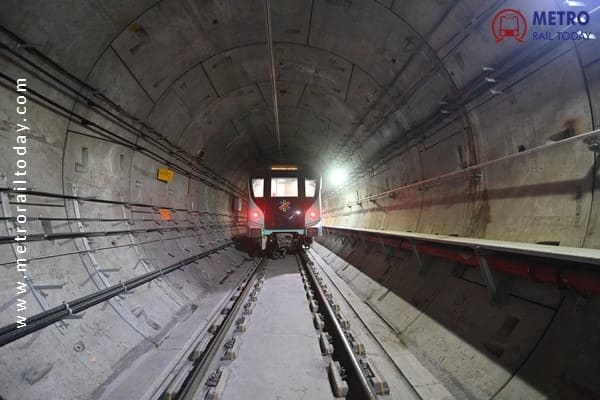
New Delhi, India (Metro Rail Today): The Delhi Metro Rail Corporation (DMRC) has achieved a significant milestone in the construction of Phase 4, completing the tunnelling work on the deepest underground stretch of the project. This remarkable achievement occurred with the breakthrough of a tunnel boring machine (TBM) at the IGNOU station site on the Aerocity-Tughlakabad corridor (Golden Line).
The historic breakthrough was celebrated in the presence of the Chief Minister of Delhi, Smt. Rekha Gupta, along with Delhi’s Minister of Industries, Food & Supplies and Environment, Forest & Wildlife, Manjinder Singh Sirsa.
This new tunnel, constructed at an average depth of approximately 27 meters (with a minimum depth of 15 meters and a maximum depth of 39 meters), is one of the deepest tunnels in the Delhi Metro network. The completion of this stretch follows the recent completion of a parallel tunnel between Chhatarpur Mandir and IGNOU on February 25, 2025. With both up and down lines now completed, DMRC has overcome a major challenge in Phase 4’s underground construction.
Notably, the depth of the tunnel surpasses the Magenta Line’s tunnel at Hauz Khas (about 30 meters deep), while the Airport Express Line tunnel below Rajiv Chowk Metro station reaches a depth of around 45 meters.
Key Details of the Tunnel Construction
A total of 1,048 tunnel rings with an inner diameter of 5.8 meters were installed to complete the 1,460-meter-long tunnel. The tunnel was built using the Earth Pressure Balancing Method (EPBM), a proven technique in tunnelling, with the rings cast at a fully mechanized yard in Mundka. The precast concrete segments were steam-cured to ensure early strength.
The tunnelling work faced several challenges, including a steep gradient and varied geological conditions that included mica and hard rock. These challenges caused damage to the screw auger, which was replaced during the drive. Despite these hurdles, all necessary safety precautions were taken during construction, especially as the tunnel ran beneath existing viaducts and built-up structures. Ground movements were carefully monitored with sensitive instruments to prevent any settlement in surrounding areas.
Recent TBM Breakthroughs Highlight Rapid Progress
The breakthrough at IGNOU station is the third successful TBM breakthrough within just four weeks, marking the swift progress of Phase 4’s underground work. Here is a summary of recent breakthroughs:
- February 25, 2025: IGNOU, Aerocity-Tughlakabad Corridor, 1,475 meters
- March 6, 2025: Vasant Kunj, Aerocity-Tughlakabad Corridor, 1,550 meters
- March 18, 2025: IGNOU, Aerocity-Tughlakabad Corridor, 1,460 meters
As part of Phase 4, DMRC is constructing 40.109 kilometers of underground lines, with the Aerocity-Tughlakabad corridor contributing 19.343 kilometers of underground sections.
The Role of Tunnel Boring Machines (TBMs)
A TBM is a large, mechanized machine designed to excavate tunnels with a circular cross-section through different soil and rock strata. These machines have revolutionized tunnel construction, particularly in urban areas where surface disruption must be minimized. Since Phase 1, DMRC has relied on TBMs for efficient underground tunnelling, with around 30 TBMs deployed for Phase 3 alone, covering approximately 50 kilometers of underground sections.
The successful completion of this challenging tunnel breakthrough at IGNOU Station not only underscores DMRC’s commitment to advancing the city’s metro infrastructure but also marks a significant step toward completing the transformative Phase 4 project, which will further enhance connectivity and ease of travel in Delhi.


MRT Online Desk
Metro Rail Today is an authentic and global news provider for the Rail & Metro industry from and around the world.