

Trending Now
 TBM Servarayan achieves Tunnel Breakthrough on Corridor 3 of Chennai Metro Phase 2
 India targets 350 kmph Indigenous Bullet Train to accelerate High-Speed Rail ambitions
 RTA invites bids for $9.2 billion Dubai Metro's Gold Line Expansion Project
 ICT–RINA JV awarded Design Consultancy Contract for Jaipur Metro Phase 2
 J. Kumar Infraprojects achieves TBM Breakthrough at Mahipalpur for Delhi Metro Phase IV
- DPR submitted for 671 km Hyderabad–Pune–Mumbai High-Speed Rail Corridor
 Former Railway Board Member Anil Kumar Khandelwal Joins Advisory Board of Rail Chamber
 Govt proposes 270-km Orbital Rail Corridor to transform Regional connectivity in Delhi-NCR
 Tamil Nadu approves ₹9,335 Crore Chennai Airport–Kilambakkam Metro Corridor
 NCRTC to appoint General Consultant for Delhi–Panipat–Karnal Namo Bharat RRTS Corridor
First Time in India: Namo Bharat and Meerut Metro to Share Tracks in Landmark Transit Model
MRT Online Desk
Posted on: 2025-05-21 08:10:00
Viewer: 2,552
Comments: 0
Country: India
City: Lucknow

Meerut, India (Metro Rail Today): In a landmark development for Indian public transportation, Namo Bharat, the semi-high-speed rail connecting Delhi, Ghaziabad, and Meerut, and the newly developed Meerut Metro, will soon begin operating on a shared infrastructure network. This first-of-its-kind integration in the country marks a major step forward in multimodal connectivity and urban transit innovation.
The initiative, led by the National Capital Region Transport Corporation (NCRTC), is designed to provide seamless, efficient, and commuter-friendly travel across the National Capital Region. With both systems running on the same tracks, supported by a unified operations and safety ecosystem, the project promises to revolutionize mobility for lakhs of daily commuters.
Namo Bharat currently operates at an operational speed of 160 kmph between New Ashok Nagar in Delhi and Meerut South. The Meerut Metro, with a top operational speed of 120 kmph, will soon begin service across a 23-kilometre stretch from Meerut South to Modipuram Depot, covering 13 stations. This ambitious integration is not only the first in India but is also expected to serve as a model for other cities nationwide.
To ensure smooth operations on shared tracks, NCRTC has developed a detailed timetable, with Namo Bharat services currently running every 15 minutes, and expected to increase to every 10 minutes once the full 82-kilometre corridor from Sarai Kale Khan to Modipuram becomes operational. Meerut Metro services will run every seven minutes. Both systems will be managed through a centralized Operations Control Centre, which uses the European Train Control System (ETCS) Level-2 over an LTE backbone—a global first.
The system also integrates Automatic Train Protection (ATP), Automatic Train Supervision (ATS), and Platform Screen Doors (PSD), ensuring precision scheduling, enhanced safety, and improved operational reliability. ATP ensures compliance with speed limits and signals, while ATS manages service frequency and coordination between services. PSDs, directly linked with ETCS, enhance passenger safety at platforms.
One of the most commuter-centric features of the project is the design of key interchange stations such as Meerut South, Shatabdi Nagar, Begumpul, and Modipuram. These stations feature island platforms, where Namo Bharat and Meerut Metro trains arrive on opposite sides. This design enables effortless transfers without requiring passengers to use stairs, lifts, or escalators. For instance, a passenger traveling from Modinagar North to Meerut North can board a Namo Bharat train and transfer to the metro at Begumpul without changing platforms. A single ticket will suffice for the entire journey, eliminating the need for separate bookings.
Ticketing has been designed to offer maximum flexibility and convenience. Tickets can be purchased from counters, vending machines supporting cashless payments, or via the Namo Bharat Connect mobile app, which also offers journey planning features. Integrated ticketing across Delhi Metro, Namo Bharat, and Indian Railways is being enabled through partnerships with DMRC and IRCTC. In the near future, commuters will also be able to book through the IRCTC app, streamlining multimodal journeys across the NCR.
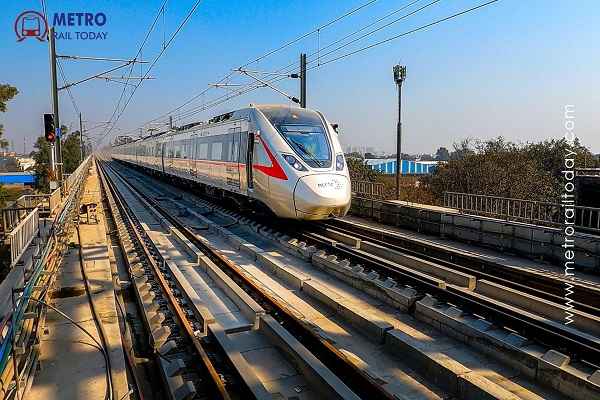
Namo Bharat trains are comprised of six coaches, with the first coach designated as a premium class and the second reserved for women. The Meerut Metro, operating with three coaches per train, includes dedicated seating for women, senior citizens, and differently-abled passengers. The trains are visually distinguished by their color schemes—maroon stripes for Namo Bharat and parrot green for Meerut Metro—ensuring clear identification by commuters.
The 82-kilometre Delhi-Ghaziabad-Meerut corridor includes 16 Namo Bharat stations. The 23-kilometre Meerut Metro stretch covers 13 stations, with an average travel time of 30 minutes across its route. Interchange points are located at Meerut South, Shatabdi Nagar, Begumpul, and Modipuram. Notably, Begumpul, Meerut Central, and Bhaisali stations are constructed underground, while the rest are elevated, except for Modipuram Depot, which is at grade.
To further enhance connectivity, the project integrates with Indian Railways, local bus depots, and other metro systems at strategic nodes. Special attention has been paid to the design and layout of key stations to facilitate easy multimodal transfers and ensure barrier-free access for all.
Welcoming this innovation, Mrs. Mamta Shah, Managing Director and CEO of Urban Infra Group, emphasized the broader impact of the shared infrastructure model on urban development and smart mobility. “This shared infrastructure model is not only a technological breakthrough but also a blueprint for efficient urban mobility. It demonstrates how intelligent design and digital integration can improve public transit experiences, reduce carbon footprint, and make cities more liveable. Urban Infra Group proudly supports such transformative developments,” she said.
With the Namo Bharat–Meerut Metro corridor poised for full-scale launch, India is taking a significant step towards smart, sustainable, and inclusive transportation. The success of this integrated system could set the standard for future regional rapid transit projects, marking a new era in Indian public transport.

MRT Online Desk
Metro Rail Today is an authentic and global news provider for the Rail & Metro industry from and around the world.