

Trending Now
 Modern Trainlines and the End of Coal Trains: Why Rail Networks Have Moved Forward
 Siemens Bags Order from Titagarh Rail Systems for Pune Metro Extension Trainsets
 Titagarh Rail Systems becomes Corporate Member of Chamber of Railway Industries (Rail Chamber)
 World Bank approves ₹1,400 crore Civil Tender for Gurugram Metro Phase 2
 Bi-RIDE invites ₹200 crore Tender for Soladevanahalli Depot of Bengaluru Suburban Rail Project
 GHV India awarded ₹107.79 crore Civil Contract for Lucknow Metro East-West Corridor
 Pune Metro Line 3 set to launch First 12-km Section on 15 July 2026
 DMRC gets approval to Fell or Transplant 364 Trees for Central Vista Metro Corridor under Phase IV
 ₹4.5 Lakh crore Metro Rail Investment reaches less than 5% of Urban Population in India
 West Bengal plans to launch Water Metro Systems in Kolkata
Govt of India approves ₹35,000 crore Delhi-Bawal Namo Bharat RRTS Corridor
MRT Online Desk
Posted on: 2026-01-27 09:10:00
Viewer: 4,697
Comments: 0
Country: India
City: New Delhi
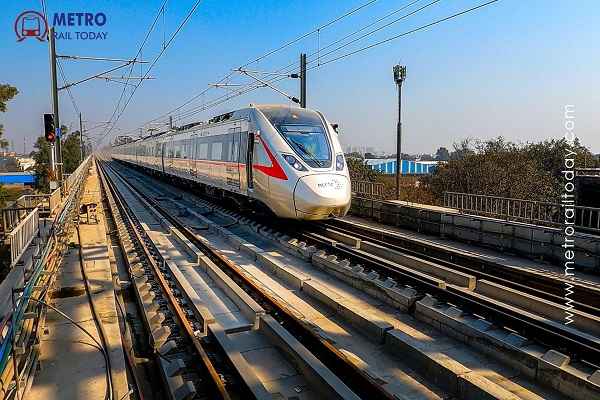
New Delhi, India (Metro Rail Today): In a significant push towards expanding high-speed regional rail connectivity in the National Capital Region, the Union Ministry of Housing and Urban Affairs has approved the construction of the Delhi–Bawal RRTS corridor, revising the earlier plan that proposed the route only up to Dharuhera in Gurugram district. The approval marks a strategic realignment of the ambitious Delhi–Alwar Namo Bharat project, with Bawal now designated as the first-phase terminal in Haryana.
The decision follows a proposal sent by the Haryana government last year, seeking extension of the Regional Rapid Transit System beyond Dharuhera to Bawal. Officials confirmed that the revised alignment has now received formal clearance from the Centre, paving the way for faster implementation and wider regional benefits.
Union Minister Manohar Lal Khattar, in a letter dated January 18 to Union Minister of State and Gurugram MP Rao Inderjit Singh, stated that the Delhi to Bawal stretch has been approved for execution in the first phase. He further noted that the extension from Bawal to Behror in Rajasthan will be undertaken in the second phase of the project.
Part of NCR’s Long-Term Transport Vision
The approval aligns with the Functional Plan on Transport for NCR-2032 prepared by the National Capital Region Planning Board, which envisages a network of semi-high-speed transit corridors to decongest roads and promote balanced regional development. According to the revised plan, the Delhi–Alwar Namo Bharat corridor will originate from Sarai Kale Khan in Delhi and terminate at Bawal in Haryana during the first phase.
Mrs. Mamta Shah, MD & CEO of Urban Infra Group, said the Centre’s decision reflects a pragmatic approach to infrastructure planning. “Extending the RRTS corridor to Bawal strengthens regional connectivity and ensures that emerging industrial and residential hubs in South Haryana are seamlessly integrated with Delhi. This is the kind of future-oriented planning needed to decongest highways and support sustainable urban growth,” she noted.
Relief for Delhi–Jaipur Highway, Wider Economic Impact
The extension to Bawal is expected to significantly reduce pressure on the Delhi–Jaipur National Highway by offering a fast, reliable and high-capacity public transport alternative. Rao Inderjit Singh, who had earlier advocated for the extension, had pointed out that the move would benefit a large population in South Haryana while easing traffic congestion along one of North India’s busiest corridors.
Dr. Vinod Shah, Director General of the Indian Chamber of Railway Industries (Rail Chamber), described the approval as a milestone for regional rail development. “The Delhi–Bawal RRTS approval underscores the growing role of Namo Bharat corridors in reshaping intercity travel. With high speed, high frequency and seamless integration, this project will act as a catalyst for industrial growth and employment across Haryana and Rajasthan,” he said.
As per the latest detailed project report prepared by the National Capital Region Transport Corporation, construction of the RRTS corridor from Sarai Kale Khan to Shahjahanpur–Behror via Gurugram is likely to begin in August 2026. The corridor is targeted for commissioning by November 2031.
The 102-kilometre rapid rail system is estimated to cost around ₹35,000 crore, with funding to be shared by the Government of India and the governments of Haryana and Rajasthan. Once completed, the Delhi–Bawal RRTS corridor is expected to emerge as a critical mobility spine for the NCR, offering faster, greener and more efficient travel across state boundaries.


MRT Online Desk
Metro Rail Today is an authentic and global news provider for the Rail & Metro industry from and around the world.