

Trending Now
 Govt of India explores Namo Bharat Rapid Rail to replace proposed Cuttack–Bhubaneswar Metro Project
 Global tender floated for Automatic Fare Collection System for Mumbai Metro Line 6
 Delhi Metro secures 6th rank among largest metro rail systems in the world by network length
 Indian Railways grants NOC to resume tunnelling works on Patna Metro Corridor 2
 Efkon India Bags ₹103 Crore Telecom Systems Contract for Mumbai Metro Lines 7A and 9
 Bids invited for Telecommunication Systems Contract for Kochi Metro Phase 2 Pink Line
 KMRL invites bids for supply of Heavy-Duty Escalators for Kochi Metro Phase 2 Pink Line
 Spain floated €357.6 Million civil works tender for Burgos–Vitoria High-Speed Rail Line
 Wabtec bags multiple contracts to supply over 680 Pantographs for Rail & Metro projects in India
 Titagarh Rail bags major Rolling Stock contract for Ahmadabad Metro Phase 2 and Surat Metro
Govt of India explores Namo Bharat Rapid Rail to replace proposed Cuttack–Bhubaneswar Metro Project
MRT Online Desk
Posted on: 2026-03-16 07:00:00
Viewer: 51
Comments: 0
Country: India
City: New Delhi
New Delhi, India (Metro Rail Today): The Central Government is considering the introduction of Namo Bharat Rapid Rail services between Bhubaneswar and Cuttack to strengthen public transport connectivity between the two major cities of Odisha.
Union Railway Minister Ashwini Vaishnaw informed the Rajya Sabha that the government is examining the feasibility of operating Namo Bharat trains on a proposed railway line connecting the twin cities.
According to the minister, a new railway line is being sanctioned between Bhubaneswar and Cuttack, which could support frequent Namo Bharat services operating at intervals of around 30 minutes.
“A new railway line is being sanctioned on which a Namo Bharat Rapid Rail can run every 30 minutes between Cuttack and Bhubaneswar. Such an arrangement is being made possible by the double-engine government,” Vaishnaw said.
The initiative aims to significantly improve public transport infrastructure in the Bhubaneswar–Cuttack urban region, enabling faster, reliable and high-frequency travel between the two cities.
The minister also explained that the project was earlier discussed as a Cuttack–Bhubaneswar Metro system, but the government later evaluated alternative options to identify a more cost-effective transport solution.
“A conventional railway track costs around ₹30 crore per kilometre, while metro track construction may cost about ₹300 crore per kilometre. Therefore, people’s money should be invested wisely,” Vaishnaw noted.
The adoption of a rapid rail model instead of a metro system could significantly reduce infrastructure costs while still delivering high-speed urban connectivity.
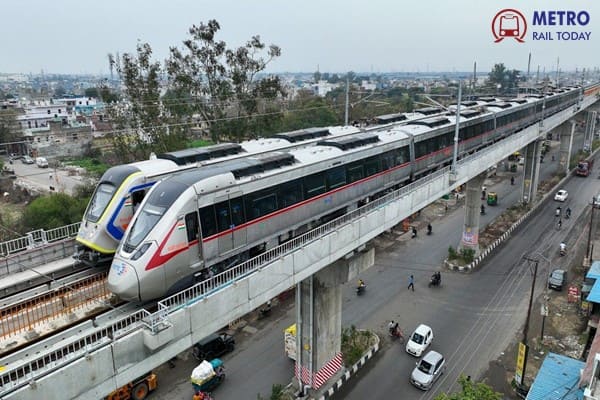
The Namo Bharat rapid trains, designed for India’s Regional Rapid Transit System (RRTS), are equipped with several modern passenger amenities and safety features.
Key features include:
-
2×2 seating arrangement for comfortable travel
-
Grab handles and overhead luggage racks
-
Charging sockets for mobile phones and laptops
-
Public announcement and passenger information display systems
-
Onboard entertainment system
-
Route maps displayed during the journey
-
Emergency communication facilities
In addition, the trains will feature advanced safety systems such as:
-
CCTV surveillance
-
Fire and smoke detection systems
-
Fire extinguishers
-
Door status indicators
Unlike conventional metro systems, the trains will also use a push-button door opening mechanism, allowing passengers to open doors at stations.
Each trainset will also include:
-
A premium coach
-
A dedicated women’s coach
The Namo Bharat trains are fully air-conditioned and designed to operate at a maximum speed of 180 km/h, supported by the ETCS Level-2 signalling system for enhanced safety and operational efficiency.
Currently, Namo Bharat services are operational in the Delhi–NCR region on the 82-km Delhi–Ghaziabad–Meerut corridor, which is India’s first Regional Rapid Transit System (RRTS).
Commenting on the development, Mrs. Mamta Shah, MD & CEO, Urban Infra Group, said that the rapid rail model could play a transformative role in improving mobility in growing urban clusters.
“Regional rapid transit systems like Namo Bharat offer a highly efficient solution for connecting closely located cities and urban clusters. Deploying such systems between Bhubaneswar and Cuttack can significantly reduce travel time while supporting sustainable urban development and economic integration in the region,” she said.
If implemented, the Namo Bharat rapid rail service between Bhubaneswar and Cuttack would mark a significant step toward developing modern regional mobility infrastructure in eastern India.
The project is expected to reduce travel time, improve commuter convenience, and strengthen economic linkages between the two cities, which together form one of Odisha’s most important urban and administrative hubs.

MRT Online Desk
Metro Rail Today is an authentic and global news provider for the Rail & Metro industry from and around the world.