


Trending Now
 Second TBM begins excavating India’s First Undersea High Speed Rail Tunnel on MAHSR Project
 Govt of India gives In-Principle approval to Meerut–Haridwar–Rishikesh Namo Bharat RRTS Corridor
 TÜV SÜD and MEDHA Servo Drives sign MoU to advance Hydrogen Rail Technologies in India
 PM Narendra Modi flags off India’s First and World’s most powerful Hydrogen-Powered Rail Service
 DMRC to study Double-Decker Flyover-cum-Metro Corridor for Delhi Metro Phase V Expansion
 RITES awarded ₹79.22 crore Consultancy Contract for Patna Metro Rail Project
- Pre-construction activities begins for 306 km Chennai–Bengaluru High Speed Bullet Train Corridor
 DMRC floats ₹18.97 crore Electrical Tender for Delhi Metro Red Line Extension to Kundli
 Bangalore Metro to launch ₹1,274 crore tender for Platform Screen Door Upgrade across 191 Stations
 AECOM-led JV bags Design Consultancy Contract for Chennai Metro Phase 1 Capacity Enhancement
Titagarh Rail bags major Rolling Stock contract for Ahmadabad Metro Phase 2 and Surat Metro
MRT Online Desk
Posted on: 2026-03-11 17:10:00
Viewer: 1,182
Comments: 0
Country: India
City: Ahmedabad
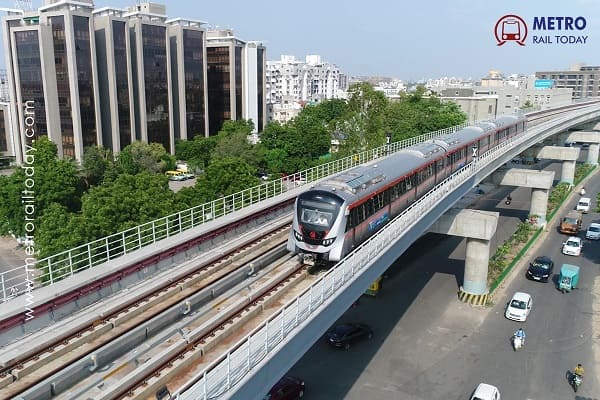
Gandhinagar, India (Metro Rail Today): The Government of Gujarat has placed an order for 34 new metro trainsets to support the expansion of urban rail transit in the state. The order includes 10 trainsets for the Ahmedabad Metro Phase-II project and 24 trainsets for the upcoming Surat Metro, according to an official statement released on Wednesday.
The metro trains are being manufactured at Titagarh Rail Systems’ production facility in Kolkata, marking another step toward strengthening India’s domestic rolling stock manufacturing ecosystem.
The additional 10 trainsets for Ahmedabad Metro will support the ongoing expansion and operational efficiency of the network.
Ahmedabad Metro Phase-1 and Phase-2 are already operational, and the Ahmedabad–Gandhinagar metro corridor currently spans about 68.2 kilometres, with 32 trainsets already in service.
Officials said the new trainsets will help increase train frequency, reduce passenger waiting time, and improve the overall commuter experience across the network.
The order also includes 24 trainsets for the Surat Metro Rail project, which is currently under construction.
The 40.3-kilometre Surat Metro network is being developed to provide modern and sustainable public transport for one of Gujarat’s fastest-growing cities.
Once operational, the metro system is expected to significantly enhance urban connectivity, reduce traffic congestion, and provide a reliable mass transit option for Surat’s expanding population.
Gujarat has emerged as one of India’s rapidly expanding metro markets. The state’s metro rail network currently spans approximately 108 kilometres, with plans to expand it to around 190 kilometres in the coming years.
Future developments include the 6.04-kilometre Ahmedabad Airport Metro line, as well as proposals to extend metro connectivity to other major cities such as Rajkot and Vadodara.
These initiatives form part of the state government’s broader strategy to expand sustainable, high-capacity urban transport infrastructure.
According to the government statement, the new metro trains will be equipped with state-of-the-art driverless technology designed to enhance safety, punctuality and operational efficiency.
The trains will incorporate advanced features such as real-time monitoring systems, automated braking mechanisms, optimised speed control, and intelligent fault diagnostics to ensure reliable performance.
Passenger safety and comfort have also been prioritised, with the trains featuring CCTV surveillance, fire detection systems, fail-safe door operations, and obstacle detection technologies.
Officials said these features will position Gujarat’s metro systems as a benchmark for modern, smart and sustainable urban transportation.
Commenting on the expansion of metro rolling stock in India, Mrs. Mamta Shah, MD & CEO, Urban Infra Group, said that growing investments in metro systems across states are accelerating the transformation of urban mobility.
“The expansion of metro networks in cities like Ahmedabad and Surat reflects the increasing importance of high-capacity public transport in managing urban growth. Investments in modern rolling stock and driverless technologies will play a crucial role in improving operational efficiency, safety and commuter experience in India’s rapidly developing urban centres,” she said.
She added that the continued development of metro systems across Indian cities will support sustainable mobility while reducing congestion and emissions in densely populated urban regions.
With the addition of new trainsets and ongoing network expansions, Gujarat is positioning itself as a key player in India’s evolving metro ecosystem.
As projects in Ahmedabad and Surat progress, the state’s growing metro infrastructure is expected to play a vital role in shaping efficient, environmentally friendly and future-ready urban transportation systems.

MRT Online Desk
Metro Rail Today is an authentic and global news provider for the Rail & Metro industry from and around the world.