

Trending Now
 Gamuda awarded RM3.7 billion contract to build Keelung Mass Rapid Transit in Taiwan
 Maharashtra forms special Task Force to plan Rail, Metro and RRTS expansion
 Govt. of India approves ₹12,200 crore, 29-km Thane Integral Ring Metro project in Maharashtra
 World’s Top 20 Metro Systems: Engineering Marvels Transforming the Future of Urban Mobility
 NCRTC celebrates Three Years of Namo Bharat, Highlights 4.5 crore Passenger Journeys
 Alstom eyes ₹2,000 crore Chennai Metro tender for supply of 168 Train Coaches
 SYSTRA India emerges as lowest bidder for Thane Metro Design Consultancy Contract
 Adani Group's Cemindia Projects wins ₹921.63 crore Underground Package for Jaipur Metro
 EFKON India wins ₹288.11 crore Station Systems Contract for Indore Metro Rail Project
 L&T partners with IIT Madras-Backed TuTr Hyperloop to explore Next-Gen Mobility
India likely to start trial run of first bullet train in 2026, deadline extended
MRT Online Desk
Posted on: 2022-04-14 08:10:00
Viewer: 3,985
Comments: 0
Country: India
City: New Delhi
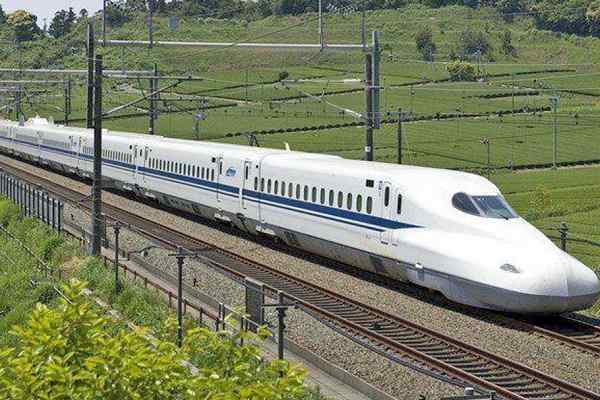
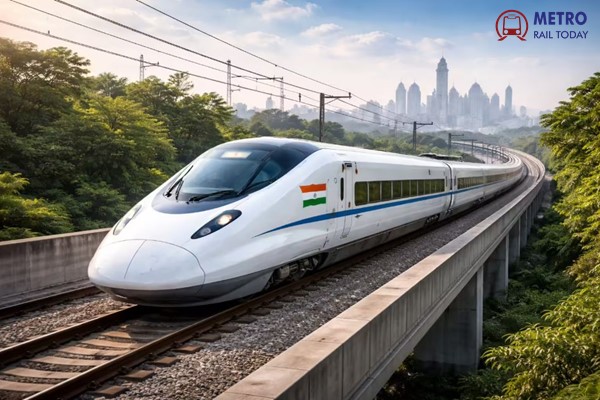
New Delhi, India (Metro Rail Today): The deadline for commissioning the first section of the Mumbai-Ahmedabad High-Speed Bullet Train project is again rescheduled from December 2023 to August 2026. The 50-km stretch from Surat to Bilimora is expected to be completed by 2026. Due to delays acquiring land in Maharashtra, the completion deadline of the entire route has been pushed to October 2028.
According to officials, the trials on the Mumbai-Ahmedabad bullet train corridor will be conducted on the first 50-km stretch between Bilimora and Surat in 2026. The first bullet train will run at a speed of 350kmph. However, the operational speed of the train will be 320kmph.
The services will come at a fare matching the economy-class flights and are likely to have a higher free-luggage limit. The total length of the Mumbai-Ahmedabad bullet train corridor is 508.17 km and the train is expected to take around 2 hours and 58 minutes to travel between Ahmedabad and Mumbai, covering a total of 12 stations (8 stations in Gujarat and 4 in Maharashtra state).
A delegation team headed by Satoshi Suzuki, Japanese Ambassador to India and senior officials of the National High Speed Rail Corporation Ltd (NHSRCL) are presently in Gujarat from April 12, 2022 and carrying inspection of ongoing construction activities on the project route.
"Visited Surat Bullet Train Station construction site. Pleased to see steady progress in the work. Marching ahead to fulfill Japan and India's common dream of India’s first Bullet Train. Japan and India will always walk together until the completion of the Bullet Train project," said Satoshi Suzuki, Japanese Ambassador to India.
"Visited the Span by Span (SBS) Casting Yard in Surat, Gujarat. Many casted segments getting ready for erection on the viaduct of MAHSR. Indian workers are implementing the precision casting required for the Japanese Shinkansen Bullet Train system," he added.
"Visited the Full Span Launching Method (FSLM) Casting Yard in Navsari, Gujarat. Found L&T’s Girder Transporter placed on the MAHSR viaduct. Happy to see the Pier Work which is almost completed. India’s engineers are working full steam to construct India’s first Bullet Train with Japanese technology. I am sure that their children will be proud," he further added.
“It will be a game-changer for travellers and a competition for air travel. The bullet train will have less check-in time, more leg space and above all, connectivity, which is denied on-board airplanes,” said an official.
The high-speed bullet trains will run on special tracks called the “slab track system”, popularly known as HSR technology for the construction of tracks, patented by the Japanese. Using designs procured from Japan, construction is being done through the Full Span Launching Method, one of the most sophisticated bridge construction technologies in the world. The NHSRCL has built 200-250 pillars per month between Bilimora and Surat.
The longest (1.26 km) bridge under the project will be completed by July 2024. In Gujarat and Dadra and Nagar Haveli, 100 percent of the civil/construction contracts for the construction of the entire 352km route have been awarded to Indian contractors.
The work on all eight high-speed rail stations from Vapi to Sabarmati is in various stages of construction, the officials said. The passenger terminal hub at Sabarmati, integrating HSR, Metro, BRT and two Indian Railways stations, is expected to be completed by August this year.
Satish Agnihotri, Managing Director, NHSRCL said that Japanese technology is “the best in the world”, adding that the Japanese government-funded more than 80 percent of the project at an interest rate of 0.1 percent and has given India 50 years to repay. “Japan’s E5 series of bullet trains beat both France and Germany in terms of technology speed and other segments,” he said.

MRT Online Desk
Metro Rail Today is an authentic and global news provider for the Rail & Metro industry from and around the world.