

Trending Now
 Siemens Bags Order from Titagarh Rail Systems for Pune Metro Extension Trainsets
 Titagarh Rail Systems becomes Corporate Member of Chamber of Railway Industries (Rail Chamber)
 World Bank approves ₹1,400 crore Civil Tender for Gurugram Metro Phase 2
 Bi-RIDE invites ₹200 crore Tender for Soladevanahalli Depot of Bengaluru Suburban Rail Project
 GHV India awarded ₹107.79 crore Civil Contract for Lucknow Metro East-West Corridor
 Pune Metro Line 3 set to launch First 12-km Section on 15 July 2026
 DMRC gets approval to Fell or Transplant 364 Trees for Central Vista Metro Corridor under Phase IV
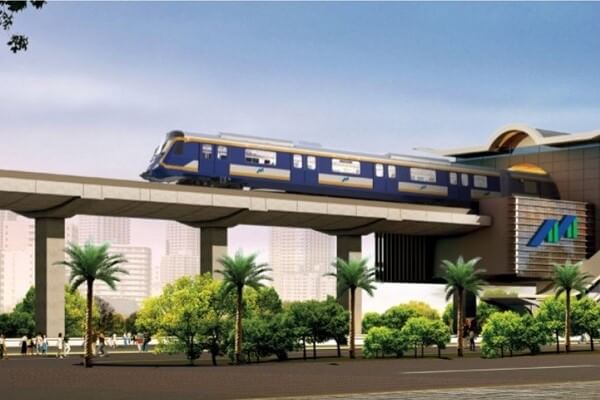 ₹4.5 Lakh crore Metro Rail Investment reaches less than 5% of Urban Population in India
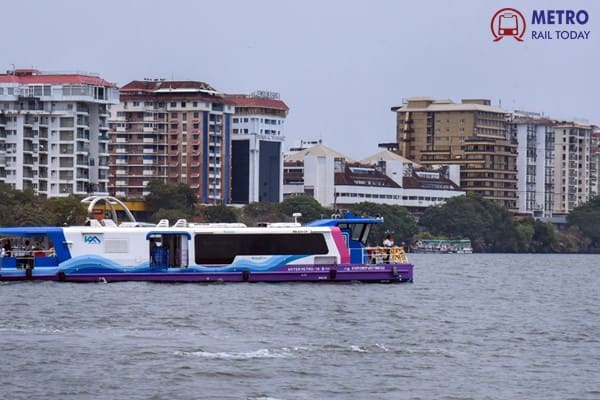 West Bengal plans to launch Water Metro Systems in Kolkata
- Titagarh Rail Systems targets full Indigenous Aluminium Coach Manufacturing by FY2027
Indofast Energy partners with Mumbai Metro to set up Battery-Swapping Stations along Aqua Line
MRT Online Desk
Posted on: 2026-01-13 09:15:00
Viewer: 1,219
Comments: 0
Country: India
City: Mumbai
Mumbai, India (Metro Rail Today): Indofast Energy, one of India’s leading battery-swapping solutions providers, has entered into a strategic partnership with Mumbai Metro Rail Corporation Limited (MMRCL) to establish a network of 23 battery-swapping stations along the Mumbai Metro Aqua Line 3 corridor. The collaboration marks a significant step towards integrating mass rapid transit with sustainable last-mile mobility solutions in the country’s financial capital.
Under the agreement, battery-swapping stations will be deployed across eight key Aqua Line 3 stations—Aarey JVLR, SEEPZ, MIDC, Santacruz Metro, Bandra Kurla Complex, Dharavi, Worli and Acharya Atre Chowk. The infrastructure will support electric two-wheelers, three-wheelers and small commercial vehicles, enabling commuters to seamlessly transition between metro services and electric vehicles for last-mile travel.
The initiative is expected to particularly benefit delivery partners, ride-hailing drivers and daily commuters using the north–south Aqua Line 3 corridor, making electric mobility a more practical option for end-to-end journeys within the city.
Commenting on the partnership, Anant Badjatya, CEO of Indofast Energy, said the collaboration represents a fundamental shift in urban mobility planning. He noted that integrating battery-swapping infrastructure directly with Mumbai’s metro network would address last-mile connectivity challenges while creating a convenient ecosystem for electric mobility. According to him, the initiative aligns with Indofast Energy’s mission to make battery swapping the default choice for urban transportation and to accelerate EV adoption in one of India’s largest metropolitan regions.
MMRCL Director (Planning) R. Ramana said the partnership supports Mumbai Metro’s vision of a well-connected and environmentally sustainable transport network. He added that setting up battery-swapping stations at metro stations would encourage greater use of electric vehicles for short trips, helping reduce traffic congestion and air pollution while strengthening the role of public transport in the city’s clean mobility transition.
Indofast Energy currently operates 19 battery-swapping stations in Mumbai, including its 1,000th station at Lokmanya Tilak Terminus. The addition of 23 stations under the MMRCL partnership will significantly expand this footprint, creating one of the densest battery-swapping networks in any Indian metro city. Each station will feature automated swapping technology capable of serving multiple vehicle categories using a common battery platform.
The company said the expanded network would help eliminate range anxiety and charging downtime for EV users, encouraging wider adoption of electric vehicles for daily commuting and last-mile logistics. Nationally, Indofast Energy operates more than 1,125 battery-swapping stations and has facilitated over 43 million battery swaps, enabling electric vehicles to travel approximately 1.17 billion kilometres and avoid an estimated 62,000 metric tonnes of tailpipe carbon dioxide emissions.
The collaboration with MMRCL further strengthens Indofast Energy’s role as a key enabler of sustainable urban mobility, adding to its partnerships with vehicle operators, logistics companies and infrastructure providers across India, as well as metro rail systems in cities such as Bengaluru and Hyderabad.

MRT Online Desk
Metro Rail Today is an authentic and global news provider for the Rail & Metro industry from and around the world.