

Trending Now
 Jupiter Wagons Eyes ₹20,000-Crore Mumbai Suburban Mega Rolling Stock Tender
 Mumbai Metro Chief Ashwini Bhide appointed as First Woman BMC Commissioner
 TBM ‘Parvati’ completes Underground Tunnelling on Kanpur Metro Phase 1 Project
 Surat Metro begins First Trial Run on 8.5 km Diamond Corridor between Dream City and Althan Tenement
 Cemindia wins ₹1,024 crore Civil Contract for Central Vista Tunnel Package of Delhi Metro Phase V
 TBM ‘Durgavati’ begins tunneling works on Bhopal Metro Underground Stretch
 Washington Metro celebrates its Golden Jubilee—50 years of passenger service
 Two TBMs arrive in Mumbai for undersea tunneling on Mumbai-Ahmedabad Bullet Train Project
 Alstom awarded €915 million Rolling Stock Contract for Belgrade’s First Driverless Metro Line
 Bhopal Metro begins Signalling works to boost train frequency on Priority Corridor
NCRTC achieves third tunnel breakthrough on Delhi-Meerut RRTS Corridor
MRT Online Desk
Posted on: 2023-02-07 13:25:00
Viewer: 2,122
Comments: 0
Country: India
City: New Delhi
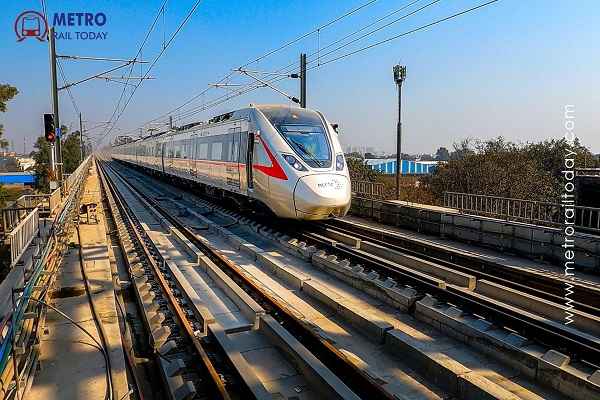
New Delhi, India (Metro Rail Today): The engineers of Afcons Infrastructure Limited have recorded third tunnel breakthrough on Delhi-Ghaziabad-Meerut RRTS corridor in Meerut today. Tunnel Boring Machine (nicknamed Sudarshan 8.2), which is constructing this tunnel, successfully completed the construction of about 2 kilometer long tunnel between Bhainsali and Meerut Central Station. The TBM made breakthrough through the tunnel retrieving shaft made at Meerut Central Station.
This is the third tunnel breakthrough of Delhi-Meerut RRTS corridor in Meerut. Sudarshan 8.1 completed the construction of the first tunnel from Bhainsali to Meerut Central Station about one and a half months ago. It is noteworthy that two parallel tunnels are constructed for the movement of RRTS trains in the underground corridor of Delhi-Merut RRTS Corridor. With the completion of the construction of the second parallel tunnel from Bhainsali to Meerut Central, the underground part of this section has been completely constructed.
The first successful breakthrough in Meerut was recorded in October 2022, under which Sudarshan 8.3 constructed the tunnel from Gandhibagh to Begumpul. Presently, Sudarshan 8.3 is constructing the second parallel tunnel from Gandhibagh to Begumpul. In the coming weeks, both the TBMs – Sudarshan 8.1 and Sudarshan 8.2, which have completed tunnel construction from Bhainsali to Meerut Central, will be reassembled for twin tunnel construction between Bhainsali to Begumpul.
With the breakthrough of 2 km long second parallel tunnel from Bhainsali to Meerut Central, NCRTC has achieved another milestone of the project. After the construction of the tunnel, the work of laying track inside the tunnel will start. Precast track slabs are being manufactured at the track slab factory of Casting Yard, Shatabdi Nagar, Meerut. These track slabs will be taken to the site of the tunnel through trucks-trailers and installed. This work will be done at a fast pace in line with the target of opening the entire corridor to the public by 2025.
More than 9000 pre-cast segments have been used for the construction of about 2 km long tunnel from Bhainsali to Meerut Central. In the tunneling process, these segments are inserted into the bored tunnel and a ring is formed by joining the seven segments. Each segment is 1.5 m long and 275 mm thick. These segments and rings are joined with the help of bolts. Large rolling stock and 180 km. Due to the high design speed per hour, the diameter of the RRTS tunnels being constructed is 6.5 metres. Compared to the metro system, this is the first time in the country that a tunnel of such a large size is being constructed.
Casting of these tunnel segments is being done at NCRTC's casting yard at Shatabdi Nagar, with assured quality control. Pre-casting helps in safe and speedy execution of works while ensuring quality control.
The Delhi-Meerut RRTS project is being implemented as per the stipulated time frame. Meerut has three underground stations at Meerut Central, Bhaisali and Begumpul. Of which Meerut Central and Bhaisali are the part of Meerut Metro, while Begumpul station will provide both RRTS and Metro services. NCRTC is going to provide the local transit services in Meerut on RRTS network itself, which will have 13 stations in a distance of 21 km.


MRT Online Desk
Metro Rail Today is an authentic and global news provider for the Rail & Metro industry from and around the world.