


Trending Now
 Tender issued for Feasibility Study to Transition Hubballi-Dharwad BRTS to Modern Tram System
 Tamil Nadu Chief Minister seeks Centre’s approval for Bengaluru–Hosur Metro Link
 K-RIDE to appoint Detailed Design Consultant for Bengaluru Suburban Rail Project
 Prime Minister Narendra Modi inaugurates first 15-km stretch of Chennai Metro Phase 2
 Karnataka proposes 270-km RRTS Network linking Bengaluru with Tumakuru, Mysuru and KGF
 Alstom and Vingroup sign MoU to supply up to 200 Metro Trains for Hanoi Urban Rail Projects
 Afcons Infrastructure wins ₹1,383 crore Civil Contract for Lucknow Metro Phase 1B Corridor
 GMRL issues ₹1,662 crore Civil Tender for Sector 9–Cyber City Gurugram Metro Rail Corridor
 Madrid unveils €1.57 billion Metro Rail Expansion Programme with 27.8 km of New Corridors
 Global Tender launched for Project Management Consultancy for Abu Dhabi Tram Line 4
NCRTC begins groundwork for 136-km Delhi–Panipat–Karnal Namo Bharat RRTS Corridor
MRT Online Desk
Posted on: 2026-04-03 06:20:00
Viewer: 4,633
Comments: 0
Country: India
City: New Delhi
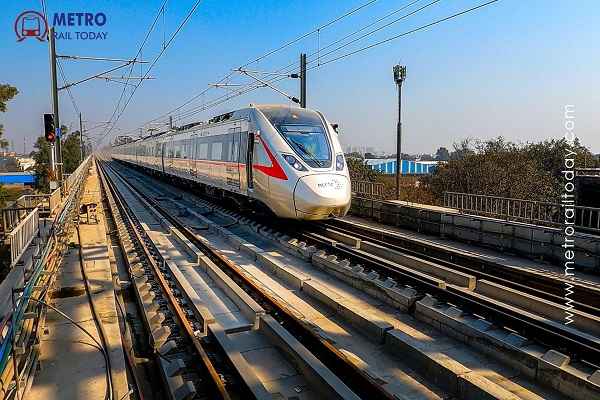
New Delhi, India (Metro Rail Today): In a significant step toward expanding high-speed regional connectivity in the National Capital Region (NCR), the National Capital Region Transport Corporation (NCRTC) has initiated groundwork for the Delhi–Panipat–Karnal Namo Bharat corridor, marking the transition of the project from planning to early-stage execution.
The 136-km Regional Rapid Transit System (RRTS) corridor will connect Sarai Kale Khan in Delhi to New ISBT Karnal in Haryana, linking key urban, industrial, and educational hubs across the region.
According to officials, detailed surveys have commenced in Delhi to identify utilities along the proposed alignment, while utility shifting activities have begun in parts of Haryana.
“Detailed surveys are being carried out in Delhi to identify utilities falling within the proposed alignment. In Haryana, preparatory work, including the shifting of utilities, has already been initiated,” a senior NCRTC official said.
To accelerate early-stage work, NCRTC has also floated a tender for shifting civil utilities, including:
- Sewer lines
- Water supply pipelines
- Stormwater drainage systems
The utility relocation work is expected to be completed within 12 months.
Corridor Overview and Key Infrastructure
The Delhi–Panipat–Karnal corridor will feature:
- Total length: 136 km
- Delhi section: ~36 km
- Haryana section: ~100 km
- Total stations: 17
- 6 in Delhi
- 11 in Haryana
Key stations and connectivity points include Sonipat, Ganaur, Samalkha, Panipat, and Karnal.
Additionally, two depots are planned at:
- Murthal
- Ganjbar (Panipat)
These will support train stabling, maintenance, and operations.
High-Speed Operations and Travel Time Reduction
The corridor is designed for semi-high-speed Namo Bharat trains, with:
- Design speed: 180 km/h
- Operational speed: up to 160 km/h
Once operational, the corridor will significantly cut travel time:
- Delhi to Karnal: ~90 minutes
- Kashmiri Gate to Panipat: < 60 minutes
- Indraprastha to Sonipat: ~35 minutes
- Kashmiri Gate to Murthal: ~30 minutes
Trains are expected to operate at 15-minute frequency, enabling high-capacity regional commuting.
Boost to Economic and Regional Development
The corridor will pass through several key economic and institutional hubs, including:
- Kundli industrial zone
- Barhi industrial area
- Panipat city and IOCL refinery
- Sonipat education cluster
This connectivity is expected to boost industrial growth, workforce mobility, and regional integration across NCR.
Part of Phase-I RRTS Expansion
The Delhi–Panipat–Karnal line is the third corridor under Phase-I of the RRTS network, following:
- Delhi–Ghaziabad–Meerut (partially operational)
- Delhi–Gurugram–SNB–Alwar (under development)
The expansion reflects NCRTC’s broader vision to develop a high-speed, high-frequency regional rail network connecting major urban nodes around Delhi.
Commenting on the development, Mrs. Mamta Shah, MD & CEO, Urban Infra Group, said:
“The initiation of groundwork for the Delhi–Panipat–Karnal corridor signals steady progress in building a truly integrated regional mobility network for NCR. Projects like Namo Bharat are redefining intercity travel by combining speed, frequency, and reliability, while also unlocking economic potential across emerging urban corridors.”
With surveys and utility shifting now underway, the project is entering a critical phase that will pave the way for civil construction and large-scale infrastructure deployment in the coming months.
Once completed, the corridor will play a vital role in decongesting Delhi, improving regional accessibility, and enabling sustainable mobility solutions for millions of commuters.


MRT Online Desk
Metro Rail Today is an authentic and global news provider for the Rail & Metro industry from and around the world.