

Trending Now
 Govt. of India approves ₹12,200 crore, 29-km Thane Integral Ring Metro project in Maharashtra
 World’s Top 20 Metro Systems: Engineering Marvels Transforming the Future of Urban Mobility
 NCRTC celebrates Three Years of Namo Bharat, Highlights 4.5 crore Passenger Journeys
 Alstom eyes ₹2,000 crore Chennai Metro tender for supply of 168 Train Coaches
 SYSTRA India emerges as lowest bidder for Thane Metro Design Consultancy Contract
 Adani Group's Cemindia Projects wins ₹921.63 crore Underground Package for Jaipur Metro
 EFKON India wins ₹288.11 crore Station Systems Contract for Indore Metro Rail Project
 L&T partners with IIT Madras-Backed TuTr Hyperloop to explore Next-Gen Mobility
 Alstom, Larsen & Toubro unveil First Driverless Trainset for Mumbai Metro Lines 4 and 4A
 BEML, Czech Republic delegation explore strategic Industrial and Technology Partnerships
NCRTC celebrates Three Years of Namo Bharat, Highlights 4.5 crore Passenger Journeys
MRT Online Desk
Posted on: 2026-10-17 17:30:00
Viewer: 133
Comments: 0
Country: India
City: New Delhi
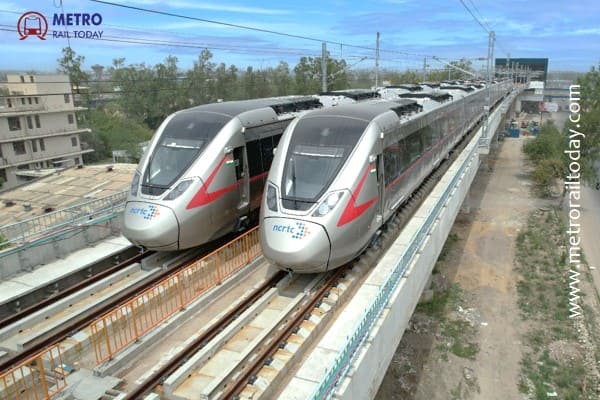
New Delhi, India (Rail & Metro Today): The National Capital Region Transport Corporation (NCRTC) celebrated Namo Bharat Diwas 2026 in New Delhi on 17 October, marking three years of operations on India’s first operational Regional Rapid Transit System (RRTS) corridor. The event highlighted the Delhi–Ghaziabad–Meerut corridor’s progress, rising passenger numbers, multimodal connectivity initiatives and plans for expanding regional rapid transit across the National Capital Region (NCR).
The celebration was attended by Union Minister of Housing and Urban Affairs and Power Manohar Lal, Union Minister of State for Housing and Urban Affairs Tokhan Sahu, NCRTC Chairperson and Secretary in the Department of Capital Development, Ministry of Housing and Urban Affairs, D. Thara, and Secretary of the Department of Urban Development Satendra Singh. NCRTC Managing Director Shalabh Goel, along with the corporation’s directors and senior officials, welcomed the dignitaries.
Namo Bharat Records More Than 4.5 Crore Passenger Journeys
Addressing the gathering, Manohar Lal said Namo Bharat represents a new chapter in regional connectivity and modern urban transportation. He noted that the 82-km Delhi–Ghaziabad–Meerut corridor had recorded more than 4.5 crore passenger journeys since Prime Minister Narendra Modi inaugurated its first section on 20 October 2023.
“Better transportation does not merely reduce distances between cities but also connects people with new opportunities, thereby accelerating regional development and economic progress,” the minister said, commending NCRTC’s officers, engineers, technical experts and workforce for their contribution to the project.
Namo Bharat operations began in October 2023 with the inauguration of the 17-km priority section between Sahibabad and Duhai Depot. The remaining sections were subsequently opened in phases. On 22 February 2026, the Prime Minister dedicated the entire 82-km Namo Bharat corridor to the nation, alongside Meerut Metro.
According to NCRTC, the service now carries more than 1.1 lakh commuters daily and has recorded its highest-ever single-day ridership of approximately 1.68 lakh passengers. Faster and more frequent services are helping improve access to workplaces, educational institutions and economic centres across the region.
Multimodal Connectivity and Sustainability in Focus
NCRTC used the occasion to showcase initiatives aimed at improving the commuter experience and strengthening the project’s long-term sustainability. These include better multimodal integration, first- and last-mile connectivity, and the Solar on Track initiative.
The corporation also highlighted the development of a 110 MW captive solar power plant intended to support the project’s environmental and financial sustainability. These measures form part of a broader effort to make regional public transport more accessible, energy-efficient and convenient for passengers.
Expansion Plans for Regional Rapid Transit
NCRTC also highlighted the potential expansion of the Namo Bharat network. According to the information shared at the event, the proposed Delhi–Panipat–Karnal and Delhi–Gurugram–Behror corridors were expected to receive approval soon. Two other corridors—Ghaziabad–Jewar and Noida–Faridabad–Gurugram—were at the Detailed Project Report (DPR) stage.
If approved and implemented, these corridors could extend the benefits of high-speed regional connectivity to additional urban and economic centres across the NCR. Their progress will depend on the required approvals, planning and implementation processes.
Building the Future of Regional Mobility
Three years after the start of operations, Namo Bharat has emerged as a significant development in India’s regional transport landscape. Its growing ridership, integration with other transport modes and emphasis on sustainability demonstrate the role that regional rapid transit can play in connecting cities and expanding access to opportunities.
As NCRTC advances planning for additional corridors, the experience of the Delhi–Ghaziabad–Meerut line is likely to remain important in shaping the future of regional mobility in India.

MRT Online Desk
Metro Rail Today is an authentic and global news provider for the Rail & Metro industry from and around the world.