


Trending Now
 Alstom eyes ₹2,000 crore Chennai Metro tender for supply of 168 Train Coaches
 SYSTRA India emerges as lowest bidder for Thane Metro Design Consultancy Contract
 Adani Group's Cemindia Projects wins ₹921.63 crore Underground Package for Jaipur Metro
 EFKON India wins ₹288.11 crore Station Systems Contract for Indore Metro Rail Project
 L&T partners with IIT Madras-Backed TuTr Hyperloop to explore Next-Gen Mobility
 Alstom, Larsen & Toubro unveil First Driverless Trainset for Mumbai Metro Lines 4 and 4A
 BEML, Czech Republic delegation explore strategic Industrial and Technology Partnerships
- Six Firms qualify for ₹1,160 crore Underground Tunnel Package of Jaipur Metro Rail Project
 Alstom and Siemens sign $1.5 billion Rolling Stock contract for Riyadh Metro Rail Project
 Bangladesh approves Tk 58,477 crore contracts for Dhaka Metro Lines 1 and 5
Rajasthan reviews DPR and funding plan for Delhi-Gurugram-Alwar Namo Bharat RRTS Corridor
MRT Online Desk
Posted on: 2026-09-04 08:22:00
Viewer: 1,105
Comments: 0
Country: India
City: Jaipur
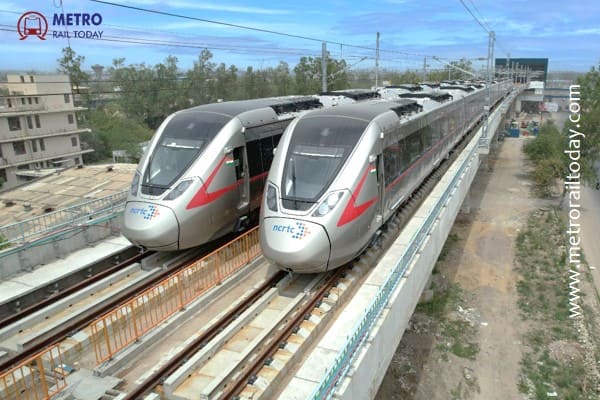
Jaipur, India (Rail & Metro Today): The proposed Balwal–Behror section of the Delhi–Gurugram–Rewari–Alwar RRTS corridor has moved closer to implementation after the Rajasthan Government reviewed the supplementary Detailed Project Report (DPR) at a high-level meeting held at the State Secretariat in Jaipur.
The meeting, chaired by Rajasthan Chief Secretary V. Srinivas, focused on the supplementary DPR for the Balwal–Behror section and examined key issues including the project’s financing structure, inter-state cost sharing between Rajasthan and Haryana, land acquisition costs and the long-term economic and urban development potential of the corridor.
Following the review, the state administration directed concerned departments to complete the necessary obligations and move the DPR forward for approval. Rajasthan’s in-principle approval will be an important requirement for taking the proposal further with the Union Ministry of Housing and Urban Affairs (MoHUA).
25-km RRTS Corridor in Rajasthan
The broader Delhi–Gurugram–Rewari–Alwar RRTS corridor is planned over approximately 129 km from Sarai Kale Khan to Behror, with around 25 km falling within Rajasthan. The Rajasthan section is strategically important as it passes through the rapidly developing industrial belt of the Shahjahanpur–Neemrana–Behror region.
Four stations have been proposed in Rajasthan at SNB Border (Shahjahanpur–Neemrana–Behror), Shahjahanpur, Neemrana and Behror. The alignment is expected to strengthen regional connectivity and provide faster public transport access to major industrial and employment centres along the corridor.
The estimated cost of the Balwal–Behror RRTS project stands at approximately ₹7,747 crore, including land acquisition and other associated requirements. Given the scale of investment, establishing a clear financing framework among the Centre, state governments and other participating institutions will be critical for the project's progression.
Financing and Land Costs Under Review
The proposed financing framework is expected to comprise Central Government assistance, the respective State Government contributions, land acquisition and other land-related expenditure, and institutional sources of finance.
During the Jaipur meeting, the Rajasthan Government also examined possibilities for mobilising additional resources to meet the project's financial requirements. The District Collector, Kotputli-Behror, and the Chief Executive Officer of the Behror Industrial Development Authority have been directed to identify suitable measures for resource mobilisation.
According to Mrs. Mamta Shah, MD & CEO, Urban Infra Group, the proposed RRTS extension could play an important role in integrating Rajasthan’s emerging industrial centres with the wider NCR mobility network.
“The Balwal–Behror section can become an important link between Rajasthan’s industrial growth centres and the wider Delhi-NCR region. Beyond reducing travel time, a well-integrated RRTS system can support labour mobility, improve access to employment and strengthen the attractiveness of industrial clusters. Clear financial commitments and coordinated implementation between the states will now be critical.”
Haryana–Rajasthan Cost Sharing
Another major issue reviewed during the meeting was the proposed allocation of financial and other responsibilities for the section between the Bawal–Rajasthan border and the concerned areas in Rajasthan. Since the corridor has an inter-state character, a clearly defined cost-sharing arrangement between Haryana and Rajasthan will be necessary before implementation can progress.
The financial responsibilities are particularly important because the project involves substantial expenditure on civil infrastructure, land acquisition, stations and associated systems. Early agreement between the participating governments could help reduce delays during subsequent approval and execution stages.
DPR to Move for Further Approval
The Chief Secretary has directed the concerned departments to complete the required obligations and advance the DPR for approval. The state’s in-principle approval to MoHUA will represent a significant administrative milestone, although the project will still require further technical, financial and regulatory clearances before construction can begin.
For Rajasthan, the Balwal–Behror RRTS section represents more than an inter-city transport investment. Its proposed alignment through Shahjahanpur, Neemrana and Behror places the project within one of the state’s most important industrial growth belts. If implemented, the RRTS could strengthen the connection between these emerging economic centres and Delhi-NCR, supporting more integrated regional development and sustainable mobility.


MRT Online Desk
Metro Rail Today is an authentic and global news provider for the Rail & Metro industry from and around the world.