

Trending Now
 GMRC launches ₹439 crore Tender for construction of 5 New Ahmedabad Metro Stations
 Global tender issued for procurement of 60 Rolling Stock coaches for Hyderabad Metro Rail Project
 Global tender issued for procurement of 102 Rolling Stock coaches for Patna Metro Rail Project
 Gamuda awarded RM3.7 billion contract to build Keelung Mass Rapid Transit in Taiwan
 Maharashtra forms special Task Force to plan Rail, Metro and RRTS expansion
 Govt. of India approves ₹12,200 crore, 29-km Thane Integral Ring Metro project in Maharashtra
 World’s Top 20 Metro Systems: Engineering Marvels Transforming the Future of Urban Mobility
 NCRTC celebrates Three Years of Namo Bharat, Highlights 4.5 crore Passenger Journeys
 Alstom eyes ₹2,000 crore Chennai Metro tender for supply of 168 Train Coaches
 SYSTRA India emerges as lowest bidder for Thane Metro Design Consultancy Contract
NCRTC plans to link Delhi-Meerut RapidX Corridor with Delhi Metro's Red Line
MRT Online Desk
Posted on: 2023-10-28 06:55:00
Viewer: 3,145
Comments: 0
Country: India
City: New Delhi
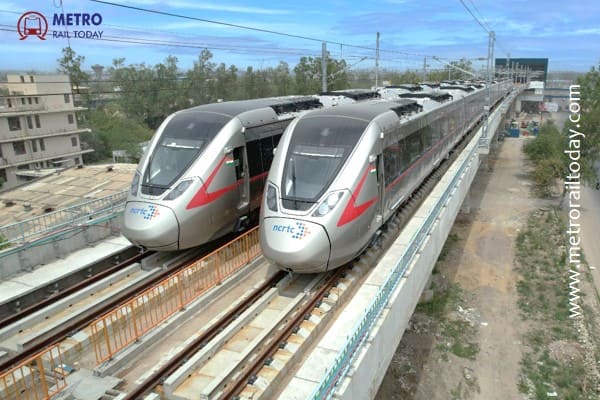
New Delhi, India (Metro Rail Today): The National Capital Region Transport Corporation (NCRTC) has set its sights on an ambitious project aimed at bridging the transportation gap between the bustling cities of Delhi, Ghaziabad, and Meerut. Their latest venture involves the integration of the 17-kilometer priority section of the Regional Rapid Transit System (RRTS) with the Delhi Metro line. Officials at NCRTC have announced plans to construct a foot-over-bridge within the next three months, seamlessly linking the RRTS Ghaziabad station and the Metro's Red Line station at New Bus Adda.
Spanning an impressive 82 kilometers, the RRTS project, once completed, is expected to revolutionize the region's transportation landscape, providing a crucial link between these major urban centers. The recent inauguration of the 17-kilometer priority section by Prime Minister Narendra Modi on October 20 marked a significant milestone in this transformative endeavor. Renamed as the Namo Bharat trains, the RapidX trains are now operational, with stations established at Sahibabad, Ghaziabad, Guldhar, Duhai, and Duhai Depot, as confirmed by NCRTC.
Since its commencement, the priority section has garnered a daily ridership of approximately 8,000 to 10,000 individuals. Notably, the Sahibabad and Ghaziabad stations are poised for seamless multimodal integration with various other transport systems, including the Metro and UP Roadways buses.
Chief Public Relations Officer of NCRTC, Puneet Vats, affirmed that the impending linkage of the RRTS Ghaziabad station and the Red Line Metro station is scheduled for completion within the next three months. Vats emphasized the convenience this would offer passengers, facilitating smooth transitions between the two stations. Moreover, plans are in place for the integration of the Sahibabad station with the Metro, underscoring the commitment to promoting efficient and interconnected transportation networks.
Furthermore, the RRTS Sahibabad station is already integrated with the nearby Uttar Pradesh State Road Transport Corporation bus station. In a similar vein, the Ghaziabad Development Authority (GDA) has proposed connecting Noida's Sector 62 to Sahibabad via the Metro, although these plans are still pending implementation.
To encourage public uptake, NCRTC has introduced several electric AC feeder buses operating from ISBT Anand Vihar to Sahibabad, alongside electric feeder autos facilitating commuting between the stations of Sahibabad, Ghaziabad, Guldhar, and Duhai, all at an affordable minimum fare of ₹10, as stated by NCRTC officials.
Considering the educational landscape, areas like Duhai and Muradnagar host numerous private engineering colleges and higher education institutions. Recognizing the growing need for enhanced connectivity, NCRTC is determined to establish last-mile connectivity until the 17-kilometer priority section is extended by an additional 25 kilometers towards Meerut. This extension will include stations at Muradnagar, Modinagar (North), Modinagar (South) in Ghaziabad, and Meerut (South) in Meerut, a project that NCRTC anticipates completing by the first quarter of 2024.
The forthcoming extension is projected to not only bolster ridership but also significantly improve the overall commuting experience for passengers, cementing the RRTS as a pivotal component of the region's evolving transport infrastructure.
In conclusion, the impending integration of the RRTS Ghaziabad station and the Red Line Metro station represents a significant step towards fostering an interconnected and efficient transportation network, underscoring the commitment of NCRTC to enhance the overall travel experience for commuters within the National Capital Region.

MRT Online Desk
Metro Rail Today is an authentic and global news provider for the Rail & Metro industry from and around the world.