


Trending Now
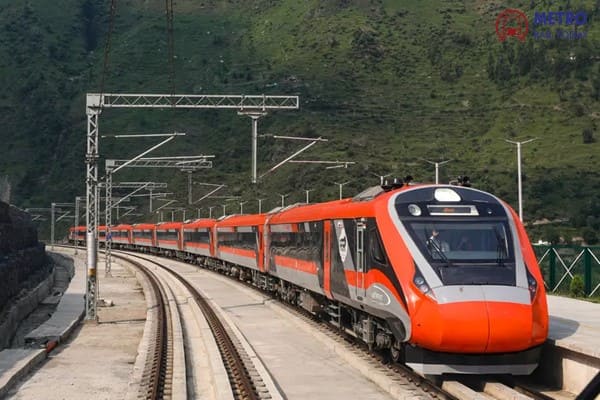 Japanese Delegation visits KRIDE to explore Bengaluru Suburban Rail Project opportunities
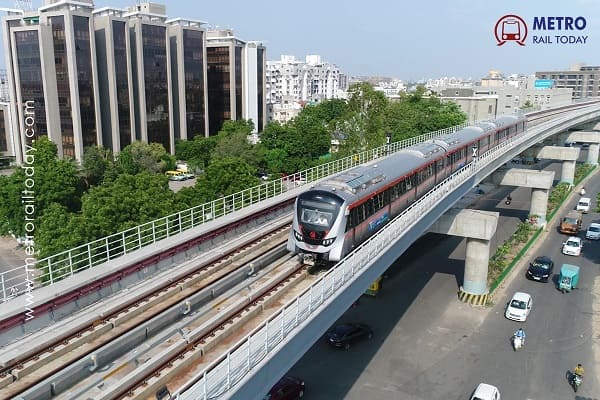 GMRC issues ₹879 crore Civil Tender for Airport Extension under Ahmedabad Metro Phase 2A
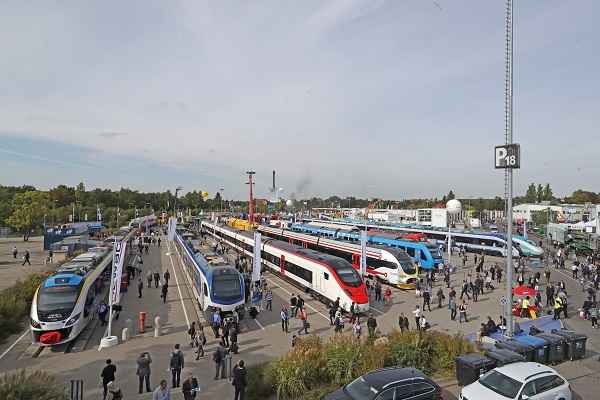 Global Mobility Leaders Alstom and Siemens become Corporate Member of Chamber of Railway Industries
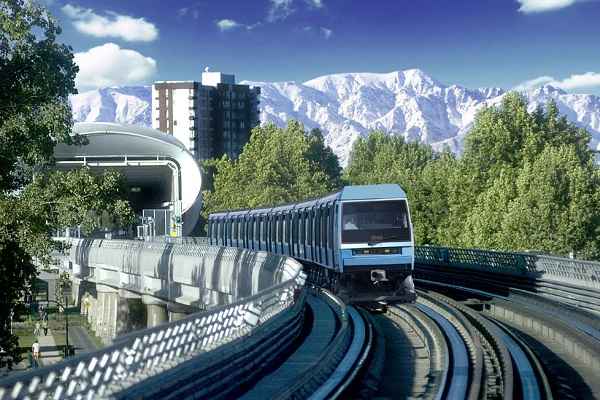 L&T-MHI JV wins contract for Automated People Mover at Dubai’s Al Maktoum International Airport
 Delhi Metro Rail Network to expand to 695 km by 2047, Six new RRTS Corridors planned
 HÜBNER at InnoTrans 2026: Global rail expertise and local capability for India’s Next-Gen Mobility
 Australia shortlists three firms/consortia for Sydney–Newcastle High Speed Rail Project
 MRVC set to procure 238 AC Vande Metro Trainsets worth ₹19,293 crore from Indian Railways
 Maharashtra approves ₹17,725 crore Mumbai Metro Line 13 linking Mira-Bhayandar with Vasai-Virar
 Gujarat issues three tenders for 48.38-km Metro-RRTS Hybrid corridors under Ahmedabad Metro Phase 3
Union Budget 2026 puts India's Rail & Metro sectors on a High-Speed Growth Track
MRT Online Desk
Posted on: 2026-02-01 16:20:00
Viewer: 1,517
Comments: 0
Country: India
City: New Delhi
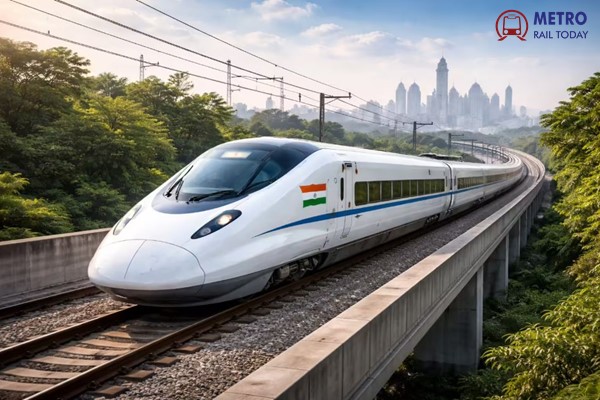
New Delhi, India (Metro Rail Today): The Union Budget 2026 has set the foundation for what could be the most consequential decade in the history of Indian Railways. With a record ₹2.93 lakh crore capital expenditure earmarked for the Ministry of Railways, the government has moved decisively beyond incremental upgrades toward building a high-speed, high-capacity and future-ready transport system.
Industry bodies and global OEMs have widely welcomed the announcement, describing it as a structural shift that positions railways not merely as a public service, but as a central driver of India’s economic and industrial transformation.
High-Speed Rail: From Prestige Project to Economic Infrastructure
High-speed rail has often been debated through the lens of cost. Budget 2026 reframes the conversation around connectivity, productivity, and long-term economic returns.
The government has sanctioned two additional bullet train corridors — Delhi–Varanasi and Varanasi–Siliguri, creating a powerful east–north connectivity spine through Uttar Pradesh, Bihar, and West Bengal. According to the Railway Minister, travel time between Delhi and Varanasi will reduce to under four hours, while the Varanasi–Siliguri corridor via Patna will take less than three hours.
“This belt will emerge as a new economic corridor. Healthcare, education, tourism and trade activities will multiply, bringing transformational benefits to the region,” the minister said.
The Rail Chamber believes these corridors will stimulate logistics hubs, manufacturing clusters, and real estate development, while also reducing dependence on short-haul aviation and highways.
Urban Mobility Gets a Multi-Layered Push
While high-speed corridors dominate headlines, Budget 2026 places equal emphasis on urban and peri-urban mobility, recognizing that India’s growth will be shaped as much by daily commutes as by intercity travel.
An allocation of ₹24,500 crore has been proposed for Metro Rail projects across 15 cities, with a strong push toward MetroLite and MetroNeo systems in smaller cities to balance affordability and coverage.
Regional Rapid Transit Systems (RRTS) also receive a significant boost, with ₹8,000 crore allocated for expanding the Delhi–Meerut model and conducting feasibility studies for corridors such as Bengaluru–Mysuru and Hyderabad–Warangal.
Suburban rail networks—often the most overstressed yet under-invested systems—have been allocated ₹12,000 crore, focusing on Mumbai, Bengaluru, and Chennai. Key priorities include capacity augmentation, elimination of unmanned level crossings, and rollout of the Kavach 5.0 safety system.
Uttar Pradesh: Emerging as a Rail Infrastructure Powerhouse
Uttar Pradesh continues to be a major beneficiary, with ₹20,012 crore allocated for FY 2026–27. Infrastructure projects worth ₹92,056 crore are currently underway across the state, spanning track expansion, station redevelopment, and safety upgrades across three railway zones.
According to the Ministry of Railways, these investments will transform UP into a strategic rail and logistics hub, especially with multiple high-speed and semi-high-speed corridors passing through the state.
Rail Chamber: “A Blueprint for a Developed India”
The Rail Chamber, India’s leading advocacy body for the rail and infrastructure ecosystem, termed the budget a “blueprint for a developed India”, highlighting the clarity of intent and long-term policy direction.
Dr. Vinod Shah, Director General of the Chamber of Railway Industries, underscored the strategic importance of the allocation.
“The Union Budget 2026 is not just about numbers; it is about the audacity of vision. Allocating ₹2.93 lakh crore in Capex is a clear signal that railways are being positioned as the backbone of India’s GDP growth,” he said.
According to the Rail Chamber, the most transformative announcement is the approval of seven new High-Speed Rail (HSR) corridors, which marks India’s transition from experimentation to network-scale deployment of high-speed rail.
“By green-lighting seven corridors, India is moving beyond the pilot phase. We are now building a comprehensive high-speed network that will redefine mobility, compress travel time, and unlock new economic clusters across Tier-2 and Tier-3 cities,” Dr. Shah added.
Employment, Industry and the Road to 2047
The Rail Chamber estimates that the current Capex cycle could generate over 1.2 million direct and indirect jobs, spanning construction, signaling, digital systems, rolling stock manufacturing, and maintenance.
The Chamber has urged private players to actively participate in upcoming Energy, Mineral and Cement Corridors, emphasizing that rail-led logistics efficiency will be crucial to India’s industrial competitiveness.
The Rail Chamber further noted that the budget maintains a careful balance between futuristic investments and everyday passenger needs.
Funds have been allocated for the manufacturing of 2,500 Amrit Bharat coaches, continued station redevelopment under the Amrit Bharat Station Scheme, and completion of 100% broad-gauge electrification within the fiscal year.
“What stands out is the balance,” Dr. Shah observed. “While India builds speed corridors and RRTS networks, the budget does not forget the common passenger. Safety systems like Kavach and station modernization ensure that the benefits of this massive Capex reach every citizen.”
Industry Response: Global Confidence in India’s Rail Vision
Global rolling stock manufacturers have responded positively. Olivier Loison, Managing Director of Alstom India, welcomed the clarity and scale of the government’s vision.
“We welcome this progressive Union Budget 2026 that prioritizes national development. The announcement of seven high-speed rail corridors will significantly boost passenger mobility and strengthen the economic ecosystem. This budget provides the right momentum for modernization in manufacturing, skilling, and community impact, aligned with the Viksit Bharat vision,” he said.
A Defining Moment for Indian Railways
As India charts its course toward the 2047 vision of a developed nation, Union Budget 2026 stands out as a defining inflection point. It signals a shift in Indian Railways—from a transport utility to a globally competitive, technology-driven, and sustainability-focused growth engine.
The tracks are being laid not just for faster trains, but for faster economic momentum, deeper regional integration, and long-term national resilience.

MRT Online Desk
Metro Rail Today is an authentic and global news provider for the Rail & Metro industry from and around the world.