

Trending Now
 Parsons-Led JV selected Project Management Consultant for Riyadh Metro Red Line Extension
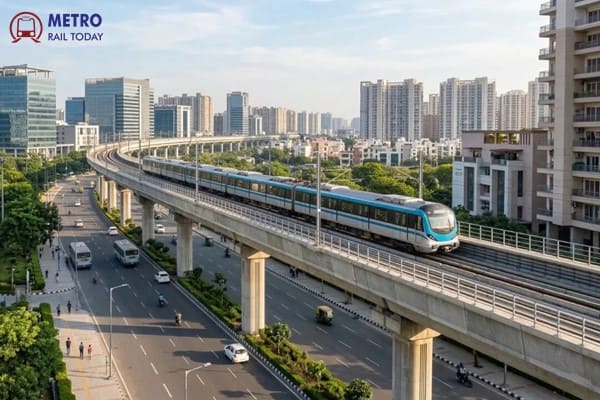 Vietnam signs turnkey contracts for Hanoi Metro's five driverless lines spanning 253.5 km
 India’s First indigenous Bullet Trainset B28 takes shape at BEML’s Bengaluru Facility
 GMRC invites bids for ₹197.14 crore Ahmedabad Metro Gyaspur Depot Development Project
 Govt of India approves 1500-km Delhi–Guwahati Northern Bullet Train Corridor
 Railway Board grants conditional clearance to RCF-Built Vande Bharat Trainset with Alstom Propulsion
 Two Consortia Bid for General Consultancy Contract for Hyderabad Metro Phase 2 Project
 RNS Infra–Gayatri Projects JV awarded ₹342 crore Civil Contract for Bengaluru Suburban Rail Project
 PM Modi to inaugurate Pune Metro's Hinjewadi–Shivajinagar Metro Corridor on November 3
 Govt of India approves ₹24,269 crore Hyderabad Metro Phase 2 Project with five new corridors
Vietnam signs turnkey contracts for Hanoi Metro's five driverless lines spanning 253.5 km
MRT Online Desk
Posted on: 2026-11-02 07:05:00
Viewer: 88
Comments: 0
Country: Vietnam
City: Ha noi
Hanoi, Vietnam (Rail & Metro Today): Hanoi has taken a major step towards expanding its urban rail network, with contracts signed for five metro lines covering approximately 253.5 km. The projects, covering Lines 1, 2, 8, 10 and 14, are planned to be developed with fully automated, driverless train operations as part of the Vietnamese capital's long-term urban mobility strategy.
The Hanoi People's Committee held a signing ceremony for the agreements between the Hanoi Metropolitan Railway Management Board (MRB) and a consortium comprising Vinhomes Joint Stock Company and SGC Investment and Construction Joint Stock Company.
The projects will be implemented through engineering, procurement and construction (EPC) turnkey contracts based on standards of the International Federation of Consulting Engineers (FIDIC). The programme includes the development of railway infrastructure and supporting depots for train stabling, maintenance and operational requirements.
Five Metro Lines to Connect Hanoi's Major Growth Centres
The five proposed lines will create a wide-ranging urban rail network connecting central Hanoi with suburban districts, emerging urban developments, the airport and major transport hubs.
Line 1 will extend approximately 59 km, connecting Hung Vuong Stadium, the railway industrial park, Ngoc Hoi, Hanoi Railway Station, Yen Vien, Thu Lam Urban Area and Noi Bai International Airport.
Line 2, covering around 60 km, will link Noi Bai International Airport with Nam Thang Long, Tran Hung Dao, Thuong Dinh and either Thuong Phuc or Hung Vuong Stadium.
Line 8 will span approximately 64 km, connecting Hoa Lac, Son Dong, Mai Dich, Ring Road 3, Linh Nam and Thuan An. Line 10 will cover around 38.7 km, serving Vo Chi Cong, Ring Road 2.5, the Times City/Vinh Tuy area and Co Loa/Dong Anh.
The fifth project, Line 14, will extend approximately 31.8 km, linking Thang Long Bridge, Hong Ha and the Ocean Park/Gia Lam area.
Together, the five corridors are expected to strengthen public transport connectivity, increase passenger-carrying capacity and reduce dependence on private vehicles. The network is also intended to support transit-oriented development (TOD), encouraging more compact urban growth around metro stations.
Speaking at the signing ceremony, Hanoi People's Committee Chairman Vu Dai Thang described the simultaneous implementation of the five lines as particularly important for the city's development. He said the projects were technically complex, large in scale and subject to a demanding schedule, with completion targeted for 2030.
GoA4 Automation and Integrated Railway Technology
A major feature of the programme is the proposed adoption of Grade of Automation 4 (GoA4), the highest level of railway automation. Under this system, trains can operate without onboard drivers or operating staff, supported by automated train control, monitoring and safety systems.
The five lines are planned around common technical standards to facilitate network integration and consistent operations. Proposed specifications include the standard 1,435 mm track gauge and communications-based train control (CBTC).
Hanoi also plans to incorporate digital technologies throughout the project lifecycle, from engineering and construction to operations and maintenance. These include front-end engineering design (FEED), building information modelling (BIM), geographic information systems (GIS) and a project common data environment (PCDE).
A Network Operations Control Centre (NOCC) is also envisaged to centrally monitor and coordinate operations across multiple urban railway lines. Such an integrated approach could improve operational oversight, service coordination, asset management and maintenance planning.
Domestic Industry Participation and Long-Term Urban Development
Beyond improving passenger mobility, the five projects are intended to strengthen Vietnam's domestic railway industry. The programme aims to encourage greater participation by Vietnamese businesses, develop local technological capabilities and expand domestic involvement in the railway supply chain.
The proposed expansion forms part of Hanoi's long-term urban development strategy, which takes a 100-year perspective. By connecting established city centres with new urban areas and major transport gateways, the metro network is expected to influence the city's future land-use patterns and economic development.
If delivered within the proposed timeframe, the five lines would represent a substantial transformation of Hanoi's public transport system. However, achieving the 2030 target will require coordinated planning, timely land acquisition, effective project management, technology integration and rigorous safety certification, particularly given the scale of the programme and its ambition to introduce fully driverless metro operations.

MRT Online Desk
Metro Rail Today is an authentic and global news provider for the Rail & Metro industry from and around the world.