


Trending Now
 Siemens Bags Order from Titagarh Rail Systems for Pune Metro Extension Trainsets
 Titagarh Rail Systems becomes Corporate Member of Chamber of Railway Industries (Rail Chamber)
 World Bank approves ₹1,400 crore Civil Tender for Gurugram Metro Phase 2
 Bi-RIDE invites ₹200 crore Tender for Soladevanahalli Depot of Bengaluru Suburban Rail Project
 GHV India awarded ₹107.79 crore Civil Contract for Lucknow Metro East-West Corridor
 Pune Metro Line 3 set to launch First 12-km Section on 15 July 2026
 DMRC gets approval to Fell or Transplant 364 Trees for Central Vista Metro Corridor under Phase IV
 ₹4.5 Lakh crore Metro Rail Investment reaches less than 5% of Urban Population in India
 West Bengal plans to launch Water Metro Systems in Kolkata
- Titagarh Rail Systems targets full Indigenous Aluminium Coach Manufacturing by FY2027
175 km of Bangalore Metro Rail Network to be Operational by December 2027
MRT Online Desk
Posted on: 2025-12-22 07:05:00
Viewer: 2,225
Comments: 0
Country: India
City: Bengaluru
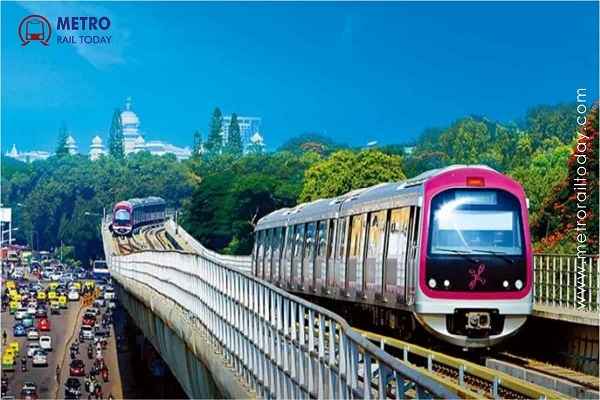
Bengaluru, India (Metro Rail Today): Karnataka Deputy Chief Minister D K Shivakumar on Monday announced that 175 km of the Namma Metro network will be operational in Bengaluru by December 2027, marking a major milestone in the city’s urban mobility expansion. Shivakumar, who also holds the portfolio of Minister in-charge of Bengaluru Development, made the announcement following a high-level review meeting with officials of Bangalore Metro Rail Corporation Limited (BMRCL).
At present, 96 km of metro network is operational in the city. The Deputy CM said the state government is aggressively fast-tracking metro projects to ease congestion and improve commuter experience.
Highlighting the benefits of recently commissioned corridors, Shivakumar said the 24-km Yellow Line, operationalised after the current government assumed office, has already shown measurable results.
“The 24-km Yellow Line has a daily footfall of nearly one lakh passengers. According to police data, traffic congestion has reduced by around 30 per cent on roads running parallel to this corridor,” he told reporters.
Metro Expansion Roadmap Till 2027
Outlining the expansion timeline, Shivakumar stated that:
-
41 km of metro lines will be commissioned in 2026
-
An additional 38 km, including the much-awaited Airport Line, will be operational by December 2027
-
This will take Bengaluru’s total metro network length to 175 km
He also confirmed that plans are underway to extend metro connectivity to Tavarekere, Hosakote, Bidadi and Nelamangala, with Detailed Project Reports (DPRs) currently under preparation.
Phase 3: 100 km Metro Network with Double-Decker Corridors
The Deputy CM announced that tenders will be floated next month for around 100 km of metro lines under Phase 3, which will predominantly feature double-decker corridors—with an elevated road at the lower deck and metro tracks above.
“We have expedited Phase 3 to ease traffic congestion in the city. The entire Phase 3 will be developed in a double-decker format,” Shivakumar said.
He added that the Magadi Road stretch has also been converted into a double-decker project, citing heavy vehicular movement from Hassan and western Karnataka through this corridor.
To improve project viability and commuter convenience, the government has directed BMRCL to promote commercial development around metro stations.
“We have instructed officials to acquire additional land to create commercial activity near metro stations. Adequate parking facilities will also be provided,” Shivakumar said.
Project Cost and Funding Structure
The projected cost of Phase 3 of Namma Metro stands at ₹25,311 crore. Of this:
-
₹15,600 crore will be financed through the Japan International Cooperation Agency (JICA)
-
Tenders worth ₹9,700 crore are scheduled to be called in January
Responding to concerns over bids exceeding initial cost estimates, Shivakumar clarified that the financial risk largely rests with the private players.
“The government is not paying the entire amount upfront. The bidder has to invest in the project, and we will reimburse only 40 per cent of our estimated cost,” he said, adding that metro construction costs in Mumbai have touched ₹1,200 crore per km.
Commenting on Bengaluru’s metro expansion strategy, Mrs. Mamta Shah, MD & CEO, Urban Infra Group, said:
“Bengaluru’s decision to aggressively expand its metro network, especially through double-decker corridors, reflects a pragmatic response to severe land constraints and traffic pressure. While such designs are complex and capital-intensive, they are essential for cities aiming to scale mass transit quickly without disrupting existing road infrastructure.”
With Phase 3 tenders imminent and multiple corridors scheduled for commissioning over the next two years, Bengaluru is positioning itself for a transformative leap in urban mobility. However, experts note that execution speed, coordination across agencies, and cost discipline will be critical to ensuring that the ambitious 175-km target is met within the announced timeline.


MRT Online Desk
Metro Rail Today is an authentic and global news provider for the Rail & Metro industry from and around the world.