

Trending Now
 Gamuda awarded RM3.7 billion contract to build Keelung Mass Rapid Transit in Taiwan
 Maharashtra forms special Task Force to plan Rail, Metro and RRTS expansion
 Govt. of India approves ₹12,200 crore, 29-km Thane Integral Ring Metro project in Maharashtra
 World’s Top 20 Metro Systems: Engineering Marvels Transforming the Future of Urban Mobility
 NCRTC celebrates Three Years of Namo Bharat, Highlights 4.5 crore Passenger Journeys
 Alstom eyes ₹2,000 crore Chennai Metro tender for supply of 168 Train Coaches
 SYSTRA India emerges as lowest bidder for Thane Metro Design Consultancy Contract
 Adani Group's Cemindia Projects wins ₹921.63 crore Underground Package for Jaipur Metro
 EFKON India wins ₹288.11 crore Station Systems Contract for Indore Metro Rail Project
 L&T partners with IIT Madras-Backed TuTr Hyperloop to explore Next-Gen Mobility
China opens four High-Speed Railway Lines, Adds 1,142 km to existing Bullet Train Network
MRT Online Desk
Posted on: 2026-09-29 07:10:00
Viewer: 1,789
Comments: 0
Country: China
City: Beijing
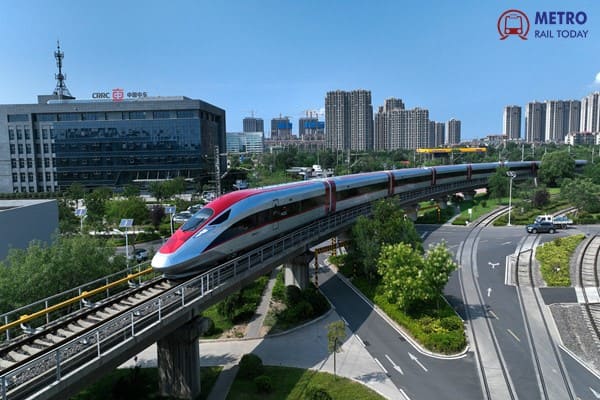
Beijing, China (Rail & Metro Today): China has further expanded its already extensive high-speed railway network with the simultaneous opening of four new high-speed rail lines on September 28, adding around 1,142 km of new railway infrastructure across different regions of the country.
The new openings include projects in northeastern, northern, central and western China, featuring operating speeds of up to 350 km/h. The new lines are expected to significantly reduce travel times between major cities and regional centres while improving connectivity across the national high-speed rail network.
Harbin–Yichun Line Brings High-Speed Rail to Permafrost Region
In northeast China, the 250 km/h Harbin–Yichun line connects Heilongjiang's provincial capital Harbin with Yichun along a 318-km alignment. The line has seven stations, including Suihua and Tieli.
Its Yichun West terminus is notable for being the northernmost high-speed railway station in China. The region experiences extremely cold winters, with temperatures capable of falling to around -40°C, and the station is the first high-speed railway station in China to be built in a permafrost region.
China Railway has initially introduced 10 round trips per day, including a daily long-distance service to Beijing and another to Dalian. The number of services is expected to increase to 19 trains per day.
The fastest end-to-end journey between Harbin and Yichun is now 1 hour 46 minutes, compared with a minimum journey time of 6 hours 32 minutes on the conventional railway, representing a substantial reduction in travel time.
552-km Xiong'an–Shangqiu Section Opens
The longest of the four newly opened sections is the 552-km Xiong'an–Shangqiu section of the Beijing–Hong Kong high-speed railway. Designed for speeds of up to 350 km/h, the section has 16 stations, including 10 new stations.
The line begins at Xiong'an, the new national capital city area south of Beijing, and passes through important locations in Hebei, Shandong and Henan provinces.
Its route serves Cangzhou, Hengshui and Xingtai in Hebei; Liaocheng, Jining and Heze in Shandong; and Puyang and Shangqiu in Henan. The fastest journey between Xiong'an and Shangqiu is now 2 hours 27 minutes.
The new section strengthens north-south high-speed connectivity and provides another important link within China's expanding national high-speed rail system.
Yichang–Xingshan Creates New High-Speed Connection
Central China has also gained a new high-speed link with the opening of the 101-km Yichang–Xingshan line, which has a design speed of 350 km/h.
Starting from Yichang North on the Shanghai–Chongqing–Chengdu high-speed railway, the line runs northwest towards Xingshan on the Zhengzhou–Chongqing high-speed railway.
Initially, China Railway is operating just two round trips, with trains taking approximately 30 minutes to cover the route. The new connection is expected to reduce the journey time between Wuhan and Chongqing to less than four hours, with additional services anticipated in the near future.
Xi'an–Ankang Section Opens in Western China
In western China, the northern 171-km section of the 739-km Xi'an–Chongqing high-speed railway has also entered service. The newly opened section runs between Xi'an East and Ankang West and is designed for speeds of up to 350 km/h.
The section has five stations and dramatically reduces the travel time between Xi'an and Ankang. The journey, which previously took around three hours on the conventional railway, can now be completed in approximately 45 minutes.
The remaining section between Ankang and Chongqing is expected to open in 2028, completing the larger high-speed connection between the two cities.
China Continues High-Speed Rail Expansion
The simultaneous opening of the four lines demonstrates the scale and geographical reach of China's continuing high-speed railway development. From the extremely cold permafrost region of Heilongjiang to the mountainous terrain of western China, the projects introduce faster rail connections across diverse geographic and climatic conditions.
With operating speeds reaching 350 km/h on three of the newly opened routes, the latest additions further strengthen China's high-speed rail network and its role in connecting major cities, regional centres and emerging economic areas.
The new services are also expected to expand progressively, with additional train frequencies planned on several of the newly commissioned routes as passenger demand develops.


MRT Online Desk
Metro Rail Today is an authentic and global news provider for the Rail & Metro industry from and around the world.