


Trending Now
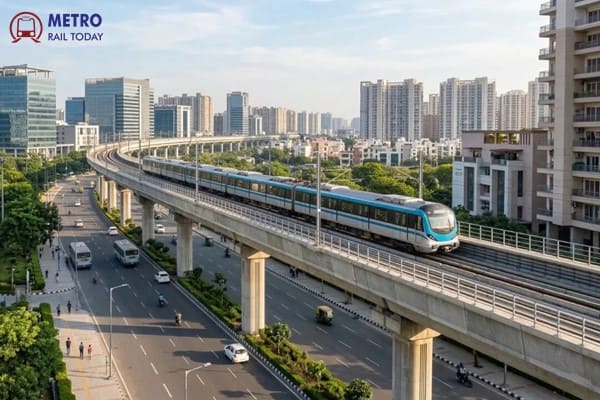 Govt. of India approves ₹12,200 crore, 29-km Thane Integral Ring Metro project in Maharashtra
 World’s Top 20 Metro Systems: Engineering Marvels Transforming the Future of Urban Mobility
 NCRTC celebrates Three Years of Namo Bharat, Highlights 4.5 crore Passenger Journeys
 Alstom eyes ₹2,000 crore Chennai Metro tender for supply of 168 Train Coaches
 SYSTRA India emerges as lowest bidder for Thane Metro Design Consultancy Contract
 Adani Group's Cemindia Projects wins ₹921.63 crore Underground Package for Jaipur Metro
 EFKON India wins ₹288.11 crore Station Systems Contract for Indore Metro Rail Project
 L&T partners with IIT Madras-Backed TuTr Hyperloop to explore Next-Gen Mobility
 Alstom, Larsen & Toubro unveil First Driverless Trainset for Mumbai Metro Lines 4 and 4A
 BEML, Czech Republic delegation explore strategic Industrial and Technology Partnerships
Govt. of India approves ₹12,200 crore, 29-km Thane Integral Ring Metro project in Maharashtra
Dr. Vinod Shah
Posted on: 2026-10-16 17:10:00
Viewer: 139
Comments: 0
Country: India
City: New Delhi
New Delhi, India (Rail & Metro Today): The Union Cabinet, chaired by Prime Minister Narendra Modi, has approved the 29-km Thane Integral Ring Metro Rail Project in Maharashtra, paving the way for a new urban transit corridor designed to ease congestion and improve connectivity across Thane. The project will feature 22 stations and is expected to serve growing residential, commercial and employment hubs across the city.
The proposed corridor will run along the western periphery of Thane, bounded by the Ulhas River on one side and Sanjay Gandhi National Park (SGNP) on the other. It will connect key areas including Naupada, Wagle Estate, Dongripada, Hiranandani Estate, Kolshet and Saket, strengthening access to important destinations within the rapidly expanding urban centre.
Elevated and Underground Sections Across 22 Stations
The 29-km metro corridor will comprise approximately 26 km of elevated infrastructure and 3 km of underground sections. The project is planned as an integral ring corridor, intended to improve urban mobility and provide an alternative to road-based travel in one of the Mumbai Metropolitan Region’s major urban centres.
By connecting residential neighbourhoods with commercial areas and employment hubs, the line is expected to improve daily commuting options for office workers, students and other passengers. The approved project information identifies the key areas to be served but does not provide a complete station-by-station list.
Maha Metro to Execute the Project
Maharashtra Metro Rail Corporation Limited (Maha Metro) will execute the project’s civil, electromechanical and associated works. Pre-bid activities have commenced, and tender documents are being prepared.
According to the government’s announcement, contracts will be floated for bidding immediately. The next major milestones will include the tendering process, appointment of contractors and subsequent implementation of the corridor.
Innovative Financing and Public Investment
The project will be funded through equal equity contributions from the Government of India and the Government of Maharashtra, supplemented by part-funding from bilateral agencies.
The financing plan also envisages innovative revenue-generation mechanisms, including the sale of station naming and access rights to corporate entities, asset monetisation and Value Capture Financing. These approaches are intended to help leverage the economic value generated by improved transport connectivity.
The government has not specified the amount expected from each funding source in the project information provided.
Ridership Expected to Cross 8.7 Lakh by 2045
The Thane Integral Ring Metro is projected to record daily ridership of 6.47 lakh passengers in 2029. This is expected to increase to 7.61 lakh in 2035 and reach 8.72 lakh by 2045, reflecting the anticipated growth in travel demand across the city.
The corridor is expected to offer a more efficient and sustainable alternative to private vehicles, helping reduce road congestion and greenhouse gas emissions. Faster and potentially more affordable journeys could also benefit students, office commuters and residents travelling between major activity centres.
Strengthening Thane’s Urban Mobility
Commenting on the significance of metro expansion for growing cities, Mrs. Mamta Shah, Managing Director and CEO of Urban Infra Group, said:
“The approval of the Thane Integral Ring Metro is an important step towards building a more connected and sustainable urban transport network. Ring corridors can improve access between residential and employment centres while reducing dependence on congested roads. Effective project execution, integrated feeder services and passenger-focused planning will be essential to realising the full benefits of this investment.”
With Cabinet approval secured and pre-bid preparations underway, the Thane Integral Ring Metro moves towards the tendering stage. Its eventual impact will depend on timely execution, effective integration with other transport services and the delivery of reliable passenger operations.


Dr. Vinod Shah
Dr. Vinod Shah is an experienced urban transport journalist, blogger and key opinion leader.