


Trending Now
 RITES submits fresh DPR to UPMRC for ₹12,000 crore Prayagraj Metro Rail Project
 Paras Railtech wins ₹84.72 crore Ballastless Track Contract for Jaipur Metro Rail Project
 Indian Railways announces 3,548 Graduate-Level Vacancies under NTPC Recruitment 2026
 European Union sanctions €10 million to support extension of Hanoi Metro Line 3
 GMRC issues ₹683 crore Tender for construction of 8.68 km stretch for Ahmedabad Metro
- GMRC launches ₹439 crore Tender for construction of 5 New Ahmedabad Metro Stations
 Global tender issued for procurement of 60 Rolling Stock coaches for Hyderabad Metro Rail Project
 Global tender issued for procurement of 102 Rolling Stock coaches for Patna Metro Rail Project
 Gamuda awarded RM3.7 billion contract to build Keelung Mass Rapid Transit in Taiwan
 Maharashtra forms special Task Force to plan Rail, Metro and RRTS expansion
Delhi-Gurugram-Bawal Namo Bharat RRTS Corridor set for Behror Extension after PIB clearance
MRT Online Desk
Posted on: 2026-07-31 17:15:00
Viewer: 1,929
Comments: 0
Country: India
City: New Delhi
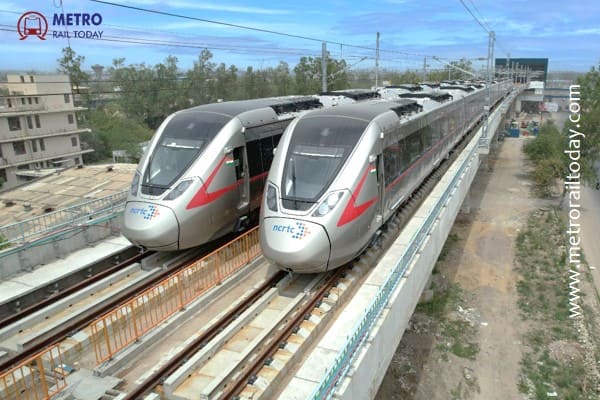
New Delhi, India (Rail & Metro Today): The proposed Sarai Kale Khan–Gurugram–Bawal Namo Bharat Regional Rapid Transit System (RRTS) corridor is set to expand further into Rajasthan, with the Union Ministry of Housing and Urban Affairs proposing an extension up to Behror. The proposal has received clearance from the Public Investment Board (PIB) and has now been forwarded to the Ministry of Finance for financial approval.
The proposed extension is expected to strengthen rapid regional connectivity between Delhi-NCR, southern Haryana and the rapidly developing industrial belt of Rajasthan. The extension will add approximately 36 km to the corridor, including around 11 km in Haryana and 25 km in Rajasthan, with four new Namo Bharat stations between Bawal and Behror.
Behror Extension to Add 36 km and Four Stations
According to the proposal, the extension from Bawal to Behror will comprise approximately 11 km in Haryana and 25 km in Rajasthan. Four new stations are proposed along the extended section, enabling passengers to travel between Bawal and Behror in around 24 minutes.
The extension is estimated to increase the project cost by approximately ₹8,000 crore, taking the overall proposed cost of the Delhi-Gurugram-Bawal-Behror corridor to nearly ₹43,000 crore.
The Ministry of Housing and Urban Affairs forwarded the PIB note after incorporating observations from the Department of Expenditure and other concerned ministries. The proposal is based on a supplementary Detailed Project Report (DPR) submitted by the National Capital Region Transport Corporation (NCRTC) on May 9, 2026.
The proposal was subsequently moved to the Department of Expenditure under the Ministry of Finance for financial clearance.
Corridor Restored Towards Original Behror Alignment
The proposed Behror extension marks another major change in the evolution of the Gurugram-Alwar Namo Bharat corridor. The corridor was originally conceived as the Delhi-Gurugram-SNB (Shahjahanpur-Neemrana-Behror)-Alwar corridor when NCRTC identified three priority RRTS corridors in 2019.
The other two priority corridors were Delhi-Ghaziabad-Meerut and Delhi-Sonipat-Panipat.
While the Delhi-Ghaziabad-Meerut Namo Bharat corridor has already become operational, the Delhi-Sonipat-Panipat corridor is awaiting final approval from the Central Government. NCRTC has also undertaken drone and soil surveys for its proposed extension towards Karnal.
The Gurugram-Alwar corridor, meanwhile, underwent several revisions. Its alignment was initially planned up to the Shahjahanpur-Neemrana-Behror region before being curtailed first to Dharuhera and subsequently to Bawal.
The latest proposal seeks to restore the corridor towards Behror, responding to growing economic activity and persistent demands from industrial stakeholders and residents in the region.
Namo Bharat to Support Haryana-Rajasthan Industrial Belt
Union Minister of State and Gurugram MP Rao Inderjit Singh said the extension has been driven by the growing economic importance of the region.
The proposal takes into account major upcoming and expanding economic centres, including the Nangal Chaudhary logistics hub, IMT Bawal and the Khushkhera-Bhiwadi-Neemrana Investment Region.
The corridor is also expected to provide faster and more reliable connectivity to thousands of workers employed in the Shahjahanpur-Neemrana-Behror industrial belt, while improving access between residential areas and employment centres.
The extension is therefore expected to support industrial development, labour mobility and regional economic integration across southern Haryana and northern Rajasthan.
NCRTC Projects Strong Ridership on Gurugram-Alwar Corridor
The proposed Gurugram-Alwar Namo Bharat corridor is expected to emerge as one of the busiest regional rapid transit corridors in the National Capital Region.
According to projections of the National Capital Region Planning Board (NCRPB), the Gurugram-Alwar corridor could record daily ridership of around 15.1 lakh passengers by 2041.
This is higher than the projected ridership of approximately 11.4 lakh passengers on the Delhi-Meerut corridor and around 9.83 lakh passengers on the Delhi-Panipat corridor.
The high projected demand reflects the rapid urbanisation and industrialisation taking place along the Delhi-Gurugram-Rewari-Bawal-Neemrana-Behror growth belt.
Strategic Link Between Delhi-NCR and Rajasthan
Once approved and implemented, the extended Namo Bharat corridor could significantly improve connectivity between Delhi, Gurugram, Rewari, Bawal, Neemrana and Behror.
The corridor will provide a faster alternative to road-based travel along a region experiencing increasing traffic congestion and rapid industrial development. It will also strengthen access to major employment centres, logistics hubs, industrial estates and emerging urban settlements.
The proposed Behror extension is particularly significant for the Delhi-Mumbai Industrial Corridor (DMIC) influence zone, where industrial and logistics activities are expanding rapidly.
The development of a high-capacity regional rail system could encourage greater public transport use while reducing dependence on private vehicles for long-distance daily commuting.
A Major Step Towards Integrated NCR Regional Mobility
The proposed extension demonstrates the evolving role of the Namo Bharat RRTS network in connecting Delhi-NCR with neighbouring economic regions rather than serving only as an intercity transport system.
With the Delhi-Meerut corridor already operational and several additional corridors under planning and development, the Namo Bharat network is gradually emerging as a key component of India's regional mobility strategy.
The proposed Sarai Kale Khan–Gurugram–Bawal–Behror corridor could become an important north-south regional transport spine, connecting Delhi-NCR with the industrial and economic centres of southern Haryana and Rajasthan.
The project will now require financial approval from the Ministry of Finance before the extended alignment can move towards the next stages of implementation. If approved, the Behror extension is expected to give a major boost to regional connectivity, industrial growth and sustainable mobility across the Delhi-NCR-Haryana-Rajasthan economic corridor.


MRT Online Desk
Metro Rail Today is an authentic and global news provider for the Rail & Metro industry from and around the world.