

Trending Now
 Alstom to deploy DTG Signalling System for Jaipur Metro’s 5.2-km Phase-1 Extension
 RVNL floats ₹297.45-crore Power Systems Tender for Kolkata Metro Purple Line
 Siemens Mobility awarded $772 million Trainset Contract for California High-Speed Rail Project
 RITES submits fresh DPR to UPMRC for ₹12,000 crore Prayagraj Metro Rail Project
 Paras Railtech wins ₹84.72 crore Ballastless Track Contract for Jaipur Metro Rail Project
 Indian Railways announces 3,548 Graduate-Level Vacancies under NTPC Recruitment 2026
 European Union sanctions €10 million to support extension of Hanoi Metro Line 3
 GMRC issues ₹683 crore Tender for construction of 8.68 km stretch for Ahmedabad Metro
- GMRC launches ₹439 crore Tender for construction of 5 New Ahmedabad Metro Stations
 Global tender issued for procurement of 60 Rolling Stock coaches for Hyderabad Metro Rail Project
Exclusive Interview with Uwe Sperber, Site Manager, Hubner Interface Systems India
MRT Online Desk
Posted on: 2026-09-07 07:10:00
Viewer: 13,255
Comments: 0
Country: India
City: Bengaluru
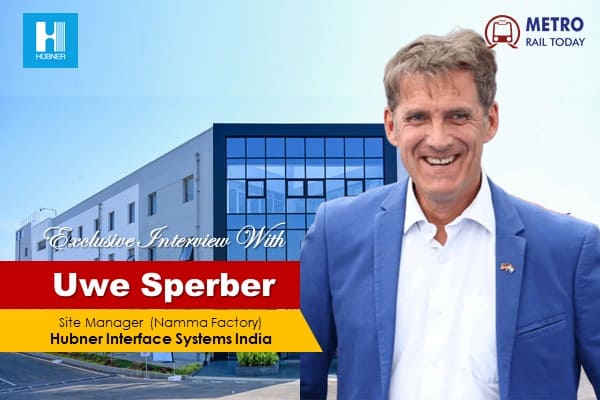
India’s rail and urban mobility sector is entering a new phase of technological advancement, localisation and global integration, creating significant opportunities for international companies with strong local capabilities. HÜBNER Group, a global leader in gangway and intercar systems, has been steadily strengthening its presence in India through local engineering, manufacturing and an expanding supplier ecosystem. Its Bengaluru-based “Namma Factory” has emerged as an important part of this strategy, producing gangway systems not only for major Indian projects but also for international markets.
In an exclusive interaction with Metro Rail Today, Uwe Sperber, Site Manager, HUBNER Interface Systems India, discusses HÜBNER’s evolving India strategy, the growth of its manufacturing and engineering capabilities, opportunities emerging from India’s expanding metro and rail networks, and the company’s focus on sustainable technologies and global market integration.
HÜBNER Group has established a significant presence in India through HUBNER Interface Systems (India) and its “Namma Factory.” Could you briefly explain HÜBNER Group’s journey and business operations in India?
HÜBNER’s journey in India reflects our commitment to combining global expertise with genuine local presence. We have been active in the Indian market for many years, supplying gangway systems for major metro projects including the Delhi Metro, the Bhopal-Indore Metro and the Regional Rapid Transit System – India's first semi-high-speed regional rail service, which has been in operation since October 2023.
The decisive step in deepening our commitment to India was the establishment of HUBNER Interface Systems India Pvt. Ltd. in 2011 and the commissioning of our “Namma Factory” near Bengaluru in 2023. Here on site, we mainly design and manufacture gangway systems, but also other products, combining the engineering know-how of the HÜBNER Group with the capabilities of our Indian team.
Since joining the company in 2016, how have you seen HÜBNER’s Indian operations evolve in terms of manufacturing capabilities, workforce, technology and business scale?
When I joined HÜBNER in 2016, our India activities were primarily focused on project-based supply and business development. What has happened since then is a genuine transformation. The most visible milestone is of course the “Namma Factory”, which has grown from 125 to more than 175 employees – and this growth is not just in numbers, but in depth of capability.
Since opening, the “Namma Factory” has already produced 800 gangway systems for the Mumbai Metro – one of the largest orders in the history of the HÜBNER Group. This achievement demonstrates that our operations in India are not only up and running but delivering at scale and at the quality level our customers worldwide expect.
How important is India within HÜBNER Group’s global manufacturing and business strategy? What specific products, technologies or capabilities developed in India are contributing to the Group’s international operations?
India is a strategically important pillar of the HÜBNER Group’s global setup, as HÜBNER has always believed that proximity to customers and markets facilitates close collaboration and excellent service for clients. From a manufacturing perspective, India contributes to the Group’s capacity for gangway systems – a product area in which HÜBNER is the global market leader. The capabilities built up in India are not only serving Indian customers but are increasingly relevant for the broader Asia-Pacific market as well.
What makes India particularly valuable in our global network is the combination of engineering talent, manufacturing competitiveness and the sheer scale of the domestic market opportunity. The skills and processes developed here feed back into the Group’s overall knowledge base.
India is witnessing rapid expansion of metro rail, regional rapid transit, high-speed rail and modern public transport systems. What opportunities do you see for HÜBNER in India’s growing rail and mobility market?
The scale of India’s rail ambitions is extraordinary, with significant investments in metro systems across dozens of cities, in regional rapid transit, and increasingly in high-speed rail. Each of these segments plays to the core strengths of HÜBNER Group. For metros, gangway systems are a key component – and our track record here speaks for itself. As new metro lines are built and existing networks expand, the demand for high-quality, reliable gangway systems will continue to grow.
Beyond gangways, our broader portfolio – including bogies, articulation systems and door safety solutions such as our SensIQ family – sets technological standards and it is highly relevant for the Indian market. As Indian operators raise their expectations for passenger comfort, safety and energy efficiency, the technologies we are developing globally will find strong application here. We combine efficiency, safety and reliability.
Could you highlight some of the key technologies, products or solutions that HÜBNER is currently developing or manufacturing in India for trains, metro systems, buses and other public transport applications?
A key focus of HÜBNER India is the development and manufacturing of gangway systems for rail vehicles. The Namma Factory in Bengaluru is supplying both the Indian market and international rail projects. It has already produced gangways for the Vande Bharat Express and is involved in metro projects Cairo, Egypt and São Paulo, Brazil. We also see potential in India for our other business areas, such as airport technology with our folding canopies for passenger boarding bridges and chassis solutions for buses and commercial vehicles. In addition to its production capabilities, the “Namma Factory” places a strong emphasis on sustainable manufacturing, including the use of solar energy.
Sustainability, localisation and advanced manufacturing are becoming increasingly important in the Indian rail sector. How is HÜBNER India responding to these trends, particularly in terms of local sourcing, innovation and sustainable manufacturing?
At HÜBNER Group, we consider sustainability in the design of a product, in its manufacturing process and in its long-term use – not simply by replacing one material with another. HÜBNER EcoTex is a good example: the bellows fabric is made entirely from recycled nylon sourced from fishing nets and sustainable raw materials. Its solvent-free production process can reduce CO₂ emissions by up to 45%, while maintaining the robustness and safety required for rail applications.
Our FXpro articulation systems follow a similar eco-design logic: up to 98% of metal parts can be reused, combining resource efficiency with long service life and low lifecycle costs. Sustainability and operational performance are not opposing goals – good engineering should bring them together.
In terms of local sourcing, we are continuously working to deepen our supply chain in India. The “Make in India” initiative also creates a structural opportunity for us. With our local manufacturing base near Bengaluru, we are well positioned to meet localisation requirements and to be a genuine partner for Indian rail manufacturers and operators.
HÜBNER Group is participating at InnoTrans 2026 in Berlin. What are the key expectations from the exhibition, and what technologies, products or innovations would you like the global rail industry to take note of?
We invented the modern gangway system and still lead the world market today., because we have never stopped wanting to be the best. With this spirit, we are constantly developing our product portfolio with new technologies. Beyond the products I have already mentioned, I would especially like to highlight two developments. First, HOLO IQ – our transparent holographic display system developed with ZEISS Microoptics, which is already in pilot operation with leading European transport companies. HÜBNER and ZEISS recently received a “special recognition” in the CNA Innovation Award for it, and I believe it represents a genuine step change in passenger information and experience.
Second, the HÜBNER AutoCouple System – a world first with the potential to fundamentally change how operators manage train capacity. This fully automated coupling of gangway systems makes it possible for operators to adjust passenger train capacity more quickly and flexibly in response to fluctuations in demand, reducing downtime and lowering staffing costs. We will be giving our customers the opportunity to break new ground by implementing the HÜBNER AutoCouple System for the first time as part of a pilot project.
For visitors and customers, InnoTrans 2026 is an excellent opportunity to see these technologies first-hand and to discuss how they can be adapted for the Indian market. We are looking forward to many good conversations at our Booth 120 in Hall 1.2.
From an Indian perspective, what role do you believe Indian engineering, manufacturing talent and the domestic supply chain can play in making India an increasingly important global hub for railway and mobility technologies?
India’s engineering talent is world-class – this is something we experience directly in our own team. The depth of technical knowledge, the problem-solving mindset and the commitment to quality that we see in our Indian colleagues are impressive, and they are a key reason why our Bengaluru facility has been able to scale so quickly and deliver such complex projects.
I believe India has the potential to become not just a large consumer of rail technology, but an important contributor to its global development. The combination of a massive domestic market – which creates real-world testing and scaling opportunities at a pace that few other countries can match – with a strong engineering base and a growing industrial ecosystem is a powerful foundation.
Finally, what is your vision for HÜBNER India’s growth over the next five years, and what message would you like to share with India’s railway, metro and public transport industry?
My vision is clear: We want to continue to build our standing as a trusted partner for gangway systems and intercar solutions in the Indian market – and to grow our footprint significantly, both in terms of the products we offer and the customers we serve. That means continuing to expand our manufacturing capacity at the “Namma Factory”, deepening our local engineering capabilities, and broadening our product portfolio beyond gangway systems to include more of the technologies that HÜBNER Group offers globally, e.g. bogie solutions for rail and chassis technologies for road vehicles. It also means being a genuine contributor to India’s rail ambitions – not just supplying components, but partnering with Indian manufacturers, operators and authorities to develop solutions that are right for Indian conditions and requirements.
Our message to India’s railway, metro and public transport industry is this: HÜBNER is here for the long term. We have invested in India because we believe in India’s rail future. We bring 80 years of global experience in making mobility happen – and we are committed to putting that experience to work for India. We look forward to growing together.

MRT Online Desk
Metro Rail Today is an authentic and global news provider for the Rail & Metro industry from and around the world.