


Trending Now
 Alstom to deploy DTG Signalling System for Jaipur Metro’s 5.2-km Phase-1 Extension
 RVNL floats ₹297.45-crore Power Systems Tender for Kolkata Metro Purple Line
 Siemens Mobility awarded $772 million Trainset Contract for California High-Speed Rail Project
 RITES submits fresh DPR to UPMRC for ₹12,000 crore Prayagraj Metro Rail Project
 Paras Railtech wins ₹84.72 crore Ballastless Track Contract for Jaipur Metro Rail Project
 Indian Railways announces 3,548 Graduate-Level Vacancies under NTPC Recruitment 2026
 European Union sanctions €10 million to support extension of Hanoi Metro Line 3
 GMRC issues ₹683 crore Tender for construction of 8.68 km stretch for Ahmedabad Metro
- GMRC launches ₹439 crore Tender for construction of 5 New Ahmedabad Metro Stations
 Global tender issued for procurement of 60 Rolling Stock coaches for Hyderabad Metro Rail Project
Indian parliamentary panel seeks push for indigenous Bullet Train technology & global best practices
MRT Online Desk
Posted on: 2026-08-11 08:21:00
Viewer: 2,304
Comments: 0
Country: India
City: New Delhi
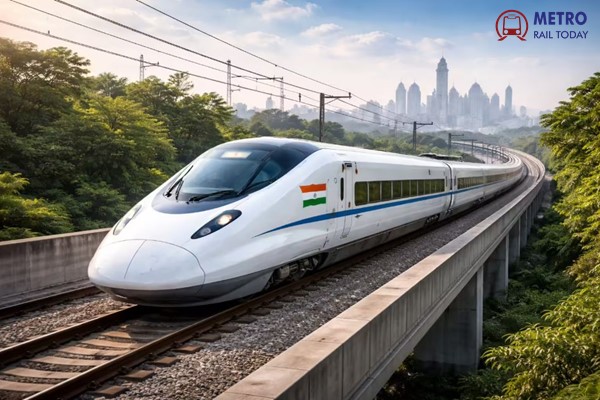
New Delhi, India (Rail & Metro Today): A Parliamentary Standing Committee on Railways has called for stronger efforts to develop domestic manufacturing capabilities for bullet train components and expand skill development programmes with international expertise as India prepares to build a nationwide high-speed rail network.
In its 10th Report, tabled in Parliament on August 10, 2026, the Standing Committee on Railways sought detailed information from the Railway Ministry on measures being taken to strengthen indigenous capabilities in high-speed rail technology, including the manufacturing of critical components.
The committee also urged the Railway Ministry to undertake a comprehensive study of successful high-speed rail networks in other countries to gain a better understanding of their operations, technology, maintenance practices and implementation models. The recommendations are particularly relevant as India prepares for seven new high-speed rail corridors announced in the Union Budget 2026-27.
Focus on Indigenous Bullet Train Manufacturing
The Parliamentary panel's recommendations come as India moves towards reducing its dependence on imported technology and developing its own high-speed rail ecosystem.
The Ministry of Railways had earlier informed the committee that detailed information regarding the manufacturing technology of Japan's E10 series Shinkansen trains was not available to India. Consequently, efforts have been initiated to develop an indigenous high-speed train platform.
The proposed Indian bullet train has been designated B28 and is being developed with a design speed of 280 kmph.
The initiative is expected to create opportunities for Indian companies involved in rolling stock manufacturing, propulsion, signalling, train control, braking systems, electrical equipment and other high-speed rail technologies.
Global High-Speed Rail Experience to Guide Future Corridors
The committee has also emphasised the importance of studying international experience before implementing India's next generation of high-speed rail corridors.
Countries with mature high-speed rail systems could provide valuable lessons in areas such as train operations, infrastructure design, safety systems, asset maintenance, passenger services, workforce development and technology localisation.
The recommendation assumes greater significance with seven new high-speed rail corridors announced in the Union Budget 2026-27:
Mumbai–Pune, Pune–Hyderabad, Hyderabad–Bengaluru, Hyderabad–Chennai, Chennai–Bengaluru, Delhi–Varanasi and Varanasi–Siliguri.
The government is already working towards developing standardised designs and technical specifications for future high-speed rail projects, drawing on experience gained from the Mumbai–Ahmedabad High Speed Rail (MAHSR) project.
Skill Development with International Expertise
The Parliamentary committee has also sought details of skilling and training programmes being conducted with international assistance and expertise.
Developing a skilled workforce is expected to be critical as India expands its high-speed rail programme. High-speed railway systems require specialised expertise in areas ranging from rolling stock maintenance and track engineering to signalling, traction, safety, operations and advanced railway systems.
The committee's emphasis on training indicates that India's high-speed rail strategy is increasingly moving beyond infrastructure construction towards creating a complete domestic ecosystem.
Mumbai–Ahmedabad Bullet Train Project Sets the Foundation
India's first high-speed rail project—the 508-km Mumbai–Ahmedabad High Speed Rail corridor—is currently under construction and is expected to serve as the technological and operational foundation for future projects.
The Railway Ministry has announced that the first phase, covering the Surat–Vapi section, is targeted to commence operations in August 2027.
Experience from the MAHSR project is expected to play an important role in developing India's indigenous rolling stock, infrastructure standards, construction practices and high-speed railway workforce.
Committee Reviews Government Action on Earlier Recommendations
The 10th report primarily examines the action taken by the government on the 17 recommendations made by the committee in its 8th Report on the Demand for Grants (2026-27).
The 8th report was presented to Parliament on March 10, 2026, while the latest report was tabled on August 10, 2026.
The committee's latest observations underline the importance of building domestic technological capabilities alongside physical infrastructure as India prepares to expand its high-speed rail network.
With the proposed B28 indigenous bullet train, standardised engineering designs, international knowledge exchange and expanded skill development, India is seeking to build a high-speed rail ecosystem that is not only capable of delivering the country's future corridors but also increasingly supported by Indian technology, manufacturing and expertise.

MRT Online Desk
Metro Rail Today is an authentic and global news provider for the Rail & Metro industry from and around the world.