

Trending Now
 Delhi-Gurugram-Bawal Namo Bharat RRTS Corridor set for Behror Extension after PIB clearance
 Thiruvananthapuram, Kozhikode Metro projects face uncertainty as Centre tightens population norm
 Indian Railways Plans Standard Design for Seven New High-Speed Bullet Train Corridors
 India’s First Vande Bharat Freight EMU hits 145 kmph in Technical Trials in Rajasthan
 Centre rejects Coimbatore and Madurai Metro proposals again, Suggests BRTS as an alternative mode
 Kochi’s integrated Mobility Model sets New Benchmark for sustainable Urban Transport
 MoHUA creates separate departments for Delhi Capital Development and Urban Development
 CMRS issues safety clearance for commercial opening of first stretch of Pune Metro Line 3
- India plans indigenous Bharat Train Control System (BTCS) for future Bullet Train Corridors
 Aurionpro secures ₹50 crore order from MMRDA to deploy AFC Systems on Mumbai Metro Line 5
Indian Railways Plans Standard Design for Seven New High-Speed Bullet Train Corridors
MRT Online Desk
Posted on: 2026-07-30 16:12:00
Viewer: 75
Comments: 0
Country: India
City: New Delhi
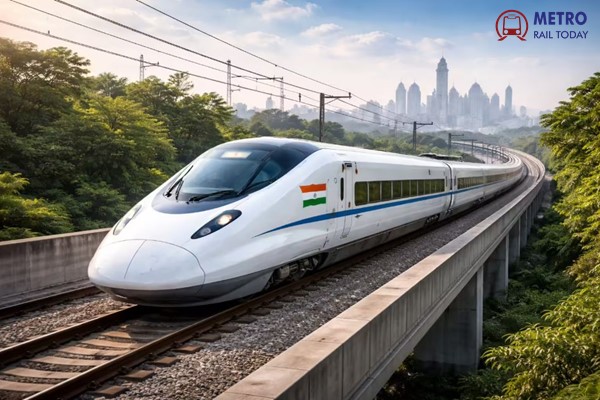
New Delhi, India (Rail & Metro Today): The Ministry of Railways is working towards adopting a standardised design and technical framework for India’s upcoming bullet train network, aimed at accelerating project execution and creating greater uniformity across the country’s high-speed rail corridors.
The move follows the announcement of seven new high-speed rail corridors in the Union Budget 2026-27. The proposed corridors are Mumbai–Pune, Pune–Hyderabad, Hyderabad–Bengaluru, Hyderabad–Chennai, Chennai–Bengaluru, Delhi–Varanasi and Varanasi–Siliguri.
NHSRCL Developing Standard Design Library
In a written reply in the Rajya Sabha, Railway Minister Ashwini Vaishnaw said the National High Speed Rail Corporation Limited (NHSRCL) has initiated the development of a standardised set of designs and technical specifications for future high-speed rail corridors.
The initiative is being undertaken based on the experience gained during the implementation of the 508-km Mumbai–Ahmedabad High Speed Rail (MAHSR) corridor, India's first bullet train project.
The standardised framework will cover key infrastructure components, including viaducts, bridges, tunnels and stations, among other elements required for high-speed rail construction.
NHSRCL is also developing a comprehensive design library under the Bharat High Speed Rail Programme. Leading technical institutions, including Indian Institutes of Technology (IITs), are being involved in the development process to bring advanced engineering expertise into the programme.
Seven Corridors to Expand India's High-Speed Rail Network
The government's proposed seven corridors are expected to establish the foundation for a wider national high-speed rail network. The corridors announced in the Union Budget 2026-27 are:
Mumbai–Pune: Connecting Maharashtra's two major economic centres.
Pune–Hyderabad: Creating a high-speed rail link between Maharashtra and Telangana.
Hyderabad–Bengaluru: Strengthening connectivity between two major technology and economic hubs of southern India.
Hyderabad–Chennai: Linking Telangana with Tamil Nadu through a high-speed rail corridor.
Chennai–Bengaluru: Providing faster connectivity between two major metropolitan centres in South India.
Delhi–Varanasi: Connecting the national capital with one of India's most important cultural and religious destinations.
Varanasi–Siliguri: Extending high-speed rail connectivity towards eastern India and the Northeast.
Mumbai–Ahmedabad to Set the Benchmark
Meanwhile, construction of the Mumbai–Ahmedabad High Speed Rail corridor is progressing rapidly. The 508-km corridor is being developed with Japanese technology and is targeted to commence operations on its priority section by August 2027.
The bullet train services on the corridor are planned to operate at a maximum commercial speed of 320 kmph, with the train's design speed reaching 350 kmph.
The experience acquired through MAHSR is now being used to develop common engineering standards for future corridors. Standardisation is expected to reduce repetitive design work, improve interoperability, facilitate faster approvals and construction, and potentially bring down project development costs.
Bharat High Speed Rail Programme
The development of the design library is an important step towards creating an indigenous knowledge base for India's expanding high-speed rail programme. By documenting and standardising engineering solutions developed during the Mumbai–Ahmedabad project, NHSRCL aims to create a reusable technical framework for subsequent corridors.
The involvement of IITs and other leading technical institutions is also expected to strengthen research, innovation and domestic expertise in high-speed rail engineering.
As India moves from its first bullet train project towards a broader network of high-speed corridors, the standardisation initiative could play a crucial role in enabling faster, more efficient and technology-driven project delivery across the country.

MRT Online Desk
Metro Rail Today is an authentic and global news provider for the Rail & Metro industry from and around the world.