


Trending Now
 Siemens wins ₹91.65 crore Telecom Contract for Kochi Metro Phase 2 Pink Line
 GHV Infra wins ₹150 crore Civil Contract for Vasantkunj Depot of Lucknow Metro East-West Corridor
 Texmaco Rail wins ₹130 crore Track Contract for Kochi Metro Phase 2 Pink Line
 Indian Railways unveils Alignments and Routes of four new High Speed Bullet Train Corridors
 Telangana pushes for approval of ₹38,595 Crore Hyderabad Metro Phase-II Expansion
 Boston Consulting Group appointed to prepare 10 years Corporate Plan for Delhi Metro
 Exclusive Interview with Champak Panda, Managing Director, Rolling Stock & Components, Alstom India
 Delhi Metro invites Expression of Interests to manufacture Platform Screen Doors in India
 NMRC to appoint General Consultant for Noida-Greater Noida Aqua Line Metro Expansion
- NHSRCL launches Five Heavy Portal Beams on Mumbai-Ahmedabad Bullet Train Project
IUT seeks clarifications on Chennai Metro’s three new proposed extension corridors
MRT Online Desk
Posted on: 2026-01-14 07:55:00
Viewer: 1,140
Comments: 0
Country: India
City: Chennai
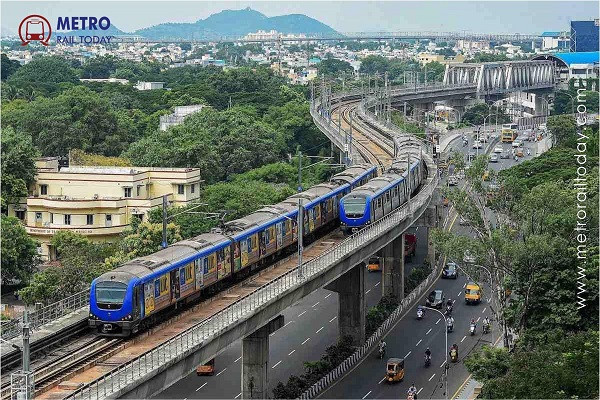
Chennai, India (Metro Rail Today): The Institute of Urban Transport (IUT), a professional body functioning under the Ministry of Housing and Urban Affairs (MoHUA), has raised a set of queries on Chennai Metro Rail Limited’s (CMRL) three proposed extension projects—Airport to Kilambakkam, Poonamallee to Sunguvarchathiram, and Koyambedu to Pattabiram—potentially impacting the timeline for central approvals.
CMRL had submitted the Detailed Project Reports (DPRs) for these three corridors to the Tamil Nadu government in 2025, following which they were forwarded to the Union government for appraisal. Collectively, the three projects represent a significant expansion of the Chennai Metro network, aimed at improving regional connectivity and easing congestion in fast-growing suburban and peripheral areas.
The Airport–Kilambakkam corridor, estimated at ₹9,335 crore, will span 15.46 km with 13 stations. The Koyambedu–Avadi–Pattabiram stretch, costing around ₹9,744 crore, will cover 21.76 km with 19 stations, while the longest of the three—Poonamallee to Sunguvarchathiram—will run 27.9 km with 14 stations at an estimated cost of ₹8,779 crore.
According to CMRL officials, the Institute of Urban Transport has examined all three proposals and sought clarifications on multiple aspects. “We are in the process of responding to the queries. Since approvals from the Centre are required, it could take anywhere between six months to one year for these projects to receive the necessary clearances,” an official said.
Sources familiar with the matter indicated that the queries relate to income classification categories used in housing assessments, elements of the economic and financial analysis to establish project viability, integration of the proposed metro corridors with other modes of urban transport, and measures proposed by CMRL to promote the ‘Make in India’ initiative during project execution.
Despite the pending approvals, CMRL has begun preliminary activities to ensure faster execution once clearances are granted. Government Orders have already been issued for land acquisition for all three corridors. “Utility shifting is the first major on-ground activity, and preparations are underway to begin this work without causing inconvenience to the public,” an official said.
CMRL is now awaiting the State government’s release of funds for these projects. Once deposited, the funds will be handed over to concerned agencies such as TANGEDCO and CMWSSB for utility relocation. Parallelly, land acquisition proceedings will be initiated. Officials believe that undertaking these preparatory works in advance will significantly compress the overall project execution timeline once final approvals are in place.


MRT Online Desk
Metro Rail Today is an authentic and global news provider for the Rail & Metro industry from and around the world.