


Trending Now
 Japanese Delegation visits KRIDE to explore Bengaluru Suburban Rail Project opportunities
 GMRC issues ₹879 crore Civil Tender for Airport Extension under Ahmedabad Metro Phase 2A
 Global Mobility Leaders Alstom and Siemens become Corporate Member of Chamber of Railway Industries
 L&T-MHI JV wins contract for Automated People Mover at Dubai’s Al Maktoum International Airport
 Delhi Metro Rail Network to expand to 695 km by 2047, Six new RRTS Corridors planned
 HÜBNER at InnoTrans 2026: Global rail expertise and local capability for India’s Next-Gen Mobility
 Australia shortlists three firms/consortia for Sydney–Newcastle High Speed Rail Project
 MRVC set to procure 238 AC Vande Metro Trainsets worth ₹19,293 crore from Indian Railways
 Maharashtra approves ₹17,725 crore Mumbai Metro Line 13 linking Mira-Bhayandar with Vasai-Virar
 Gujarat issues three tenders for 48.38-km Metro-RRTS Hybrid corridors under Ahmedabad Metro Phase 3
Know latest progress of Kolkata Metro Expansion, 20 km length stuck over land issues
MRT Online Desk
Posted on: 2025-12-06 16:00:00
Viewer: 2,710
Comments: 0
Country: India
City: Kolkata
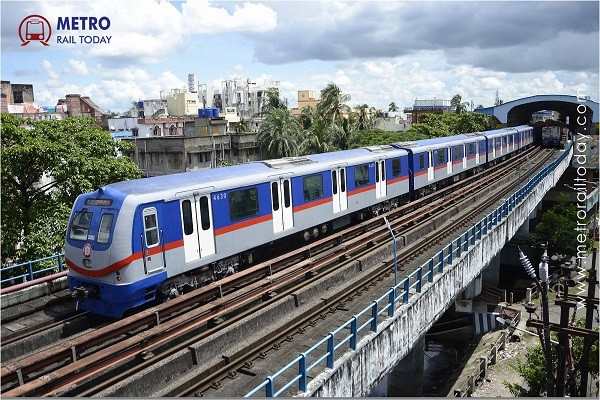
New Delhi, India (Metro Rail Today): India’s oldest metro system—the Kolkata Metro, whose construction began in 1973–74—continues its long journey of expansion, with the Union Railway Ministry flagging both significant progress and persistent bottlenecks in ongoing corridor works.
In a written reply to the Lok Sabha on December 3, Railway Minister Ashwini Vaishnaw highlighted that 45 km of new metro lines have been commissioned in the last 11 years (2014–2025). In contrast, only 28 km were added in the four decades between 1972 and 2014, underscoring the renewed push toward modernizing and expanding the city’s mass-transit backbone.
However, despite the momentum, the minister confirmed that 20 km of the 52 km under construction across four corridors remain stalled, largely due to land acquisition delays and pending utility shifting by the West Bengal Government.
Why Kolkata Metro Projects Are Delayed
According to Vaishnaw, state-level constraints remain the single biggest barrier to timely completion: “Presently, four metro corridors of total 52 km are under construction in and around Kolkata, out of which 20 km is held up due to land acquisition and utility shifting issues pertaining to the State Government,” the minister informed Parliament.
These issues include:
-
Delayed acquisition of private and government land parcels
-
Encroachment removal challenges
-
Pending permissions for utility diversion
-
Delayed traffic diversion clearances
-
Slow progress in shifting pipelines and other urban infrastructure
These administrative hurdles have created prolonged standstills, especially on strategically important corridors serving high-density urban clusters.
Kolkata Metro Project: Corridor-Wise Latest Status
1. Joka – Esplanade Corridor
-
Total Length: 14 km
-
Work Completed: 7.74 km
-
Balance: 6.26 km
-
Status: Progress severely affected due to slow land acquisition and utility diversion issues by state agencies.
-
The Joka–Taratala and Joka–Majerhat portions have already opened to the public, but tunnelling and station works closer to the city core remain stalled.
2. New Garia – Dum Dum Airport (Orange Line)
-
Total Length: 32 km
-
Work Completed: 9.8 km
-
Balance: 22.2 km
-
Status: Work is progressing sluggishly owing to delays in traffic diversion permissions from state authorities.
-
This line—once completed—will form a crucial north–south connector linking EM Bypass with the airport.
3. Noapara – Barasat Corridor
-
Total Length: 18 km
-
Work Completed: 6.77 km
-
Balance: 11.36 km
-
Status:
-
Work from Jai Hind Airport to Michael Nagar is ongoing
-
Work from New Barrackpore to Barasat remains halted due to land acquisition and encroachment issues.
-
-
This alignment runs through heavily populated suburbs and has been stuck for years.
4. Baranagar – Barrackpore Corridor
-
Total Length: 7.5 km
-
Status: Entire work is on hold due to pending shifting of a major Kolkata Municipal Corporation water pipeline along the alignment.
-
Until the pipeline is relocated, construction cannot progress.
Decades-Old Metro, New Challenges
The Kolkata Metro’s legacy is unmatched—it was India’s first metro service, with operations beginning on October 24, 1984. But its expansion has historically suffered from:
-
Inadequate funding in earlier decades
-
Irregular supply of materials
-
Complex underground conditions
-
Dense built-up areas
-
Multi-agency coordination challenges
The recent acceleration since 2014 has improved commissioning rates, but the minister’s statement underscores that state-level delays continue to impede timely completion.
Offering her insights, Mrs. Mamta Shah, MD & CEO, Urban Infra Group, said: “Kolkata Metro is India’s heritage metro system and its expansion is crucial for easing congestion in one of the country’s most densely populated regions. The delays caused by land and utility issues must be resolved quickly to ensure commuters receive world-class mobility solutions. The recent progress by Indian Railways shows strong intent—but coordinated action with the state government is essential.”
With 20 km of works stalled and several critical permissions pending, the future pace of Kolkata Metro’s expansion depends largely on faster land acquisition, utility shifting, and multi-agency coordination.
Once completed, the four corridors will significantly strengthen last-mile connectivity, reduce road congestion, and modernise the city’s public transport ecosystem.


MRT Online Desk
Metro Rail Today is an authentic and global news provider for the Rail & Metro industry from and around the world.